skip to content
Current Lead Times: Rider-Ready Framesets: 4 weeks. Full Custom Bikes: 7 weeks.

Building Your Titanium and Carbon-Titanium Bikes in the USA for 29 Years

Seven featured on Bicycling.com

Seven Cafe Racer

One of the things a custom builder can do better than most production builders is find the sweet spots in between the traditional cycling categories. Constance Winters of Bicycling.com recently tested our Cafe Racer SL in just such a special configuration, somewhere in the space between go-fast road bike and all-purpose commuter.

First, this bike has S&S couplings so it can be broken down for travel. Total time to assemble this one, straight out of the case, is about ten minutes.

Next, it has a custom Tiberius handlebar, which gives the rider multiple hand position options, both aggressive and more upright.

And finally, it features a super quiet, super clean single-speed belt drive. The belt keeps you from getting grease on your pants if you’re riding for business, and its elegant simplicity makes break down and reassembly that much easier.

All of this in a sub-15lb package.

Image: Constance Winters

The Birth of Mo Pro 2.0

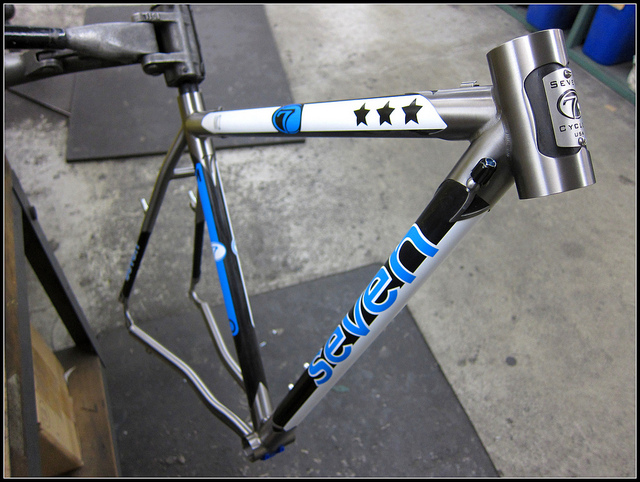
Mo Pro 2 frame nearing completion

A few weeks ago, Mo Bruno Roy returned her original Mudhoney PRO prototype. Affectionately called the Mo Honey PRO, that bike was the test case for the bike that became the production Mudhoney PRO, the bike that customers all over the world have ridden over the last season. Mo’s original was put together with hand cut and filed lugs, and she raced it hard this season so we could know more about our basic design assumptions, and to gather experiential data for the second iteration, Mo Pro 2.0, of this race-specific machine.
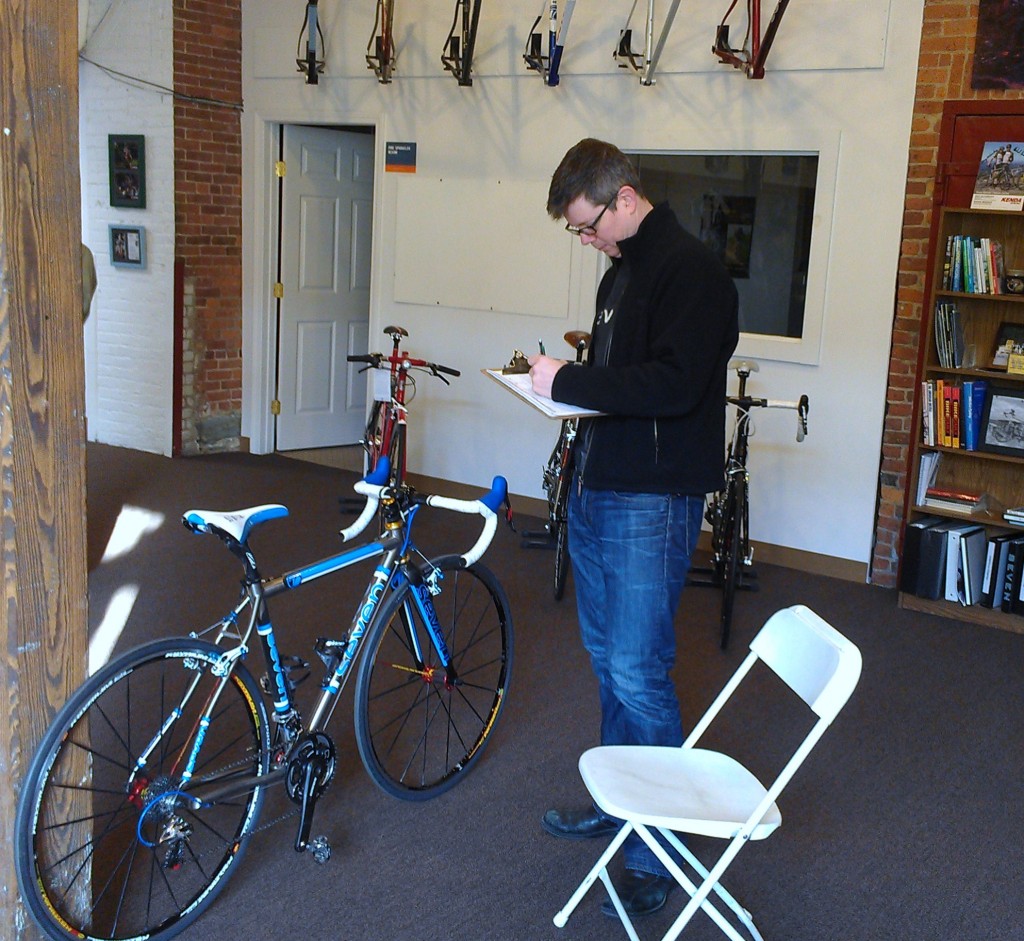
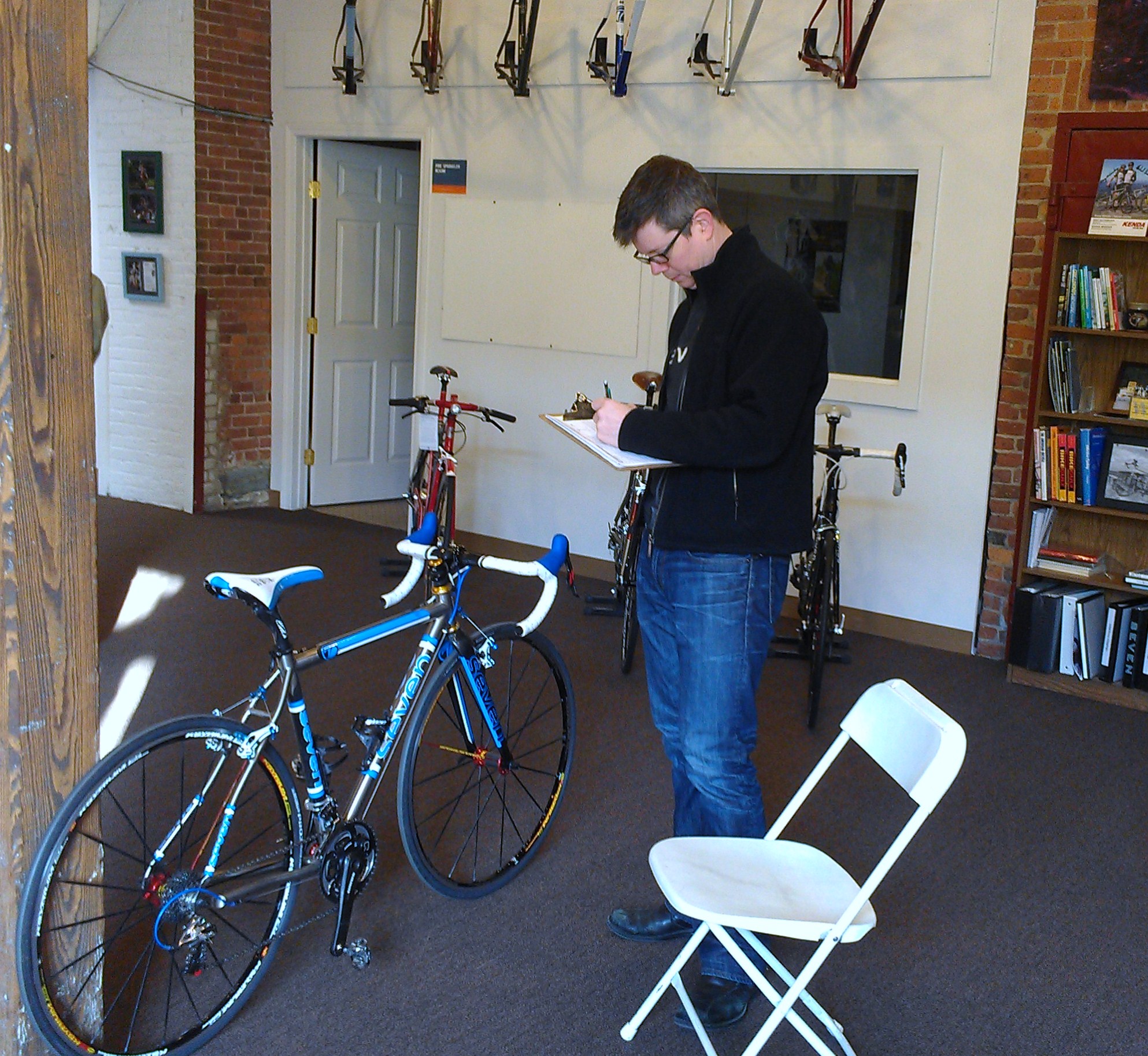
Rob going over specs for Mo

During our debrief with her, and with her mechanic/husband Matt Roy, we noted a few big, necessary changes. First, Mo wanted to change her riding position. She wanted to come forward, and up a little. To do that, she needed to make some component changes, and to maintain the handling she prefers after those changes, we needed to adjust the geometry. Easy enough.

Next, she wanted more tire clearance at the chain and seat stays. The original prototype was built with tight tolerances for racing, but we learned that just a little more mud clearance would be better. That presented a unique challenge, because Mo’s frame is small. In order to get the clearance she wanted, we experimented with a single-bend, butted seat stay designed specifically for carbon bonding. That little bit of bend gave us just what we were looking for, and it represented a step forward for the super thin stays we’ve been working with for Mo’s race bikes. The complimentary chain stays required 20 separate operations in initial machining. This is serious stuff.
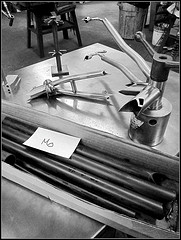
Parts of Mo's frame ready for assembly

In the past, we’ve built bikes for Mo that could be adapted to multiple purposes. A little attention from her pro mechanic husband would convert one of her race rigs for road training. Not this bike. Mo runs a somewhat unique crank set with 34/44 chain rings, and her seat/chain stays are optimized to work only with those rings, coupled with a 32mm tire. This is as race specific as a bike gets. It’s a bike for now, for winning races.

We opted to build for cantilever brakes, too, but only because race ready, drop bar, hydraulic disc brakes aren’t quite ready yet. Again, we wanted to build her the optimal race bike for right now, not a bike with compromises for future adaptation.

The final design hurdle we chose to address was toe overlap. Conventionally, a frame this small would have some overlap, and through the years, this was always something Mo was comfortable with, even though we offered to do away with it for her. This time out, we made some adjustments to the geometry to eliminate it, and that gives her more confidence in the technical sections of the cyclocross courses this bike was meant to destroy.
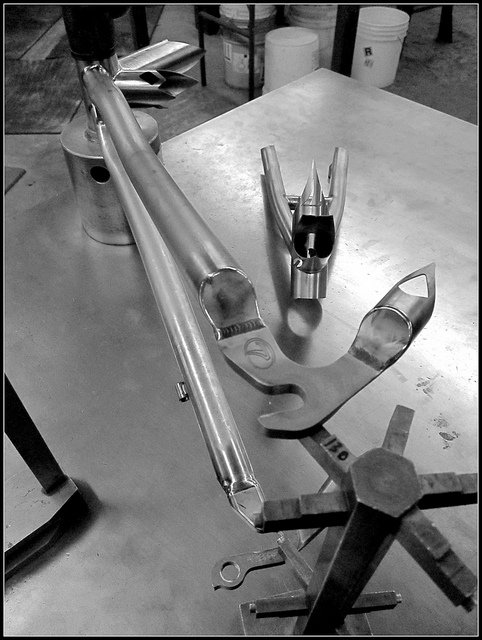
bottom bracket, chainstays and dropouts of a 622 in production

A lot of work went into pre-build design on the Mo Pro 2.0, and that led to a marathon build session that lasted long into the Friday night before Mo’s first race on it, on the Saturday. Seven Production Manager Matt O’Keefe did the final machining on this one himself, before handing it off to Staci for the rock star decal treatment.

As ever, our sponsorships are aimed at exactly this sort of collaboration. We built the original bikes to prove a concept we wanted to bring into production. After building the first generation prototypes, we then designed all the fixturing we would need to do the same design for customer bikes. In turn, the fixturing informed the accuracy and evolution of the second generation bike, which taught us about new ways to manipulate thin stays for small builds. It’s this thread that connects all our design and build work and allows everything to move forward, and to be able to pursue that thread with the input and participation of pros like Mo and Matt makes bike building fun. It reminds us why we do this.
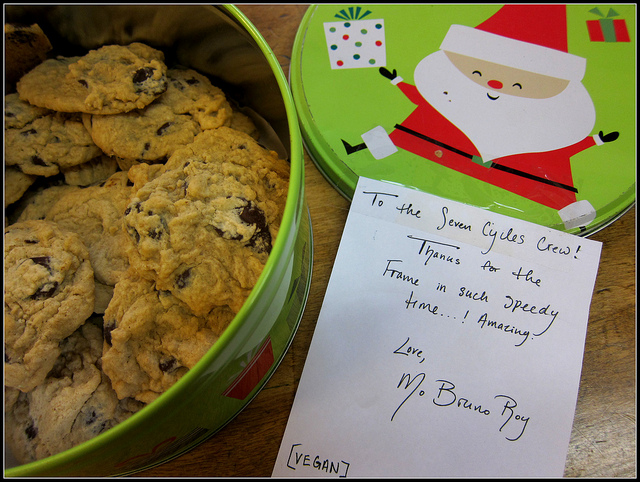
A tin of homemade cookies

Another solid reminder came in a Christmas tin a few days later. Her feedback on the bike itself is exactly what we wanted to hear, that it combines the best of her first Seven race bike and the first generation Mo Honey PRO. That confirms that we’re listening, and without listening you can’t build great custom bikes. It doesn’t matter whether you’re building for a pro like Mo or someone who will never race a day in their lives. The process is the same. Listen to what the rider wants. Apply everything you learn to everything new you want to do. Keep building. Keep iterating. Occasionally, just occasionally, stop to eat the cookies.

Matt made a cool time lapse video of the build that you can see here:

Project Codename: #MoPRO2 from Matt Roy on Vimeo.

And we were also fortunate to catch the eye of the Velo News staff at our very first race. Emily Zinn did a photo gallery of the project for their site.

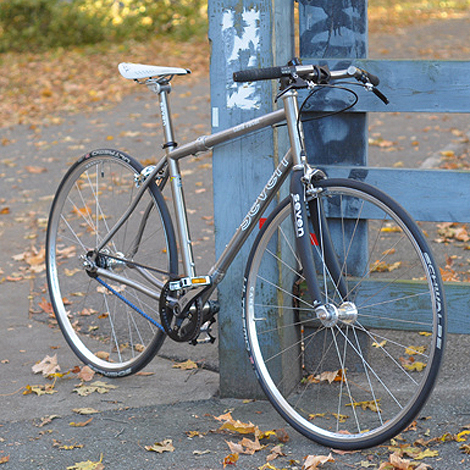
Stripped Down

Niel's new Seven singlespeed mountain bike

You would never design a whole bike build around a handlebar, except for those rare instances where someone hands you a Ti riser bar and leaves you to think about what its best use might be. This is another one of Neil’s projects, and the bar in question wasn’t so much the inspiration for the build, but rather the final piece of a puzzle that had been assembling itself somewhere in the dark recesses of his brain for some time.

He had the frame, acquired at a Seven employee auction a few years back. It had a short life as his every day mountain bike, but he found the geometry left him more upright than he liked to be over root and rock here in our New England woods, so it was in his “parts bin.”

Neil pops a wheelie in the Seven parking lot

Neil’s parts bin is like most people’s garage, just to paint you a picture.

There was also a Forward Components Eccentric Bottom Bracket, an external solution to retrofitting a single-speed drive train from a company that is no longer. These are the sorts of things Neil collects, and of course, because we have a wide assortment of lathes and mills, he and Mike were able to machine the arms of a Deore crank to work with the EBB in this configuration.

Add in a set of Avid mechanical disc brakes and a pair of Schwalbe Big Apple tires, and you have a balloon-tired, throw-back BMX, an over-sized version of the bike many of us cut our dirt-jumping teeth on.

Now this bike lives in our indoor parking lot, and it gets taken out for lunch on the regular. And just like those bikes we all grew up on, it loves to jump curb cuts and bunny hop flower beds on its way to picking up delicious sandwiches or just practicing wheelies in the parking lot.

Neil’s Big Orange Monster CX

Performance Fit Designer Neil has ideas he just can’t let go of, and he always has a project going, so none of us was too surprised when he started pushing around the concept for a new monster CX bike based around our Expat S frame set. We had done one for our old friend Chipps Chippendale at Singletrack magazine, so that build was fresh in mind.

Neil assembling his Expat S monster cross bike
We were on our regular Friday shop ride, mountain bikes on local trails, and that ride always presents the challenge of breaking off at the end and getting to work on time, or at least on-time-ish. So Neil got to thinking of good solutions, and this is the result.

Neil's Expat S - down tube detail

The 29-inch wheels allow him to crush it on the trail. The on-board bag takes care of commuter essentials. The disc brakes make it an all-weather beast. It rolls fast across town with a stiff, compact geometry and a rigid steel fork.

The orange paint with red and black accents is an homage to the Bridgestone XO-1 Neil grew up coveting, and we did a custom decal (see left) that echoes the famous Bridgestone decal from that great builder’s hey-day. If you’re going to nerd-out, go all the way, right?

Neil's Expat S

The XO-1 was originally sort of the slow-roller in the Bridgestone line-up. It came with a moustache bar and an upright riding position. It’s a short step from there to the wide drop bar associated with modern monster cx set ups. The disc brakes and fat tires just complete the re-think of this classic bike.

We saw our friends from River City Bicycles at the Interbike trade show in Las Vegas a few weeks ago, and they asked what weird, wacky stuff we were tooling on in our spare time. Well here it is guys, a throw-back Monster CX commuter.

Seven Cycles at the “Let’s Talk About Bikes” Opening Night at the BSA

Berliner bike

Many thanks to Mark Pasnik and the folks at over,under for putting on the incredible, “Let’s Talk About Bikes” exhibit at the Boston Society of Architects Space. We were honored to be included in such a thoughtful way, and we were floored when we walked into the massive exhibit space.

There were bikes displayed along the entire perimeter of the second floor, with bigger-than-life photographs papering the walls behind each bike. We were excited to see that the exhibit designers used a photo of Seven’s own Staci Sommers as the backdrop for the Seven Cycles Berlin Bike display. Staci painted the Berlin Bike, and over,under conducted an extensive interview with her about the development of the Berlin Bike’s unique paint scheme, which is published in the “Let’s Talk About Bikes” brochure.

Along with the photographic backdrop were cool graphics that contained a description of the process that took the Berlin Bike from concept to build. We’ve never before seen such an aesthetically sophisticated display of this bike. Because of the layout of the exhibit, the guests were encouraged to ogle each detail of the bikes on display, but there was a flow to the space that kept everyone moving around from bike to bike, which actually encouraged conversation and resulted in a palpable excitement in the room.

Let's Talk About Bikes Exhibit front

Seven also had Mike Salvatore’s Elium track bike on display in the front window of the exhibit. We were honored to have 2 bikes in this show. There were bikes on display from SCUL, Saila, Royal H, each of whom are Seveneers who also have their own brands. There were also bikes from Boston-based bike builders Parlee and Firefly. We don’t usually get to see all of these bikes simultaneously, and it was a treat to get a closer look at the creativity and skill that each builder brings to their bikes. It was also fun to see the reactions of the guests to the artisanship on display.

White bike hanging in the air

The exhibit also celebrated bike photography, and the myriad ways that riding has inspired photographers from all over the city. Seveneers Matt O’Keefe and Jonathan Henig had photographs on display, and friends of Seven Susi Ecker and Natalia Boltukhova were also represented.

Giant video installations dotted the exhibit, with one featuring the experience of Team Greenline Velo, and another shot from the perspective of a commuter’s bike ride through downtown Boston. The video installations, along with the variety of bikes around the gallery illustrated the mission of “Let’s Talk About Bikes”: to show the diversity of riding cultures and history in the Boston area, and to encourage discussion about how all of us as a community can make riding bikes more accessible and safe. “Let’s Talk About Bike” seeks to start a discussion among urban planners, architects, cyclists, and citizens about how the integration of a cycling-centric culture into an urban landscape can shape our cities in the 21st century, and can have a positive impact on everything from the economy to the environment.

Along with the creativity and energy in the room, there was also amazing food and drink, generously donated by Trade Restaurant, which is located next door to the BSA. This elegant touch lent the evening a note of celebration and fun that made everyone feel like they were at the best party in Boston. If you missed this event, do not despair! The exhibit is up through August 31. If you are in the Boston area this summer, we encourage you to make the “Let’s Talk About Bikes” exhibit at the BSA a must-see destination.