
Carbon Frames Hinders Rider Recovery
This information is summarized from Seven's Carbon Frame Downfall white paper. All source material and footnotes can be found in that paper.
Without exception, carbon frames ride harsher than well-designed titanium frames (see the data in the More Harshness chapter of Seven's white paper about carbon). A harsh frame transmits more vibration to the rider. Vibration requires the rider to expend energy to control the bike. This energy expenditure is reflected in increased heart rate, higher VO2 at a given wattage output, and higher blood lactate during and after efforts.
All statements and data presented on this page are verifiable through the source materials provided in the associated links below and in Seven's white paper on carbon.
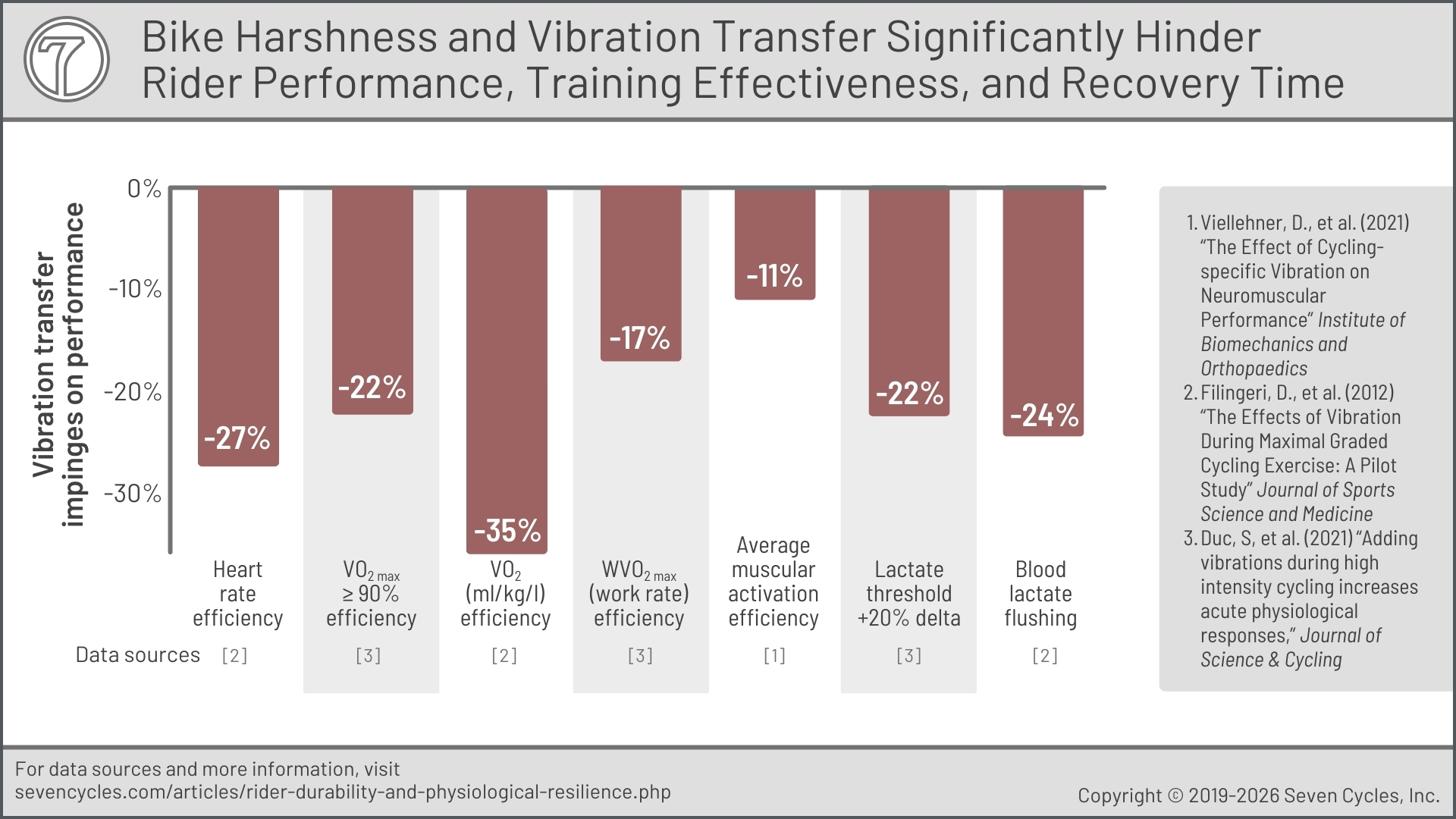
The point is, if you ride carbon, you're beating up your body and slowing down your recovery time. You're also reducing your work capacity and endurance. (Keep in mind that a harsh riding frame is not the same as a stiff frame. Read Seven's carbon white paper for a full explanation of this seeming contradiction.)
All of this is often referred to as rider durability, and it is the latest frontier in professional cycling's ongoing pursuit of improved performance. Tadej Pogačar exemplifies a rider with significant durability and that so many riders want to emulate.
Seven's white paper on carbon's shortcomings places the vibration issues within a holistic framework. In summary, greater vibration yields lower training effectiveness.
The figure above illustrates several vibration problems. Additionally, to describe the obstacle, we've included relevant quotations from sports and medical journals below.
“Vibration increased oxygen uptake and heart rate. […] heart rate supports the existence of an elevated metabolic demand. This is consistent with previous studies that reported a 7% increase in heart rate and an increase in oxygen consumption. […] The findings align with other studies of full-body vibration or high exercise intensities that report increased oxygen uptake.” — The Effect of Cycling-specific Vibration on Neuromuscular Performance, Medicine & Science in Sports & Exercise
“Vibration as an external stimulus produced a significantly greater and quicker energetic demand to the body and thus it was perceived as a greater workload.” — The Effects of Vibration During Maximal Graded Cycling Exercise: A Pilot Study, Journal of Sports Science & Medicine
“[T]ime above 90% of V̇O2max and mean V̇O2 during HIT work intervals were higher in vibration session than traditional [no vibration] session. This may at least partly be due to the increased muscle activation in lower and upper limbs observed.” — Adding vibrations during high intensity cycling increases acute physiological responses, Journal of Science & Cycling
“[I]ncreased acidosis generated during the Vib trial might be not the only cause of the anticipated skeletal muscle fatigue. […] relatively long exposure to Vib, generally more than 7 min leads to a decreased power and force production. Authors reported that an acute reduction in maximal voluntary knee extension force and a depression of the voluntary activation of the leg extensor muscles up to 180 min after an exercise bout were obtained in participants exercising on a vibrating platform. […] vibration can negatively affect cycling performance in terms of exercise duration when exercising at a constant submaximal workload.” — The Effects of Vibration During Maximal Graded Cycling Exercise: A Pilot Study, Journal of Sports Science & Medicine
“The experimental hypothesis stated that the VCE [vibration cycling exercise] […] would have produced a significant variation in the monitored physiological parameters compared to the effects of traditional cycling. The results of this study confirm this hypothesis in terms of the increased energetic demand generated by the Vib [vibration] exposure.” — The Effects of Vibration During Maximal Graded Cycling Exercise: A Pilot Study, Journal of Sports Science & Medicine
Read more about how carbon's harshness impinges on rider recovery.
Carbon Frames Ride Harsher Year After Year
The stiffer a frame is in the vertical plane, the harsher it will ride. Carbon frames have been getting stiffer in this plane for over a decade.
Two reason exist for harsher riding carbon frames: 1) a desire for aerodynamic aesthetics and 2) a need for generalized stiffness.
Why would frame designers make carbon frames ride harsher?
It's the need for generalized stiffness. Generalized stiffness is Seven's term for one of the primary and intractable issues with carbon frames.
Carbon frames must distribute stiffness suboptimally. The frame requires too much vertical stiffness (to defer failure) and, because frames need to be so light these days, designers use less material in other parts of the frame, including the bottom bracket area, which affects drivetrain stiffness.

The vertical plane can only get so light (compliant) before carbon's fatigue life becomes unacceptable. The result is a frame that is generally stiff, but not stiff enough laterally and too stiff vertically, the worst of all worlds.
Read more about how carbon frames are getting harshness.