
Bike Trail Geometry & Handling
Bike trail influences front-end handling and rider control. For each tire size, there exists a perfect trail measurement. The farther from ideal, the more unpredictable the bike's handling and the more difficult it is to control as speeds change.
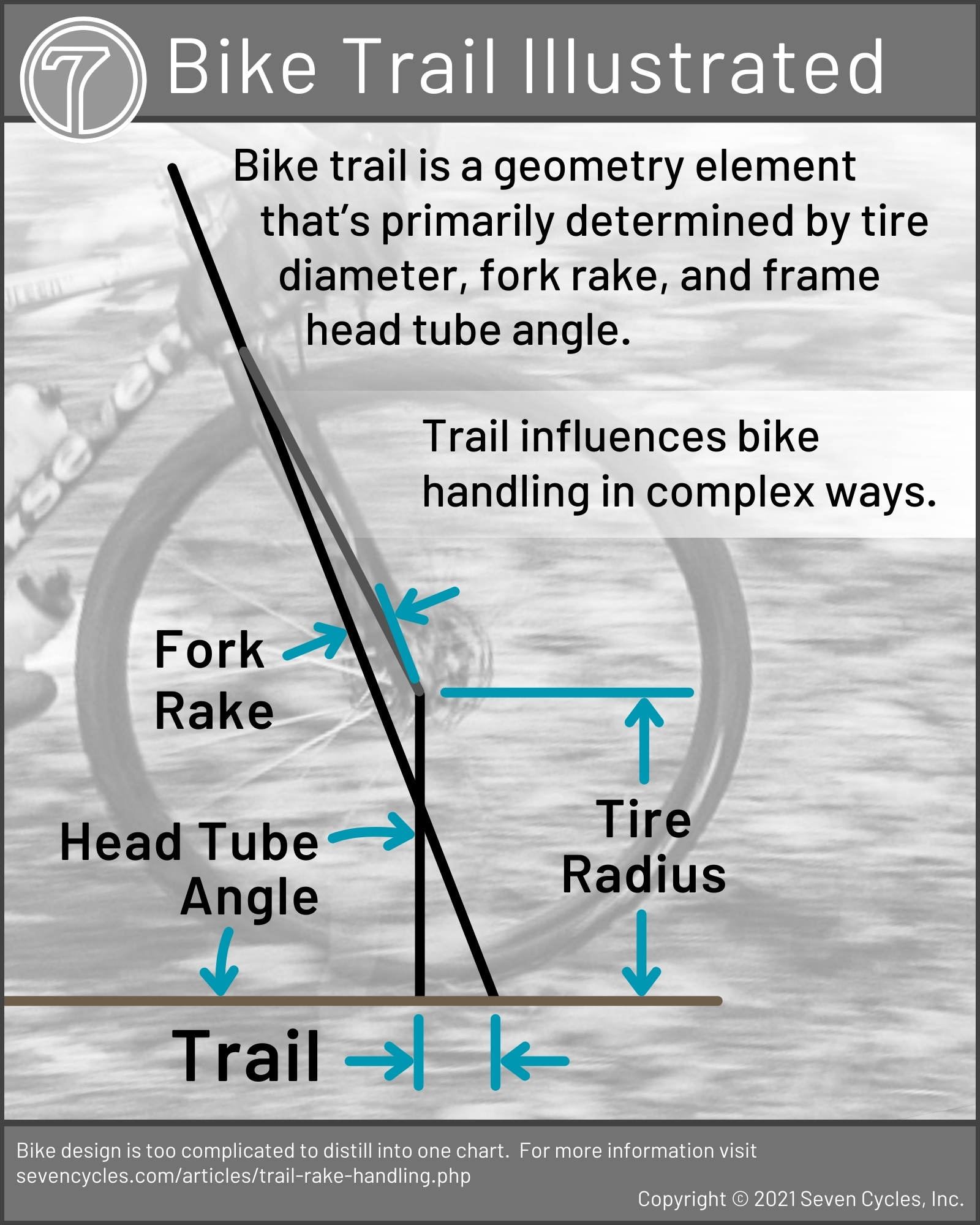
As a rider, there's not much that can change trail. Just three geometric elements, shown in Figure 1, determine 90% or more of the trail. Head tube angle is fixed (by the framebuilder), fork rake is almost always fixed (because most fork suppliers only offer one and sometimes two rakes), and tire size. Tire choice is the primary variable riders have access to, but most riders shouldn't mess with the right tire size for a marginal improvement in trail. A 10 mm change in tire size changes trail by about 3 mm; that's a meaningful sacrifice in optimal tire size for a slight improvement in trail geometry. More rider-based trail modification details below.
Many bike suppliers choose suboptimal trail geometry, as illustrated in Figure 2 and Figure 3. Fortunately, Seven has trail dialed. No production bike optimizes trail better than Seven.
Some riders obsess over trail, feeling that a specific trail number is the secret to what they loved about their previous bike. However, trail accounts for about 10% to 20% of what makes a bike handle well or poorly. What a rider likes about a bike is never a single geometry element; it is an interplay of many design decisions by the builder.
For each bike, there is an ideal trail, and it's dictated primarily by tire diameter and, to a lesser extent, rider weight distribution (center of gravity) and the type of riding the bike is designed for. For example, a mountain bike with the same diameter tire as a gravel bike should not have the same trail. Generating optimal trail is a bit of a trade secret. We have experimented with trail for nearly four decades.
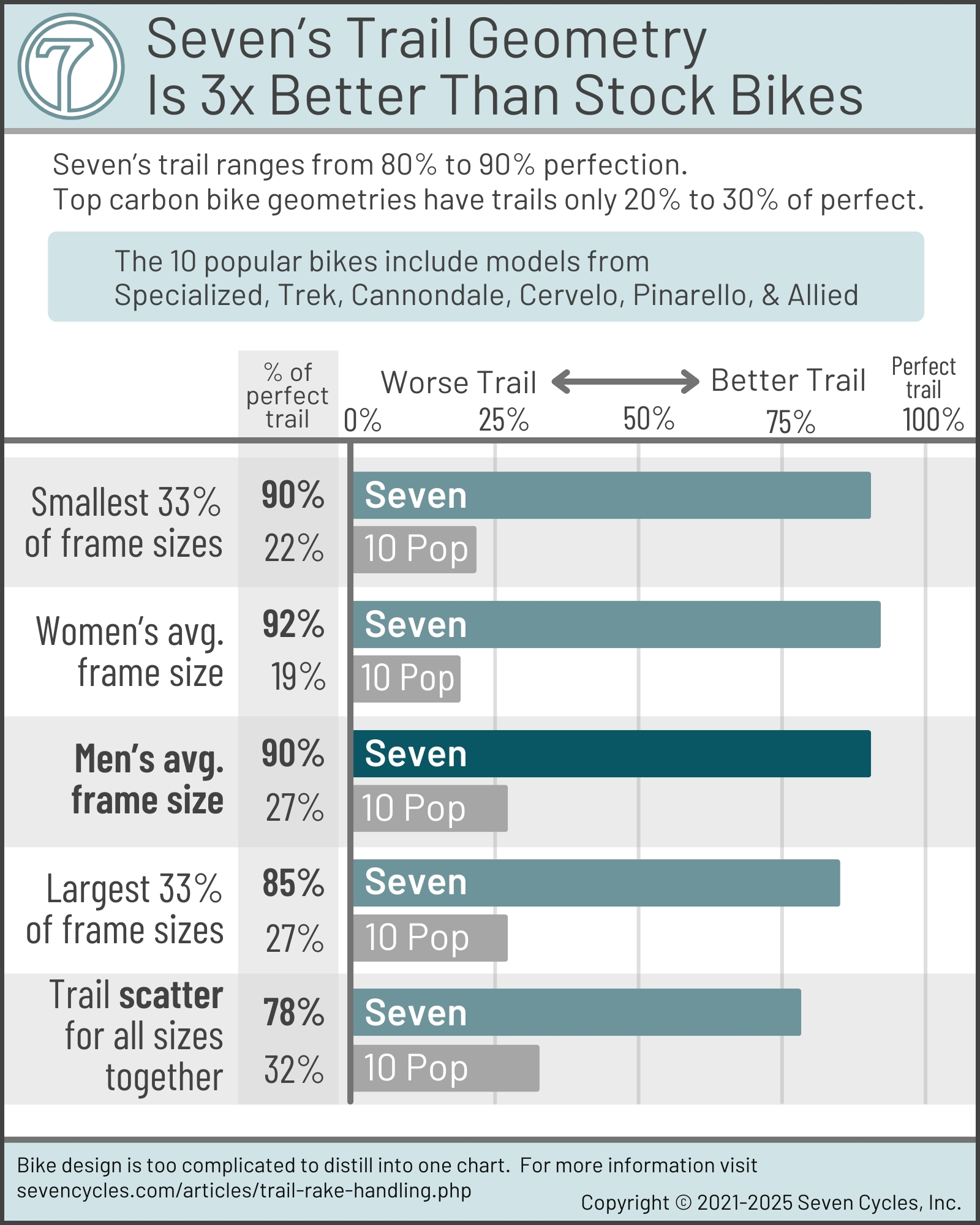
Figure 2 and Figure 3 illustrate Seven's unusual capability to optimize trail. In these examples, we chose 10 highly regarded carbon production bikes. Not one of them gets close to the trail accuracy that Seven does. Whether large brands or small, suboptimal trail is extremely common.
Two Measures Of Trail Geometry Quality
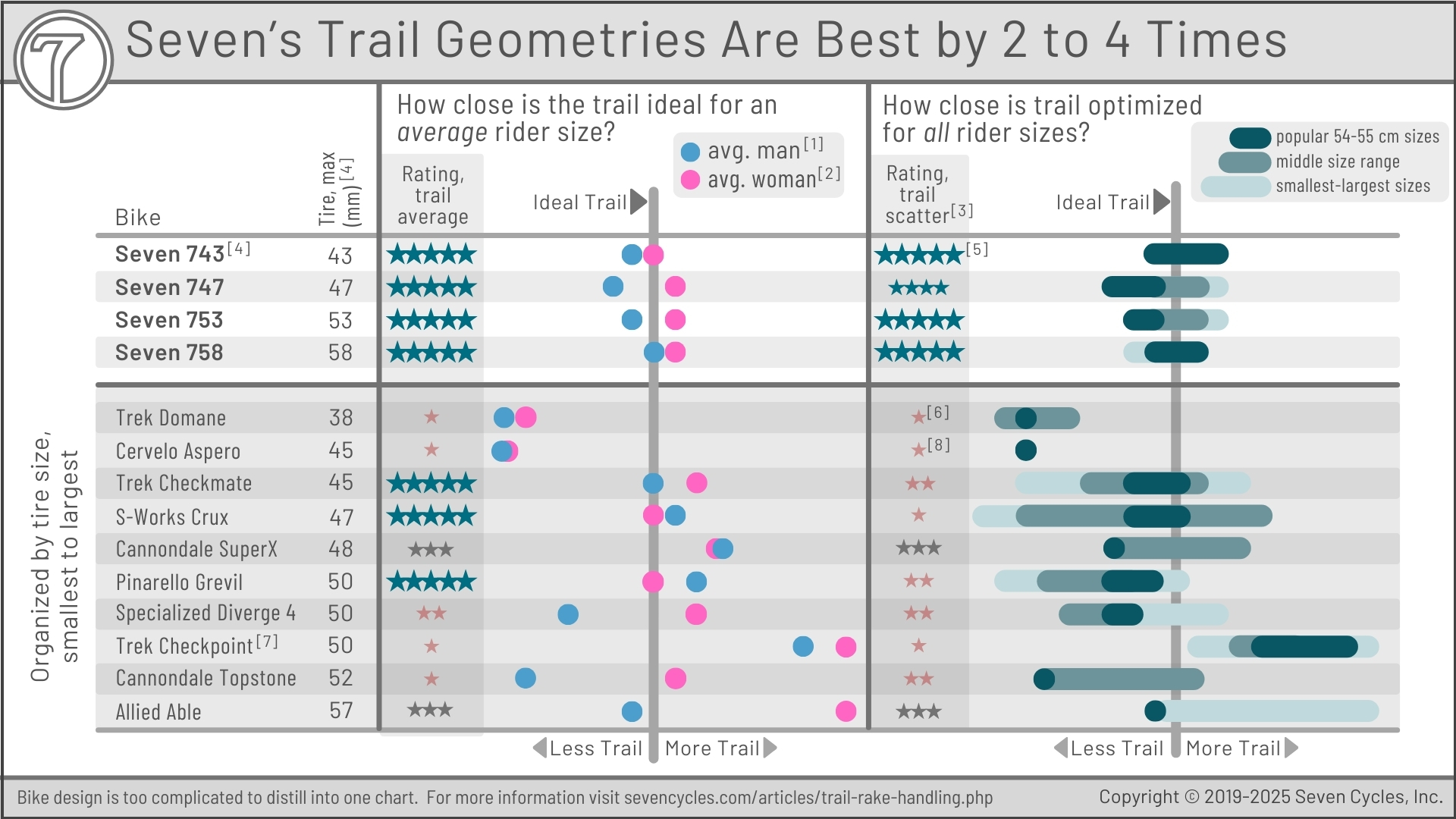
Figure 3 shows the two meaningful shorthand measures for good trail: Scatter and Rating. Trail Scatter shows how likely any rider is to find the trail to perform as hoped. The narrower the scatter, the higher the odds of the bike will behave as expected. Trail Rating is the odds that an average height male or female rider's bike size will have ideal trail. We use pink and blue to delineate the average trail for women and men in each model.
Trail rating is the most important measure. If this rating is poor, it doesn't matter how narrow the scatter is; a narrow band with the wrong trail is not helpful to anyone. So, choose a brand with a high rating first, then look at the scatter or the size that's best for you, and see where it falls on the trail continuum. Of course, with Seven's Rider-Ready designs, we take care of this so your trail will be better than just about any stock bike.
As an aside, finding 10 popular gravel bike geometry tables that show trail, or at least include head tube angle and fork rake (from which we can calculate trail), is not easy. We would have included Canyon, Colnago, Open, and possibly one or two others, but some brands do not show any of these three common geometry details.
Trail for Men, Trail for Women
Since the average man's bike is larger than the average woman's bike, trail geometries are often different. Of note, trail on smaller-than-average bikes is generally better than on larger bikes. Figure 3 shows that only one bike of the 10 has appreciably worse trail for the smaller bikes than the larger (Trek Checkpoint).
Figure 3 shows women's average bike size (in pink) for each brand. (Boys are blue.) In most cases, women's sizes provide better trail than men's most popular sizes.
Seven optimizes trail for each rider's size, not just the average man. Our male and female trail geometries are nearly identical in most cases, as shown in Figure 3. In other words, we think about everything and everyone when designing our Rider-Ready bikes. Seven designs larger and smaller bikes to have very similar trails without sacrificing other aspects of bike handling and performance. It's not simple, but it is one of the reasons that Sevens ride and handle so well.
How Seven Dials in Trail Geometry
Seven offers Rider-Ready designs that are similar to stock bike offerings and custom bikes. On our full-custom bikes, trail is always optimized by definition. In this article, we're talking exclusively about our Rider-Ready bikes. We design all of these for optimal trail geometry as illustrated in Figure 2 and Figure 3.
Seven's trail rating and scatter are, on average, about 4 times better than the 10 high-end bike examples provided in Figure 3. First, Seven's Rider-Ready trail for average-sized male and female riders is better than 80% of stock bike trails, as illustrated in Figure 2. Next, Seven's trail scatter (the range of all trails across all frame sizes) is, on average, about three times closer to ideal than stock bikes (Figure 2). Combining trail and scatter (the overall trail performance) for any given Seven is more than four times as precise as nearly all production bikes (Figure 2).
What makes Seven different? We provide more optimal trail geometries than most bikes, even with our Rider-Ready designs. Some of the engineering we share here, and some of the research is proprietary.
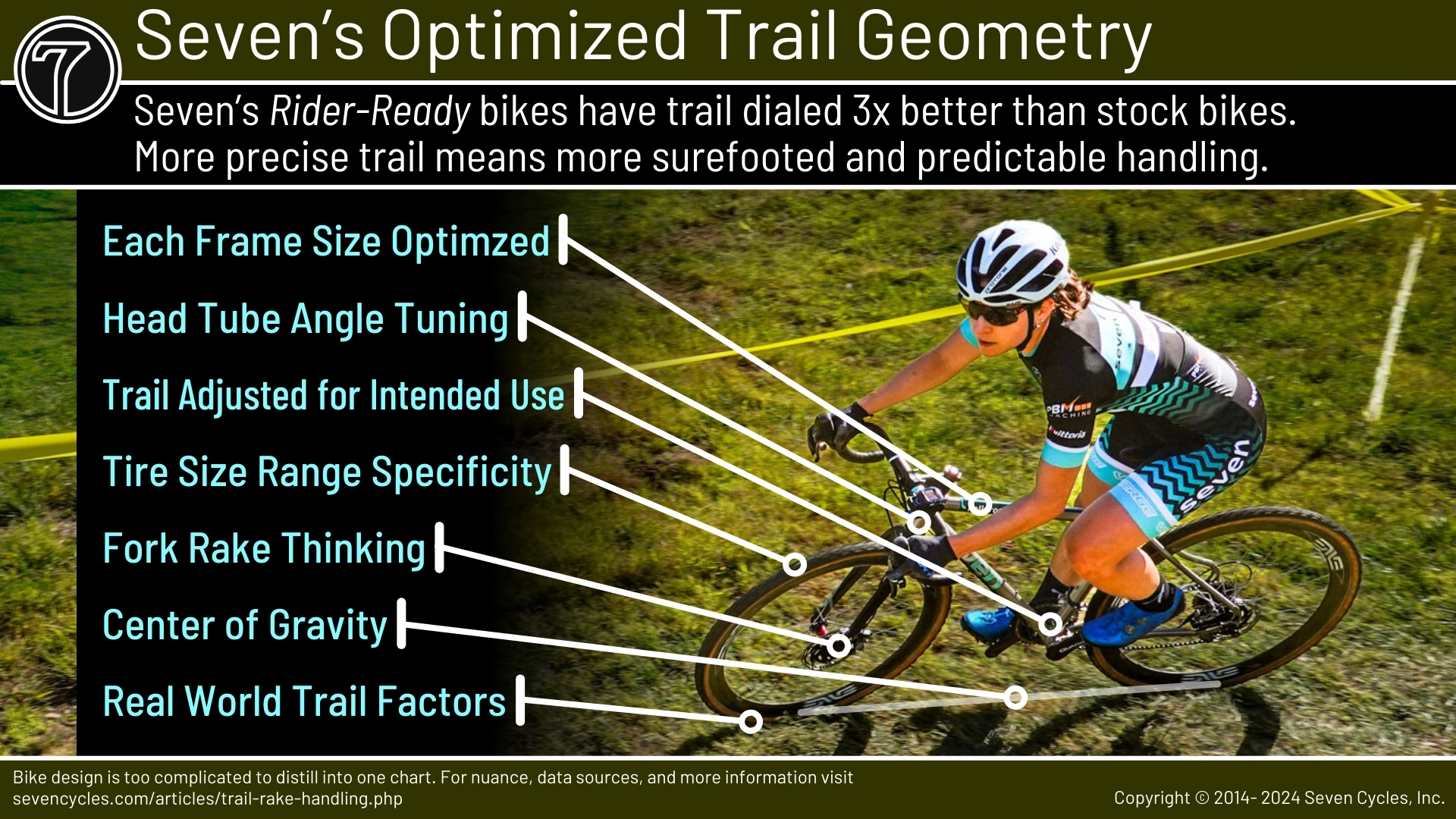
- Tire Size: Optimal trail is determined almost entirely by tire diameter. That part is pretty simple. Basically, to provide good handling, a larger tire requires more trail than a smaller tire. This is one reason we offer so many Rider-Ready bikes organized by optimal tire size: six gravel designs and four bikepacking designs for example.
- Angle tuning: Head tube angle is the largest variable when setting trail. Seven tailors head tube angles to each quarter-degree as opposed to the industry average of half-degree increments. This doubling of accuracy is non-trivial, and it tends to make framebuilders grumble. Regardless, we do it because it noticeably improves trail precision. We also have different head tube angles for almost every Rider-Ready size; again, this level of specificity makes frame machining and jig setup more complicated and time-consuming, but the results are felt in the bike's handling.
- Fork Rake: Most forks come in one or two rakes. Because of this, we designed the world's first 5.5 cm rake gravel fork in 2017. There is no more functional trail-geometry-optimizing fork. In 2000, we also created the first and still only custom-rake-caliper-brake carbon fork in the world. The more precise the fork rake, the better the trail.
- Intended Use: Trail influences the bike's handling. Friction between the tire and ground has a meaningful influence on handling; larger tires are grippier and therefore slow down handling. Seven designs with intended use and tire type in mind.
- Weight Distribution of rider and cargo. Is the bike for racing, bikepacking, 200 miles of Unbound, or all three? Do you front-load your bike or use a frame bag? Is the terrain rough and slow or smooth and fast? Is Seven's Slang geometry appropriate, or is classic geometry and handling preferred? So many questions whose answers help clarify which trail is best. It's why we have so many Rider-Ready designs in each riding category.
- Real World: We account for rider weight and tire compression (sag). These factors change the tire's functional radius and, therefore, the actual trail. Tire pressure also affects handling precision and speed, which makes the trail feel different. We modify trail to account for these variables.
Why Doesn't Every Bike Company Do What Seven Does With Trail?
As described above, optimizing trail geometry is expensive, time-consuming, tedious, and requires years of experience to provide the best bike handling for all sizes of all models.
Several design considerations work against optimizing trail, and many bike suppliers succumb to these: the business case to have just one or two simple bike designs to cover all rider interests (hint: that's not possible), time-consuming frame jig setups to adjust geometries for each frame size's trail subtleties, front center minimums designed to protect riders from injury, lack of fork rake options due to mold costs, and a lot more.
Seven's commitment to ride performance means that we take trail geometry seriously, and it's part of our comprehensive design philosophy.
Adjusting And Improving Trail
As a rider (rather than a framebuilder), there's not much that can be done to change the trail of any bike meaningfully. To illustrate, here we enumerate the bike elements that affect trail, in order of impact. None of these patches is particularly effective, and each has a negative influence on other aspects of bike handling and performance, so there is rarely a good reason to apply any of these fixes.
The best answer is not to get a bike with bad trail, hoping to improve it with component changes. That is extremely unlikely to happen, as described here:
Head tube angle: Typically, the largest share of trail determination is the frame's head tube angle. The only way to change the head tube angle is to switch to a longer or shorter fork. This is only applicable to suspension forks and a few specialty adventure-type forks. The primary issue with this solution is that when the head tube angle is altered, the rest of the geometry (seat tube angle, center of gravity, bottom bracket height) changes, too. That is rarely good.
Fork rake: Sometimes multiple fork rakes are available, so this might be possible. However, that is exceedingly rare, and more problematic is that many bike companies have proprietary forks that make it impossible to install aftermarket forks. Also, the builder should have already picked the best rake for the best trail for a given bike; changing fork rake is unlikely to improve things.
Flip chip type fork rake adapters may help, but in general, one of the chip's two rake options has better trail, so there's no benefit to flipping to the second rake option. Certainly, don't buy a flip chip fork after the fact in hopes it will improve trail geometry.
Suspension fork setup: Suspension forks often come in a few lengths, which can change the head tube angle and trail substantially. Changing suspension forks to improve trail is complicated because of the suspension travel. For example, a 120 mm travel fork changes the trail by about 3.5 cm from full extension to full compression. That's about half the total trail. Meaning, the bike handles quite different at typical ride height versus mostly compressed.
Tire size: Changing tire radius by 1.0 cm changes the trail by about 3 mm. There is no way that the trade-off will be an improvement. Regardless, choosing a suboptimal tire size just to improve trail means that wasn't the right bike in the first place.
Tire pressure: In most cases, messing with tire pressure will gain you a few millimeters of radius, which equates to about 1 mm of trail change. An overly soft or hard tire will have a much bigger influence on handling than 1 mm of trail improvement.
Be average: Be a rider who benefits from an average-sized bike because it will have better trail geometry than smaller and larger bikes, as illustrated in Figure 3.
Footnotes for Figure 3
- Bike models are organized by tire size, from smallest (38 mm) to largest (58 mm).
- Average trail: This is the trail measurement for the most popular size of each bike model. For purposes of data consistency, we use the average height of a US male.
- Average woman: The average US woman's bike size is slightly smaller than the average US man's. Smaller bikes tend to have different head tube angles than larger frames; therefore, the trail numbers are often different. Interestingly, the average-sized woman's bike tends to have marginally better trail geometry than the average man's bike, as shown in Figure 3.
- Trail rating scatter: This rating accounts for the entire range of trails for all frame sizes of a given bike model. The wider the scatter, the worse the handling for any given size.
- Seven's model examples are our Rider-Ready designs. Rider-Ready is Seven's answer to stock bikes from other companies.
- Seven scatter rating and equal size range: Seven offers 12 frame sizes in the Rider-Ready gravel bike design series. Additionally, Seven offers a much wider range of sizes. The average stock gravel bike's effective top tube length is 52 to 59 cm. Seven's Rider-Ready gravel effective top tube range is 49 to 62 cm — about 1/3 wider range. This wider top tube range would generally also have a wider trail range. Therefore, to compare equal offerings, we show Seven's size range from 52 to 59 cm as equivalent to the average stock bike size range.
- Trek Domane trail scatter: We rate one star for this scatter, even though it's narrow, because the center of the scatter is so far from the ideal trail measurement. It doesn't matter how narrow the scatter is if all the trails are bad.
- Cervelo Aspero trail scatter: We rate one star for this scatter, even though it has no scatter (every trail is identical for this model), because the center of the scatter is so far from the ideal trail measurement. It doesn't matter how narrow the scatter is if all the trails are bad.
- Trek Checkpoint trail scatter: We rate one star for this scatter, even though the scatter is only marginally wider than average, because the center of the scatter is so far from the ideal trail measurement. It doesn't matter how narrow the scatter is if all the trails are bad.
- Allied Able trail scatter: We rate this scatter, even though the scatter 3 stars, even though it is wide, because the majority of the sizes are close to ideal.