
The Problem With Aero Bikes
Global Cycling Network (GCN) Says the Latest Aero Road Bikes Are Harder to Control
Rider weight distribution problems and frame harshness issues are significant factors in increasing crashes.
"Peak Bike"
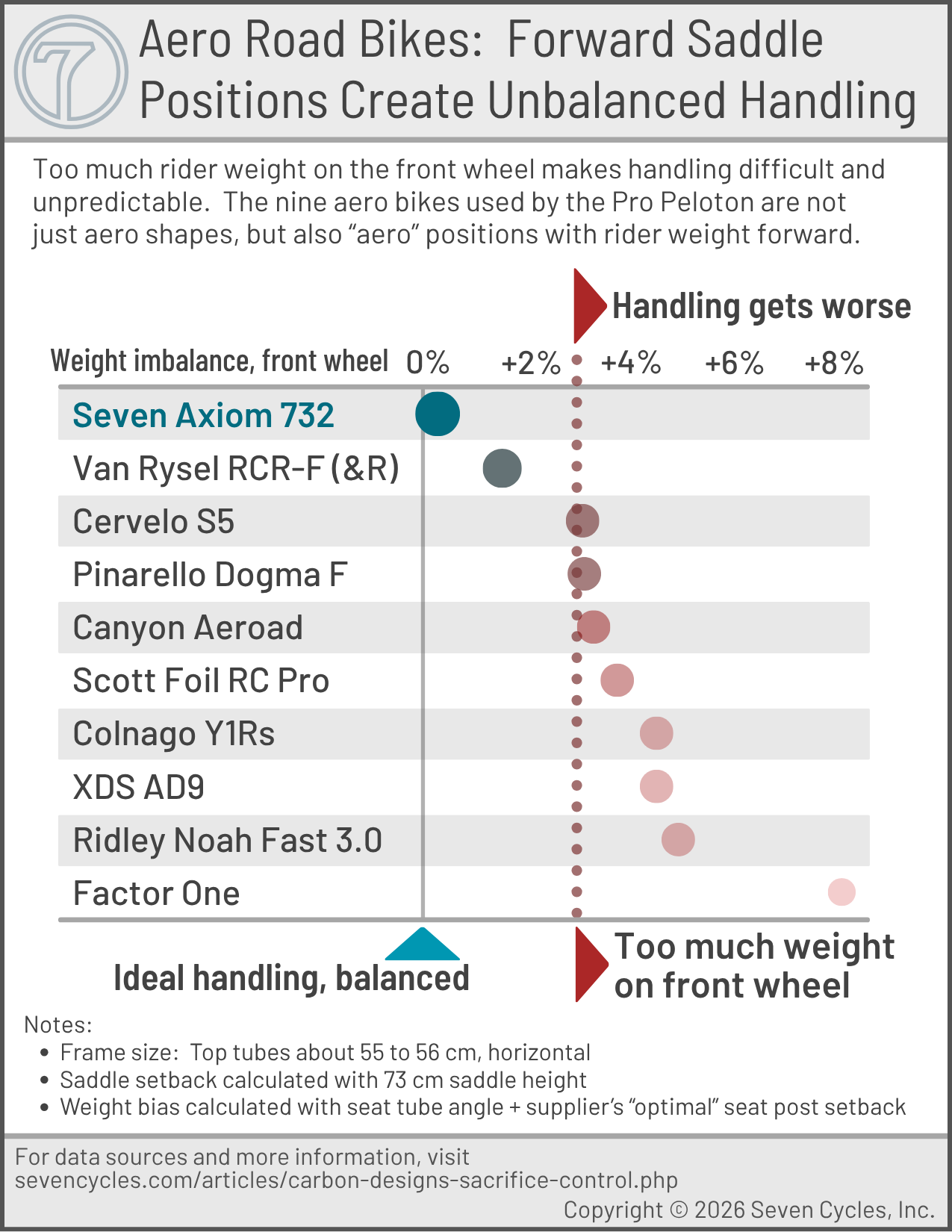
Aero bikes aren't just aero shapes; many of them put the rider in a much more forward position with steeper seat tube angles and minimal setback seat posts, as Figure 1 illustrates. Forward weight bias causes significant handling and control issues.
A recent GCN Tech video discussed the handling and control issues of modern carbon bikes. They explain in the segment called "Geometry & Handling Compromises": GCN video: Bike Handling & Handling Compromises.
"If you think about [a bike] from 10 years ago, [...] That sort of geometry. People are like 'oh, best handling bike ever. Peak bike.' [...] if you want something that handles amazing, there's different tradeoffs [in choosing an aero bike versus a bike with more traditional geometry]." — Oliver Bridgewood
"[If you] make road bikes like time trial bikes. Then you've just created this really weird bike that is designed to be ridden [...] where handling and stability is clearly an important factor, but everyone's gone, well let's not worry about that bit. [...] we'll sort of just have to accept that it's maybe not optimal in terms of handling." — Alex Paton
Why Is This Happening?
Why are there so many media and racers becoming more outspoken about bike handling and control issues, escalating bike crashes, pro retirements, and recently increasing fatalities?
The fundamental cause of these problems is current carbon bike design trends that include aero-tube aesthetics, oversized carbon shapes, and recent rider weight distribution changes.
Seven's solutions to these problems include unique material application, bike-to-rider integration, and four decades of framebuilding.
For more information on this topic, visit Seven's Article Directory: Carbon & Aerodynamics.
People aren't necessarily aware of all the tradeoffs with [modern aero bikes]. they are more akin to a time trial bike. [...] If you've ever ridden at TT bike they are horrible to ride in terms of the handling. The handling on them is awful because all your weight is the forward on the front of the bike. If you have to descend on one it's horrific, weight all over the front of the bike." — Oliver Bridgewood
"Having a bit more weight distribution further back over the bike, it does make the bike feel and handle better. [...] compared to where [your weight is] pushing over the front of the bike, I don't think it feels as good from a handling perspective. I understand that it does close you hip angle a bit, but now I think you can mitigate that with shorter cranks." — Oliver Bridgewood
Footnotes
Footnotes Figure 1
- Weight distribution assumes the seat post is what the manufacturer suggests as optimal. In most cases manufacturers recommend is 0 or 1 cm setback. A typical road bike has about 2 to 2.5 cm setback; about a 4% difference in rider weight distribution.
- Saddle position calculated with a 73.0 cm saddle height.
- Frame sizes are the closest to 55.5 cm as possible.
- Frame stack (the default front-end height) for all of these bikes is 55.1 cm +/- 1.0 cm. This is barely and options from a position standpoint. For all the talk about aero positions, manufacturers offer very little front end height options.