skip to content
Current Lead Times: Rider-Ready Framesets: 3 weeks. Full Custom Bikes: 7 weeks.

Building Your Titanium and Carbon-Titanium Bikes in the USA for 29 Years

BikeRadar: Seven Cycles offer Earth Day commuter model

Seven Limited Edition Earth Day bike

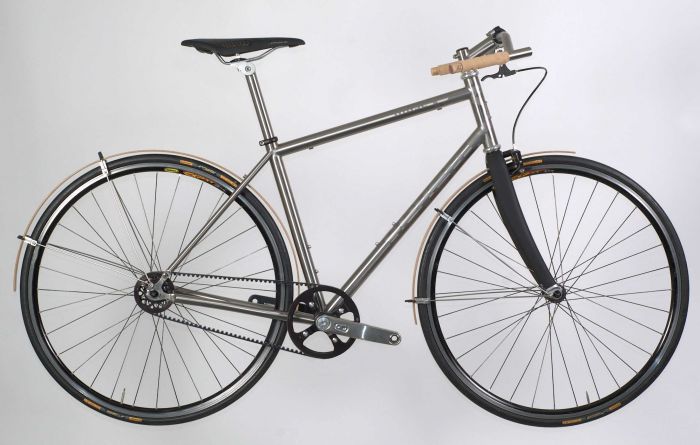
Boston-based Seven Cycles are offering a limited edition titanium commuter bike to commemorate the 39th anniversary of Earth Day on April 22.

Eco-friendly transportation doesn’t come cheap, though. For US$5,900, you can be the proud owner of a 15-pound beauty, highlighted with Chris King components, Seven’s titanium Tiberius bar, titanium stem and new titanium seatpost, Carbon Drive belt drivetrain, Crankbrothers Cobalt crankset, bamboo fenders and Mavic Open Pro/Chris King wheelset with No Tubes road kit.

“We were working on a carbon footprint reduction project, trying to see how we could reduce energy and materials usage in the fabrication and shipping processes,” marketing manager Mattison Crowe told BikeRadar. “The ‘aha!’ moment occurred when we realized that we could use what we learned to assemble a very cool bike that also impacts the way we will build bikes tomorrow.

“The timing happened to coincide with Earth Day, so we designed the bike to promote sustainability and responsible resource use on a daily basis. We’re trying to add value for the rider who seeks not only fitness and convenience, but is environmentally conscious.”

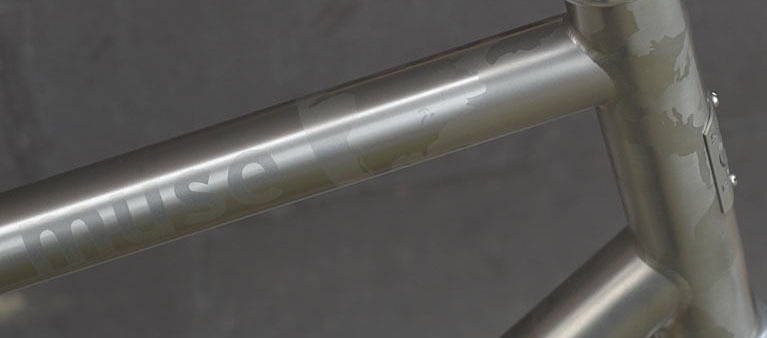
Seven start with their straight-gauge titanium Muse frame, using sandblasted graphics on the frame rather than traditional adhesive decals, in order to limit resource use. In addition to the standard graphics, each frame includes a sandblasted Earth Graphic on the front of the head tube.

Seven Limited Edition Earth Day bike detail

According to Crowe, Seven have increased their strict standards for energy and resource reduction in the making of these bikes.

“Many processes that require significant power usage will be performed using manual labor. This creates a 25 percent reduction in energy costs,” Crowe explained. “A team of Seven artisans who commute exclusively by bike will handle all design and fabrication. When ready, the bikes will ship via FedEx Ground in a reused box and packing materials.”

“The Earth Day Bike is available immediately and if we receive an order by April 6, we guarantee the frame will ready to ship by April 22,” Crowe added. “Normal delivery timeline for these bikes is four weeks.”

According to Crowe, this offer is available outside the US through Seven’s international distributors.

Anyone who purchases a limited edition Earth Day bike will receive a free one-year membership to Earth Day Network and a subscription to their publication E-Magazine, worth US$35. Seven have also committed, as a company, to commuting 7,000 miles by bike for every Earth Day Bike sold. According to Seven, the average American commutes 7,000 miles by car annually, using 350 gallons of fuel.

On April 22, 1970, Earth Day marked the beginning of the modern environmental movement, spearheaded by then US Senator Gaylord Nelson of Wisconsin. Approximately 20 million Americans participated, with a goal of a healthy, sustainable environment.

For more information, visit www.sevencycles.com.

roadbikereview.com: Seven Axiom SG Wins Choice Award

By Robert Millar

Seven is pleased to announce that the Axiom SG road model is the recipient of the 2006 roadbikereview.com Choice Award in the Frame category. Awarded at Interbike to companies whose products earned “Best Of” recognition, these are the highest rated products on the roadbikereview.com site. Winners are selected according to the highest rated products that met a minimum number of reviews for each category.

The Seven Axiom SG garnered “Best Of” status by earning a total rating of 5 out of 5, the highest possible rating. What makes this all the more impressive is that the Axiom was one of the most frequently reviewed products to earn this rating.

Here is just a sampling of the praise for the Axiom SG

“Super-stable at high-speed, lively feel to the frame, visually gorgeous, silky smooth (never chattery), superb frame craftsmanship, constant admiring compliments from other riders (the bike, not the rider…).”

“A joy to ride. Silk on the road, really. Makes me want to ride all day. Everything good about a bike, nothing bad. Any harshness or spookiness has vanished.”

“Awesome bike!!!! The whole Seven experience was a blast and the frame came out PERFECT!! I am able to ride longer, harder and faster and most importantly comfortably.”

“An excellent investment. I smile a lot when I am out on this bike. And I’m out on it a lot (for me). I no longer look for excuses to not ride and am looking for reasons to go for a ride. That seems to be the best thing you can say about any bike: it makes you want to ride.”

“The ride characteristics: Silky smooth, lively. I test-rode high-end aluminum and carbon frames and found them either harsh or dead feeling.”

Singletrack Magazine: Boutique Titanium, Seven Sola Reviewed

Singletrack Cover

Seven Sola

Seven Cycles were born out of ex-employees of Merlin Titanium, (one of the first modern companies to start building with titanium, back in the ’80s). Merlin’s chief MTB designer Rob Vandermark, and several other important folk, left Merlin to set up Seven in 1997 and haven’t really looked back. They initially made just Ti frames, but moved into also making steel and now carbon frames as well. They’re based just outside Boston, Massachusetts.

The Detail

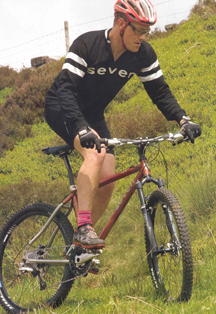
Our test frame is a production Sola frame, but with a custom paint job. Paint is an up-charge option on all Ti Sevens—but you’re equally welcome to leave it bare if you wish. We weren’t that sure about the paint to start with, but stacked against the other Ti bikes on test, it certainly stands out and is a welcome change to the utilitarian dull gray of a plain Ti frame.

For two grand, though, you’d want the beauty to be a lot more than skin deep though. Looking over the Seven, there’s a lot of simplicity and neatness going on. The seat collar is big, but neat. The dropouts are sculpted but not ostentatious and the welds and tube diameters seem ‘just right’.

There’s a lot of titanium bike history gone into this Seven. The tubing is seamlessly double butted and the seatstays feature long ‘S’ bends—both innovations developed while Rob Vandermark was at Merlin. Ironically the ‘S’ bend stays were to increase mudroom but also to give more power to cantilevers. The ‘S’ these days is much longer and results in parallel stays with an elegant kick out at the dropouts. The Sola is Seven’s butted titanium frame (the unbutted Verve is £ 1600) and comes in at barely more than 3Lbs for a 16in frame, so it’s no real surprise that it built into the lightest bike on test.

With our stock Shimano XT build and 80mm Manitou R7 forks, the Sola builds into a bike on the verge of ‘impressively light’ and a lighter, leaner or bigger, chunkier build would be easy depending on your penchant. At around 241lbs though, it felt just right for high speed blasting.

The components are a similar spec to the build on the Moots—good old reliable XT shifters, transmission and brakes, with Shimano XT wheels. They can be run tubeless, but we were keeping to our stock Kenda tires so ran tubes. The only other differences were with a Hope stem and a Thomson seatpost instead of the Moots Ti items on the Moots (there’s something very satisfying about the ‘zzzip!’ of the machined ridges on a Thomson post as it slides into a precisely reamed seat tube.

The paint is very wet looking and obviously many coats thick—this can be easily seen where it ends and the Ti frame starts showing. There’s a I mm step there, protected by a shaped vinyl strip—I suppose there’s not much else they could do here, but it would make sense to get a few spares to protect the vulnerable paint ends from chipping.

The paint has already shown signs of wear, despite helicopter tape in high risk areas. The stop-free center of the top tube is already showing scratching from the brake hose and there are a couple of other scuffs.

The Ride

Like all the bikes here, there is none of the expected ‘angels singing’ ride experience. At their best, all Ti bikes ride like ‘a bike’ and buying one won’t make you a faster rider unless it’s because it inspires you to ride bikes more. The Seven falls into that category. It’s simply a wonderfully inspiring bike to ride.

The light weight of the Seven can be felt in a couple of ways—riders used to regular steel hardtails were climbing hills a couple of gears higher, but those used to more burly trail bikes found the Sola to be just on the edge of ‘too light’ on faster descents as it can get bounced around a little. The racer boy 80mm forks (the other bikes had 100mm) that the frame was designed for meant that the Sola was happier on fast, twisty trails rather than rock fests, but it still coped admirably with some slow, thrutchy stuff. Technical climbs were particularly fun as the combination of light weight and surefootedness made slow and steppy stuff fun again.
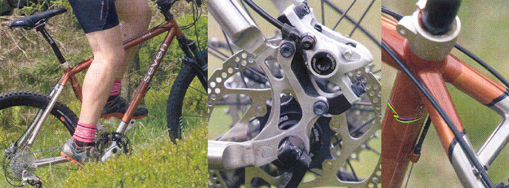
Seven Sola Details

In terms of flat-out speed and performance on high speed singletrack, the Sola was a joy to ride. Throw it into comers, lean it over and big ring it out the other side. I even found myself dropping back from the ‘pack’ just so I could wind up another sprint. There was a definite ‘snap’ to the ride and changes in speed just needed a moment’s notice.

The Sola is definitely a bike that won’t let you walk past without an appreciative look and on the trails it won’t let you go home until you’ve gone further than you were intending to. I could fault the scufflness of the paint job, but there’s nothing to stop you saving money and having a bare frame anyway. Besides, if you’re going to have a bike for ten years, it might as well gain a few scars and wrinkles- after all, the owner is certainly going to… which we have been very fortunate to draw upon. Plus, I think there is a very good work ethic out here.”

26″ vs. 29″ Wheels: Seven Helps Cyclingnews Devise the Ultimate Test

With the help of two identical Seven IMX hardtails, the folks at Cyclingnews are attempting to answer the question, once and for all, “Is bigger better or is less really more?”

While pondered for years, previous attempts to definitively answer the question of whether a 29″ wheel is better than the traditional 26″ mountain bike wheel have failed because of too many variables between the test subjects. So for the first time ever,Cyclingnews and Seven Cycles have removed all variables to create the perfect test.

In describing the two Seven’s, Cyclingnews notes, “We worked closely with the specialists at Seven Cycles to obtain a pair of Seven’s premier carbon and titanium IMX hardtail frames. Seven’s unique talents were tapped to normalize the ride qualities of the two frames by varying the titanium tubing stock as well as the carbon fiber layups, and the handling characteristics were matched as closely as possible.”

“Of equal importance was the fit of the two IMXs and this was calibrated down to the last millimeter relative not only to the rider, but also to the ground. To that effect, critical dimensions such as cockpit length, saddle height and setback, handlebar height and sweep, and even bottom bracket height are 100 percent identical between our decidedly high-zoot test pair.”

cyclingnews.com: Seven Heaven – a tour of the Seven Cycles Factory

By Steve Medcroft

The first Seven I ever saw up close was Mary McConneloug’s Tsumani cyclocross bike. She rode it during the 2004 U.S. Gran Prix of Cyclocross series. We wrote a pro bike report on it. Her partner and teammate, Mike Broderick, said that Mary had been riding the same frame for three years and that fact stuck in my head. Three years. Most riders are issued new bikes every year. Most bikes are changed and modified enough each season that the manufacturers have to upgrade their sponsored riders.

But three years before our article, Seven Cycles fit Mary for her Tsunami and she hasn’t needed to replace it since (and was giving no hint that she intended to replace it any time soon). It left me with the impression of a Seven as a lifetime purchase, a frame that would be with its owner forever.

I ran into Mary and Mike at Interbike this year. Mike and I were eyeballing Seven’s IMX hardtail mountain bike; which features titanium lugs and carbon tubing. We were talking about the way the bike rode and he was explaining how Seven tunes the bike for each buyer through a customization process that factors in something like one hundred data points. From how you like the comfort of the bike vertically to how stiff you want the torsional drivetrain, you can have a Seven built to ride and feel exactly like you want it (or exactly the way that will emphasis your riding and racing strengths and minimize your weaknesses).

But Seven isn’t a typical custom bike builder (a small shop designed around a single master frame builder); it’s an eight-year-old, 35-employee, Boston-based bike manufacturer. How do they mass-produce highly customised bicycles? I couldn’t pass up the chance to swing into the Seven factory after covering the USGP stops in Gloucester the weekend of Halloween.

First impressions

Seven got its start in January, 1997 when Rob Vandermark, head designer for Merlin Bicycles, struck out with a small group of colleagues to occupy a 1,000 square-foot corner of someone else’s machine shop 30 miles north of Boston. “The guy who owned the shop was extremely generous to us,” said Vandermark when I visited the company. “He was excited to see us get off the ground. We grew to twelve people quickly with everyone doing everything from welding and machining to sales and R&D in that tiny space.”

Seven Entrance

Vandermark, an engineer by practice, had a vision for an industrial process that could bring hand-built custom bicycles to an audience as large as a mid-sized mass-producer. He says he felt that the larger companies were too inflexible to truly process customization through their company’s systems and most custom builders were limited in size due to their single-handed approach to customization.

Seven executed Vandermark’s process in that small space until they moved to a 12,000-square foot facility in the lower level of an industrial park in Watertown, MA, about six miles from Boston Harbour as the crow flies. At the company’s front door, there is no fanfare, no neon-lit 20-foot-high Seven logo. The door is, in fact, almost hidden from view in a cul-de-sac at what looks like the rear of the building. I actually walked up to the door and backed away, convinced it was a private entrance or a loading dock and circled the whole building looking for a front entrance before coming back to the cul-de-sac.

I sat with Director of Marketing, Jennifer Miller, in Seven’s showroom, a cavernous, brick-walled corner of the space complete with racks of completely built Sevens along two walls. The display was a good example of Seven’s line: bikes designed for all different types of riders (The Elium competition road bike, The Alaris Race crit bike, the Axiom Steel for traditionalists, Sola for cross-country racing or Duo for all-mountain riding).

One thing that stuck out about that selection of bikes was the variety of frame materials. I always thought of Seven as a ti shop. “From day one, we worked with materials other than titanium,” Miller said. “The first bike we ever made as a company was steel. We were also working with carbon fibre from day one and introduced the Odonata – the first bike to strategically employ both carbon fiber and titanium tubes – in our first year. The design inspired a revolution; within a year, everyone was doing metal bikes with carbon seat stays, etc.”

Miller’s point is that to Seven, the frame material isn’t the focus of bike (most frame materials can be manipulated to produce almost any desired effect), it is the ultimate one-bike-at-a-time tuneability that can be achieved with almost any frame material that matters most.

A Fit for a King

To learn about the customisation and fit process, Miller introduced me to Zac Daab, Seven’s Senior Fit Specialist. Seven’s bike-build process starts when the retailer fills out a comprehensive customer questionnaire to gather everything they need to know about the rider’s desired fit and comfort, handling and performance, tubing and materials preferences, features and options and any accommodations the bike needs to be ready for the rider’s future.

Rob poses with Seven #001

“The questionnaire contains the hundred-plus data points we use to come up with the final build,” Daab said, using a marked-up (the document is continuously refined) copy of the Custom Kit to make his point. The goal is to gather enough data to build a custom frame without ever seeing the rider, so beyond the questions that can be answered by measuring a rider’s legs, arms, wingspan, inseam, etc, Seven asks about a rider’s weight, their previous bike, the components they plan to run, what kind of riding or racing they do. “We want to know if they are using riser bars,” Daab says, “how they want their cable routed, do they want pump pegs, the color of their decals.” Every answer matters. “Fork choice is important, for example; it can help us change the geometry of the front end of the bike.”

Daab says that Seven asks questions customers aren’t used to answering when they buy a mass-produced bike. “When you buy a bike off the floor, for example, it doesn’t matter if you’re doing centuries, crits or full-on time trials every weekend; the handling for that bike has been selected already. By handling; we mean things that control handling; the head tube angle, the bottom bracket drop, the chainstay length – they are already figured out and it doesn’t matter who you are. With a Seven, what we’re working on through the Custom Kit is how to build the perfect bike for that single rider.” That data gathered in the Custom Kit is balanced into a frame design that sets the rider in a neutral position with as much component adjustability as possible.

To prevent ambiguity, a Seven fit specialist calls the buyer directly before a final design is committed to production; a practice Daab says Seven remains committed to event though it has become a much larger task than when Seven was small. “Sometimes we’re resolving inconsistencies – if you said the reach of your current bike felt way too long but we’re looking at your body data (arm length, body length, top tube dimensions) and it doesn’t seem to check out, we want to talk about it with you to make sure we build exactly the right thing. The call is about tuning the build a little bit tighter.

Sweeping the Factory Floor

At about day eleven in the four to seven-week process, the customer signs off on the build then a build sheet, detailing the frame’s design, is sent to the floor. I left Daab, and Miller led me through a double door to view the frame production area. With concrete floors and work zones crammed with stock, machinery and welding equipment, the Seven factory floor is a genuine production facility; a dirty, grungy, make-something-with-your-hands kind of place.

Frames in production

At first pass, it looked chaotic, but although it was a little cramped (Seven has signed a lease on an adjacent space and will double the production floor in early 2006), there seemed to be purpose in the placement of ever person, every tube, every lathe and drill press.

Seven frames begin life in the frame stock bins. Stock tubes are cut, shaped, bent and butted into what is essentially a bike in a box; literally, a shallow, cardboard box filled with a jigsaw puzzle of metal tubes that will be tack-welded together at the next work station. Once the tubes are tacked into geometric position, the assembly is passed to the welders.

“Tim Delaney is a career-professional bike builder,” Miller said as we watched the lanky Delaney work the head of his Tig welder around the contours of a bottom bracket. “He’s been welding his entire life. Most of our other welders have been trained here. They may receive up to six months of training before they even tack a frame.”

A braided hose hung from a coupling attached to the bike’s head tube. “The frame has to be completely sealed,” Miller said. “It’s filled with Argon (an inert gas) to purge Oxygen and other environmental elements that could compromise the weld’s intergrity if present when the titanium is in a molten state during welding.”

When the welders (of which there are several besides Delaney) finish the frame, any carbon elements are screwed and glued in place, the frame then receives its final pieces and parts then moves on to the finishing stations where they’re buffed and prepped for painting and decals.

Before and after finishing, the frames hang on a rack for Quality Assurance to make sure there’s no reason to send them back to the floor before the final product is shipped.

Knowing which way the rudder is pointed

The fact that the core of the thirty-five employees at Seven are cyclists is evident; many wore long-sleeve wool jerseys and a half-dozen people arrived to work on bikes during my time there. But just as many employees learn their passion for cycling by working at the company. “We have a really good employee purchase programme,” Vandermark said, “We offer a very, very low price. And to the extent our employees can do any work on their bike off the clock, that’s totally taken off the top.”

So at Seven, there are a lot of people paying a few hundred dollars for very expensive bikes. “And there’s a lot of bartering going on,” he added. “A welder who can’t machine will go to a machinist who can’t weld and they’ll trade work on each other’s bikes. We have employees that have built five, six, seven bikes over time. Which is important to us; it helps to have that appreciation when you’re stressing and fussing over details.”

I asked Miller where she thought Seven would be in five years and she grinned and leaned forward in her chair. “We want to grow but we measure growth in different ways. Clearly, sales is one reason to grow and one way to measure growth, but growth also represents the opportunity to do the kind of product development we want to do, to reach that size where we can support things like health insurance and 401k’s and profit sharing. A certain amount of growth is necessary to be able to create the kind of company we want to be.”

What Miller is hinting at is something every small to mid-sized company struggles with; how do you create opportunities for smart and talented people to grow within your organisation when there are only so many ‘big’ jobs to do? “We hire a lot of creative people (an unusual number of art students, Miller told me earlier). It’s important to us that we give them a real career path; a way to start at the entry-level and develop a real career for themselves.”

The company is also dealing with the transition beyond Rob Vandermark’s ability to manage every aspect of Seven’s operation. “In the early years,” Miller says, “we had to manage growth in a different way. We couldn’t keep up with orders. As we mature, we know we have to be more sophisticated with how we chase growth. We need to bring in other perspective and we need to spread the burden of growth. I see that as our big challenge but I feel like that’s an issue most companies our size have to deal with so I’m sure we can work through it.”

There’s also the challenge to Vandermark’s customization process. Can it stay intact if Seven becomes, say, three times its current size? “It doesn’t scare me,” Miller says. “When people say ‘how can you continue to profit with a single-piece flow like that’ I just think back to when we first started. Our labor hours per bike are so much lower now than they were then. I’m confident we’ll continue to get smarter.”

Seven Partners on the Racecourse

Mike & Mary

It is not uncommon for a bicycle manufacturer to promote its product by sponsoring racers or a racing team. Seven Cycles is not a big-budget, mass-market brand so it has passed on the cost and logistics that come with the opportunity to outfit a 13-member road team and instead works closely with racing and life partners Mike Broderick and Mary McConneloug.

“We can be seen as a road manufacturer so sponsoring a mountain-bike team is odd,” Seven’s Jennifer Miller said during my visit to the company’s Boston factory. “But most of us here at the company, the founding team, were seriously into mountain biking – we all raced and we loved it – so we’re almost living vicariously through Mike and Mary.”

Don’t get Miller wrong; sponsoring McConneloug and Broderick isn’t a corporate whimsy. “Our relationship goes back almost five seasons now. I was racing mountain bikes at the time and Mary won a race that I and another member of our team was in. When Mary and Mike approached us after that about sponsorship, they presented us with a serious and professional agenda.”

The couple seemed to align philosophically with Seven’s founding team as well; they showed a focus on the environmental issues surrounding mountain biking just as Seven has implemented environment-friendly policies throughout the company. “That part of it mattered in a lot of ways,” Miller says. “And since Mary and Mike have increasingly done better and better year after year, we’ve been happy to keep working with them.”

Could Mary and Mike’s success make them more attractive to a bigger-budget team and pull them away from Seven? “Every year, we wonder whether we’ll be able to maintain this relationship,” Miller says. “And I wouldn’t blame them one bit if she was looking for something big. But part of their values are that they want the freedom to race what they want to race and they feel strongly about the companies they work with. Since we feel like we’ve formed a relationship with Mary and Mike and that our sponsorship is not purely a commercial enterprise, there’s no reason why we won’t continue to work together.”

Rob Vandermark’s Resume

1987

— Vandermark is involved in designing and building frames for Olympic medal winners, world champions and Tour de France winners including Lance Armstrong’s Subaru-Montgomery team.

1990 — Designs custom frames for Greg LeMond and his Tour de France winning Z-Team.

1991 — Began two-year study of wheelchair ergonomics and develops revolutionary wheel chair designs. Applies this knowledge of ergonomics to bicycle fit and design.

1992 — Introduces the industry’s first size-specific tube sets.

1993 — Introduces racing wheelchair for Bob Hall (the first wheelchair athlete to complete the Boston Marathon and who went on to form Hall’s wheels, a racing wheelchair supplier). Scientific Frontiers television program calls the chair “A design revolution.”

1994 — Introduces innovative light, mobile, and with a low center of gravity everyday wheelchair.

1997 — Leaves Merlin and launches Seven Cycles using the Custom Kit and Client Interview processes which allows Seven to produce highly customized bicycles in a mass-production scalable system.

2004 — Seven Cycles fits and builds 10,000th bicycle frame.