
3D-Printed Titanium: Rougher Surface, Shorter Life
The Journal of Materials Research and Technology published a 2022 peer-reviewed article titled A critical review on additive manufacturing of Ti-6Al-4V alloy: microstructure and mechanical properties. Nguyen, H.D., et al. (2022). A critical review on additive manufacturing of Ti-6Al-4V alloy: microstructure and mechanical properties. Journal of Materials Research and Technology 18:4641-4661. Its Figure 10 makes a clear case against printed titanium in bike frames: the rougher a titanium surface, the shorter its fatigue life. The decline is steep and predictable. Bike frames typically fail by cyclic fatigue. Titanium is disproportionately susceptible to surface discontinuities, abrupt transitions, and stress risers. Printed surfaces are much rougher than machined surfaces. Titanium's surface finish is a structural property, not a cosmetic one.
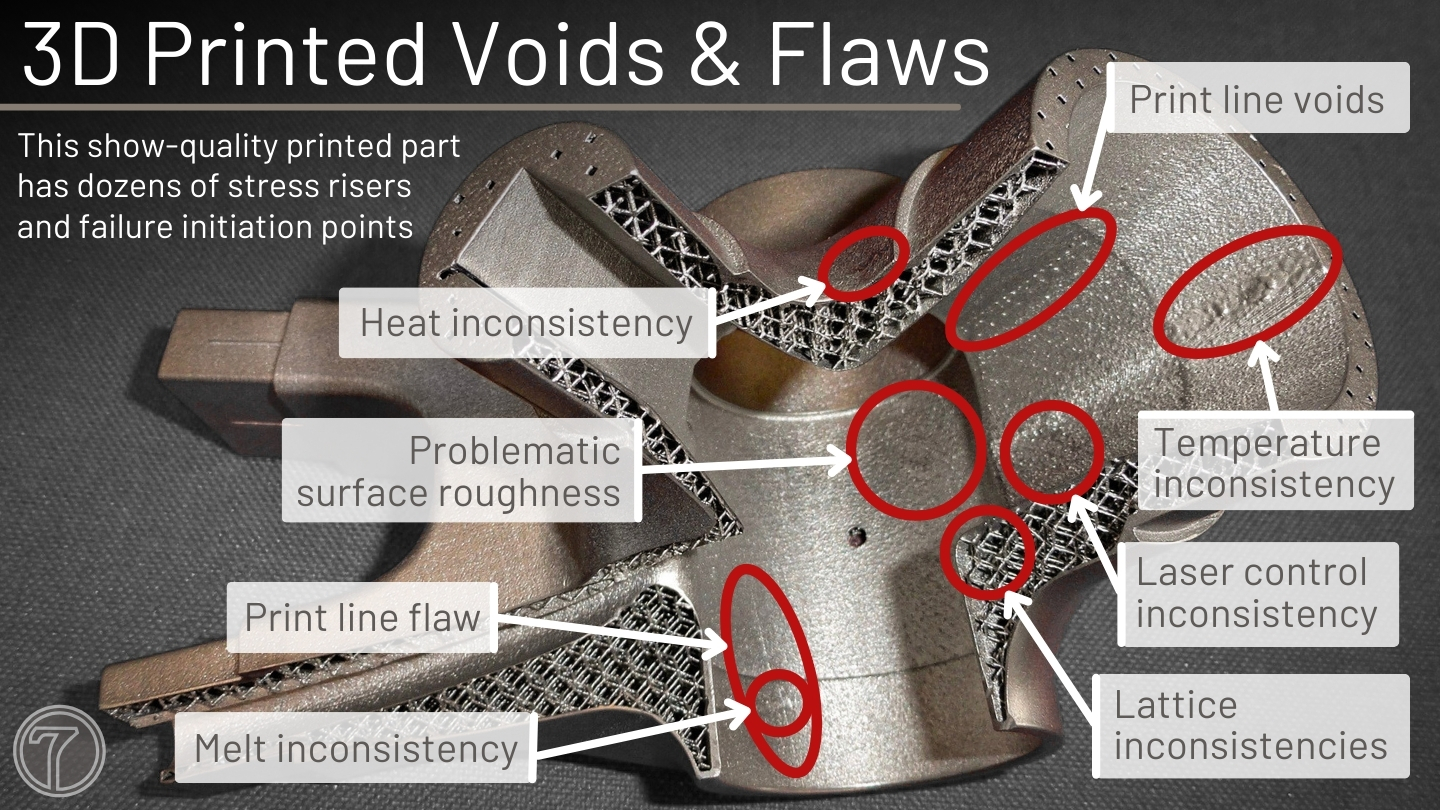
As the printed part in Figure Raw-Print illustrates:
"Poor surface roughness of as-built parts has always been one of the main limitations in AM processes." Nguyen, H.D., et al. (2022). A critical review on additive manufacturing of Ti-6Al-4V alloy: microstructure and mechanical properties. Journal of Materials Research and Technology 18:4641-4661.
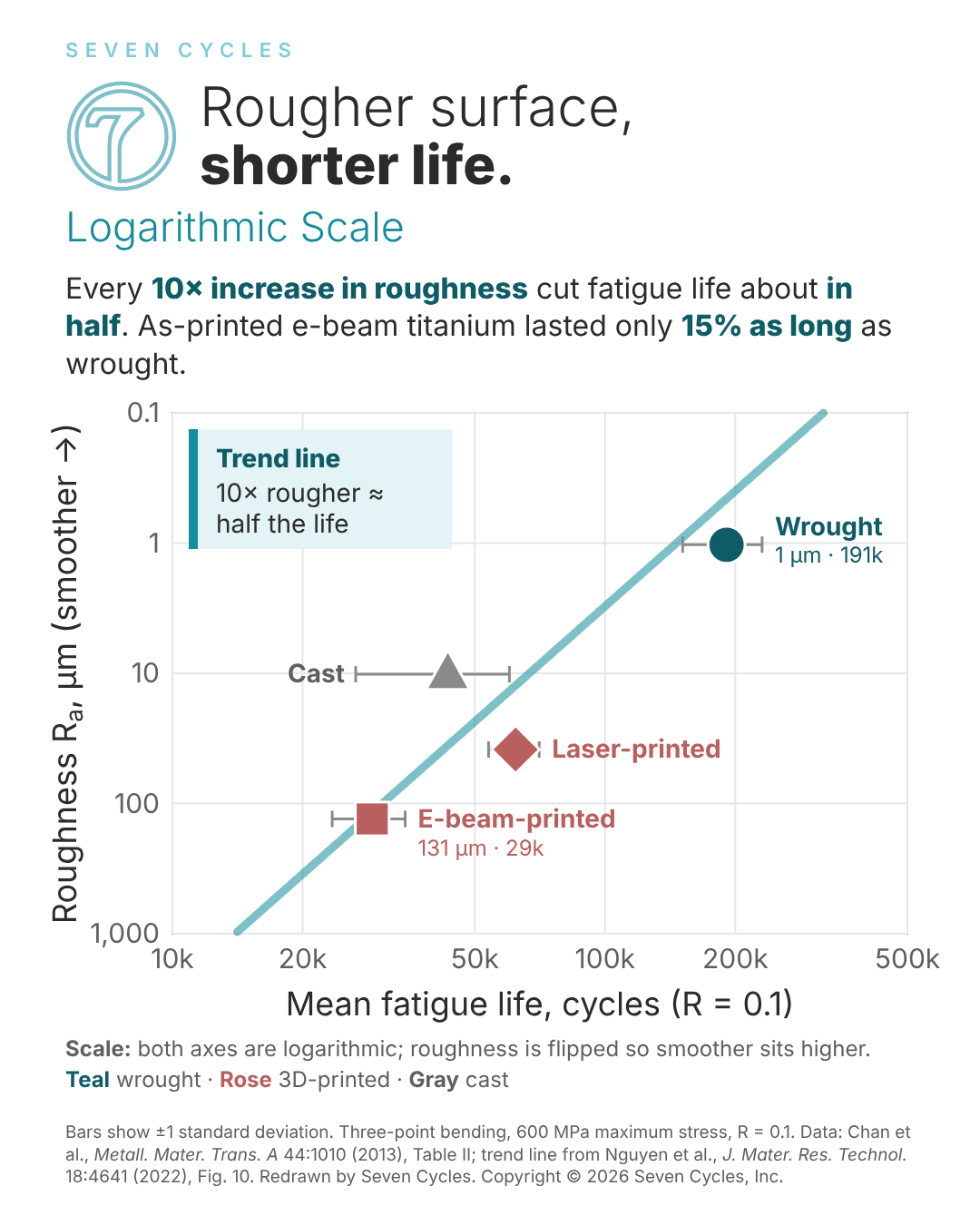
Data source: Chan et al., 2013, reproduced in Nguyen et al., 2022. Chan, K.S., Koike, M., Mason, R.L., Okabe, T. (2013). Fatigue life of titanium alloys fabricated by additive layer manufacturing techniques for dental implants. Metallurgical and Materials Transactions A 44(2):1010-1022.
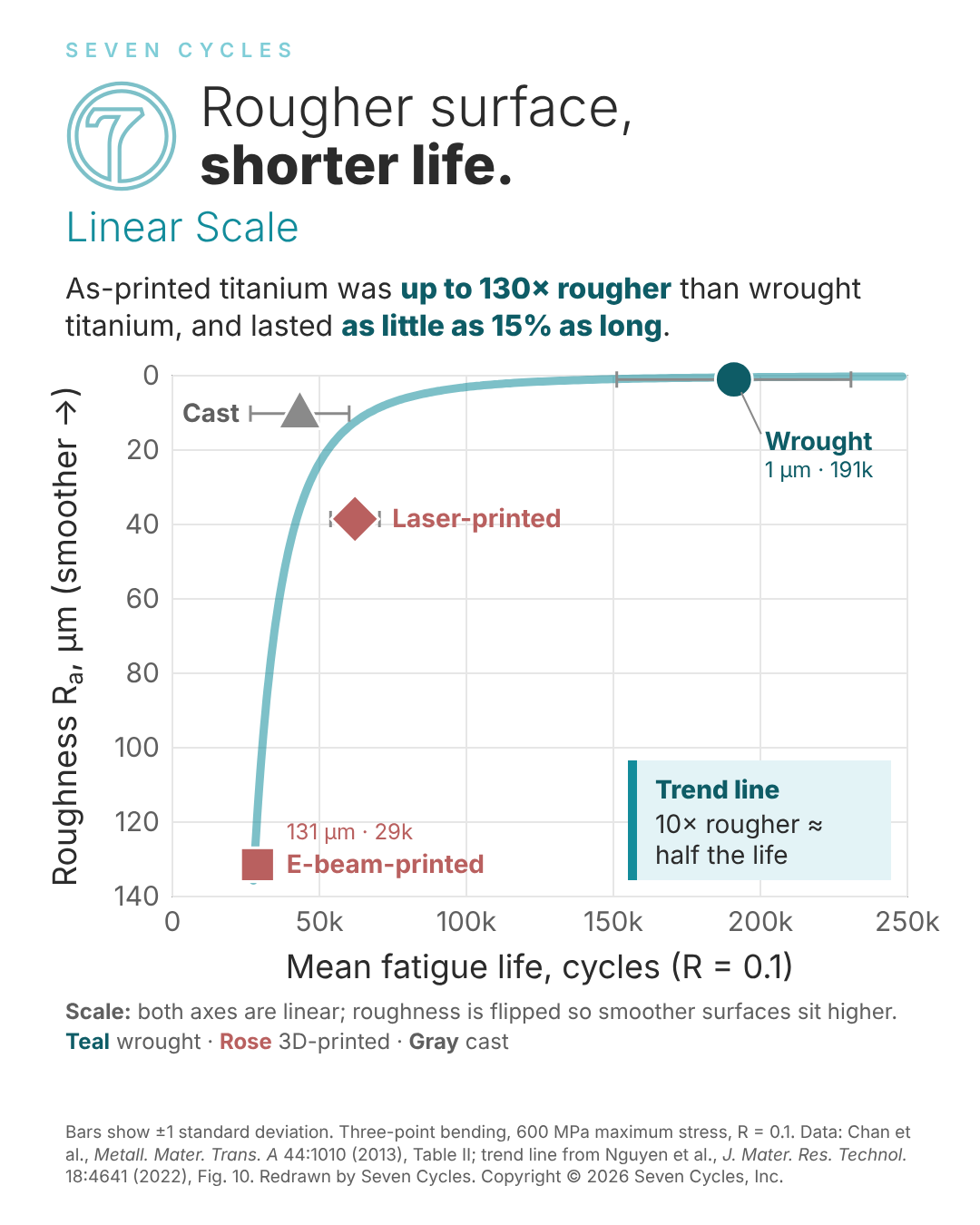
Data source: Chan et al., 2013. Chan, K.S., Koike, M., Mason, R.L., Okabe, T. (2013). Fatigue life of titanium alloys fabricated by additive layer manufacturing techniques for dental implants. Metallurgical and Materials Transactions A 44(2):1010-1022.
How to read the charts
Each marker is a group of titanium alloy 6Al-4V test samples made in different ways. The bottom shows mean fatigue life in load cycles; the further right, the longer it lasts and the better it performs. Average surface roughness (Ra) in micrometers runs up the side; higher values mean rougher surfaces and therefore worse performance. Both axes are logarithmic: each grid line step is a 10-fold change.
Marker color indicates how the titanium was made: teal is wrought, rose is laser (LBM) or electron beam (EBM) 3D-printed, and gray is cast titanium 6Al-4V. Whisker lines show the range of fatigue life for all tests.
Table: Comparing three framebuilding methods
| Group | Ra (µm) | Mean fatigue life, cycles |
|---|---|---|
| Rolled (wrought) Titanium 6Al-4V | 1.0 | 190,980 |
| LBM (Laser Beam Melted / printed), as-built Ti 6Al-4V | 38.5 | 62,113 |
| EBM (Electron Beam Melted / printed), as-built Ti 6Al-4V | 131.4 | 28,961 |
What the data show
Printed titanium is 30 to 130 times rougher than wrought titanium. Fatigue life for printed parts is about 33%, and for wrought parts, about 15%.
The trend line puts a number on it. Every 10-fold increase in roughness cuts fatigue life to about 46%. A surface ten times rougher lasts roughly half as long.
Why it matters for framebuilding
A titanium frame's service life is often constrained by its coarsest surface. Even if a part is polished to a mirror finish, no tool can reach internal surfaces and lattices in printed parts. These hidden defects often show up over time as fatigue cracks and frame failure. Titanium is "notch sensitive" and therefore particularly susceptible to defects.
Machining or polishing moves a printed part up the surface-finish curve (Figure Linear, for example), but only where a tool can reach. The inside of a hollow printed lug (Figure Raw-Print), dropout, or stay-yoke as printed (with a raw finish), is near the bottom of the curves. Smoothing (polishing or machining) isn't a full fix either. Even EDM-cut printed samples fell well short of wrought, and the e-beam set sat below the trend line, suggesting pores and microstructure also cost life.
Wrought and drawn titanium tubing starts at the top right of the Figure Linear chart, inside and out. Unlike printed hollow and lattice parts, nothing is hidden from the predicted durability results.
Table: Many printing methods and finishes
| Group | Ra (µm) | Mean fatigue life, cycles |
|---|---|---|
| Wrought Titanium 6Al-4V | 1.0 | 190,980 |
| Wrought Ti 6Al-4V ELI | 1.2 | 167,336 |
| EBM (Electron Beam Melted / printed) + EDM-cut Ti 6Al-4V | 5.1 | 48,926 |
| LBM (Laser-printed), EDM-cut Ti 6Al-4V | 7.7 | 79,889 |
| Cast Ti 6Al-4V | 10.2 | 43,324 |
| LBM (Laser Beam Melted / printed), as-built Ti 6Al-4V | 38.5 | 62,113 |
| EBM (Electron Beam Melted / printed), as-built Ti 6Al-4V | 131.4 | 28,961 |
Definitions of Technical Terms
- SLM (Selective laser melting): SLM is the most common additive manufacturing process used for bicycle frame elements and components. Laser beam melting, referred to in the referenced articles, is synonymous with SLM printing. Chan, K.S., Koike, M., Mason, R.L., Okabe, T. (2013). Fatigue life of titanium alloys fabricated by additive layer manufacturing techniques for dental implants. Metallurgical and Materials Transactions A 44(2):1010-1022. Nguyen, H.D., et al. (2022). A critical review on additive manufacturing of Ti-6Al-4V alloy: microstructure and mechanical properties. Journal of Materials Research and Technology 18:4641-4661.
- LBM (laser beam melting): 3D printing in which a laser melts thin layers of titanium powder. It's the same family as SLM and laser powder bed fusion, the process most printed bike parts use.
- EBM (E-beam-printed, electron beam melting): 3D printing in which an electron beam melts powder in a vacuum. It builds faster than laser printing, but leaves a rougher surface.
- EDM (electrical discharge machining): A method that removes metal with controlled electrical sparks rather than a cutting tool. In the chart, “EDM-cut” means the process cut away the printed surface to leave a smoother one.
- ELI (Extra Low Interstitial): A purer version of Ti-6Al-4V, also called Grade 23. It has tighter limits on oxygen, nitrogen, carbon, and iron, which improves toughness, and it's widely used in TIG welding wire and medical implants.
- Wrought: Conventionally made titanium, shaped by rolling it under pressure rather than casting or printing it.
- Ra: Average surface roughness. It's the average height of a surface's peaks and valleys measured from its centerline. A higher Ra means a rougher surface.
- µm (micrometer): One-thousandth of a millimeter. A human hair is roughly 50 - 100 µm thick.
- R (stress ratio): In fatigue testing, R is the lowest stress in each load cycle divided by the highest. R = 0.1 means the load drops to 10% of its peak but never reverses. Here, beams were loaded in three-point bending, supported at both ends and pushed in the middle, to a peak of 600 MPa, 10 times per second, until they broke. For comparison, R = -1 means fully reversed loading, an equal push and pull. R = -1 better mimics fatigue loading found in bicycle frames and components.
- Cycles: One cycle is a single round of loading and unloading. Fatigue life is how many cycles a part survives before it cracks.
- k / M: Thousand and million, so 200k means 200,000 cycles and 1M means 1,000,000.
- Cast: Molten metal poured into a mold.