
Seven Engineering: Geometry Tropes
Don't conflate frame geometry and bike performance. They are related but not interchangeable. Modifying a single element of frame geometry does not hold the secret to performance. For example, bike marketing would have you believe that shorter chainstays are better. While that can be the case, many other factors improve bike handling and performance far more than reducing chainstay length by a few millimeters. Additionally, longer chainstays often provide more benefits than shortcomings. The key is to design the bike as a system rather than a series of individual geometric elements. Changing chainstay length requires reevaluating the entire bike's design. For a deep dive into the complexity of chainstays, read our article on how we engineer chainstays.
The Fastest Road Racers Don't Need Short Chainstays (or Even a Road Bike) to Win
In 2026, "The Biggest Criterium in America Was Won on A Gravel Bike." Matthew Wilson raced the Unbound 200 gravel race, and the next week he raced the Tulsa Tough criterium. He raced the same gravel bike in both races: Unbound with gravel wheel and then Tulsa with road wheels. He won the crit.
Wilson's gravel bike features popular 42.5 cm chainstays along with other geometry element optimized for gravel riding. Marketing would have us believe that there's no way a gravel bike can perform well in a criterium. Clearly, that's not the case. Sure, Wilson may have been the fastest rider on the day, but razor-sharp bike handling has little to do with a rider's power or fitness.
Criterium racing requires the quickest handling of any racing. Additionally, the Tulsa Tough has an infamous 15% climb called Cry Baby Hill. Faster climbing is facilitated by the stiffest possible drivetrain and the lightest possible bike setup. This type of criterium race requires an all-out road race bike. Or does it? Wilson's race-winning gravel bike is anything but.
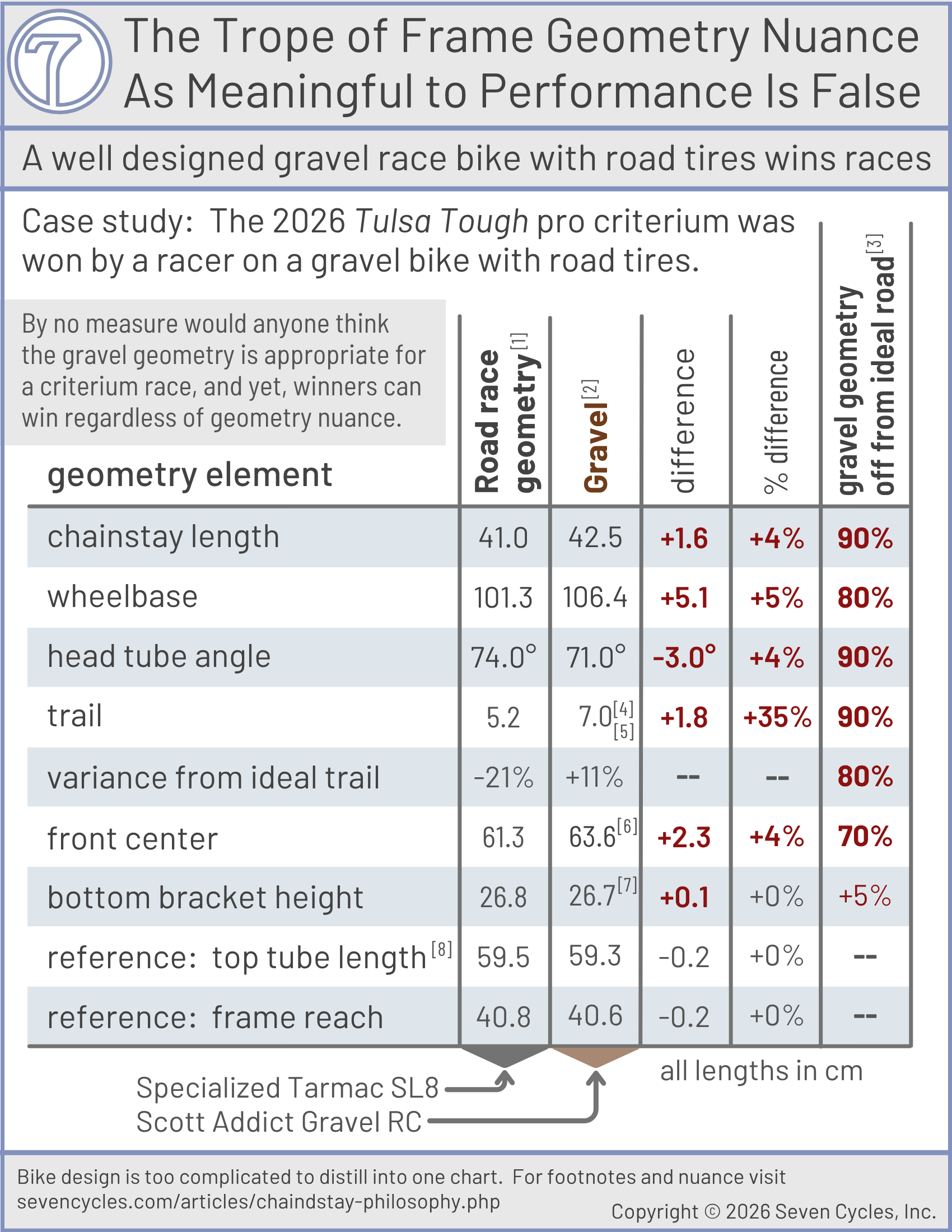
Figure 1 compares Wilson's gravel geometry to popular road race bike geometry. The gravel bike doesn't match up to a single measurement or angle of the road bike. And yet, none of that matters.
The individual frameset geometry attributes that riders often focus on to maximize road race performance are marginally impactful. Marketing focuses on numbers (41 cm chainstays, 73 degree head tube angle, etc.) because it is easy to explain and sell; "Shorter is better. Lighter is better." The reality is that bike design is complex when we're looking for optimal performance with numerous criteria.
When you're looking for your next Seven, trust our designers' engineering experience that we've applied to over 35,000 hand-built bikes. Don't get fixated on one geometric measurement. The bike is a system, and the best results come from Seven's holistic design and engineering approach.
Footnotes
Footnotes for Figure 1:Tropes about road race bike geometry are false.
- Road race geometry: We use the Specialized Tarmac SL8 as the exemplar.
- Gravel geometry: We use the Scott Addict Gravel RC that Matthew Wilson rode in the criterium as the gravel exemplar. The bike has fairly standard gravel geometry.
- Gravel geometry off from ideal road: This percentage sets the road bike as the ideal geometry element compared to the gravel geometry element. For example, the trail on the road bike is 35% shorter than the gravel bike. That is the math variance between the two. However, the range of road bike trail relative to the gravel trail is 90% off the mark compared to the entire range of trails that might be possible. This means that the gravel bike trail should be considered terrible for road crit racing. We agree that it is. Yet, somehow it worked just fine for Wilson at the Tulsa race.
- Trail for the gravel bike is calculated with 28 mm tires.
- Trail for the gravel bike is calculated because it is not included in the online geometry.
- Front center for the gravel bike is calculated because it is not included in the online geometry.
- Bottom bracket height for the gravel is calculated with 28 mm tires.
- Top tube length is effective, measured horizontally to the ground.