How fund manager Ed McCall raises two sons, makes million-dollar deals, and still competes at the top
By Stephanie Pearson
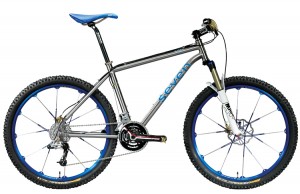
“I wish I could use a stock bike, because they’re more affordable, but I’m 6-foot-5 and 210 pounds. Custom geometry is so key for performance and comfort; I have to go custom with a Seven. Ilike it for cross-training because it’s low impact. It requires a more natural circular motion versus the linear movement of so many other exercises”.
bikeradar.com By Marcus Farley & James Costley-White
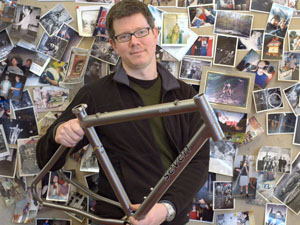
Rob Vandermark of Seven Cycles
Massachusetts-based Seven Cycles have been hand-crafting high-end custom bikes from steel, titanium and carbon fibre since 1997.
They’ve built such a reputation for themselves that they’re now the largest exclusively custom frame builders in the world.
We spoke to founder and president Rob Vandermark about Seven’s exciting new suspension partnership with Dave Weagle, their 2010 range and his bike building philosophy.
So Rob, we hear your new full-suspension mountain bikes will feature a new suspension design…
Our new suspension partnership is with Dave Weagle. Our co-designed bike line is really exciting and innovative. Working with Dave’s vast suspension knowledge in conjunction with Seven’s manufacturing and customisation capabilities has lead to a really innovative outcome: unique and individualised rider-specific suspension tuning and ride feel.
Because of this, Seven are introducing an entirely new series of suspension bikes with some design concepts that have never before been available. We’re really excited about this partnership.
You used to use Maverick’s design. What prompted the change?
Yes, in fact we were the first company – in 2001 – to offer both a titanium Maverick Monolink design and a full-custom geometry version. At that point in suspension’s evolution, the Monolink was a complete departure from how other technologies addressed suspension. Maverick provided a number of advantages with none of the typical shortcomings.
Working with the Maverick team has been a great partnership… [but] all successful products go through a cycle from introduction to growth, maturity and decline, until the lifecycle begins all over again. We’d worked with Maverick for a long period, and the time came to look at dual suspension from a different perspective.
Dave’s experience and reputation for developing technologies such as dw-link and Split Pivot made him an obvious choice. So, we contacted each other and found we each had some compelling ideas about working together. We are also fortunate that both our companies are based in Massachusetts, which makes collaborating easier.
Can you give us any more details of the new platform?
We are licensing the Split Pivot design fully intact; we can’t see any reason to modify the system because it’s a great design. The piece that Seven bring to the design is the way in which we’re tailoring the suspension system for the rider – and the way in which we integrate that suspension into the overall design of the bike.
We’ve developed a holistic order method that enables the customer to specify the suspension characteristics in exactly the same way that we do with the ride characteristics and handling of our non-suspended bikes. To us this is exciting because we’re designing the suspension feel for each rider as an integrated element of the entire bike and rider combination.
A few of the ways we’re adapting the suspension characteristics individually are by tailoring placements of pivot locations on each customer’s frame, integrating overall frame geometry and handling characteristics, matching to the customer’s fork choice, and accounting for key component selections.
These are just a few examples of how we’re optimising the Split Pivot system for the rider; there are many other factors involved but that’s a bit of an overview of how we’re approaching this new design.
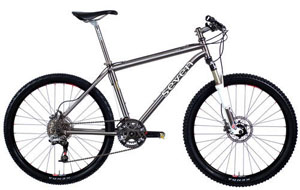
Seven have yet to unveil their 2010 full-suspension bikes, so here’s their Sola SLX hardtail
What’s Seven’s bike line-up looking like for 2010, and is there anything new on the horizon?
For 2010 Seven offer 27 models across seven categories: triathlon, road, commuting, touring, tandeming (road and mountain), cyclo-cross and mountain bikes (dual suspension and hardtail).
[There are]… a number of improvements such as a new curved down tube on all our mountain bike models, a distinct triathlon model series and a new category we refer to as Traveler, whose models are designed for off-road expeditions, loaded touring, urban commuting and anything in between.
As far as unannounced new products, our manufacturing approach allows us to make rapid product introductions, so you will continue to see new offerings added throughout the year, not just during the fall. Stay tuned to see what we have in store.
Where do you see Seven heading in future?
Because the industry is changing faster than ever, we’re sure that the next five years will be really unpredictable and exciting for riders. Fortunately, we have a five-year R&D plan. Each season our R&D plan shifts depending on customer interests, industry component design changes, and our own internal capability improvements.
A few items on our list, without giving too much away, include: we’re working on some interesting frame and component integration technologies; we’re beta testing some new service methodologies that will change the way we work with customers for the better; we’ll be augmenting our suspension bike offerings and the tune-ability of the suspension systems; we’re developing more components that relate to our frame designs; and we’ve got some big road bike technologies in development.
And yes, there is a new frame material on the near horizon [Seven currently offer bikes in full-carbon, carbon-and-titanium, titanium or steel] – but we’re not discussing it yet.
Seven currently offer frames in full-carbon, carbon-and-titanium, titanium or steel
Seven currently offer frames in full-carbon, carbon-and-titanium, titanium or steel
How are you coping with the credit crunch?
The situation seems to be improving, but the lack of visibility – for next week or next quarter – affects us just as it affects businesses of all sizes. We are fortunate to maintain good long-term relationships with our suppliers and retail partners. Our current approach is not so different from how we normally work, but we communicate more frequently and in greater depth than before.
Like all companies, we seek to reduce unnecessary expenditure wherever possible – except in R&D. Sometimes we change the resource mix for a project or adjust a product introduction timeline, but our ability to adapt quickly makes us better positioned to deal with this type of uncertainty.
Tell us more about Seven Cycles, and how you came to found it…
I’ve been a cyclist my entire life. Cycling became a vocation for me while working in a bike shop during high school and college. I majored in sculpture at the Massachusetts College of Art and The School at the Museum Of Fine Arts, Boston. I left school when I realised I could combine my two passions – cycling and sculpture – in a career of bicycle design and frame building.
Prior to participating in founding Seven, I served as head of R&D at Merlin Metalworks, a high-end bicycle frame builder and one of the first to work with titanium. During the 10 years I worked at Merlin, I was able to work in all aspects of bicycle frame building and design, from machining and welding to product development and process improvement.
I decided to leave Merlin at the close of 1996 because the company began focusing on the mainstream market at the same time that I was becoming more interested in pushing the limits of bike customisation, technology transfer and the Toyota Production System of manufacturing. I really wanted to see how these three ideas could converge in a new and successful way. Four of us started Seven in January 1997. The business has grown steadily over the years.
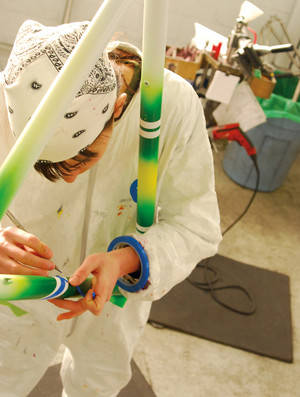
Seven offer bikes in a huge array of colours
Seven offer bikes in a huge array of colours
Where did the name come from?
It’s interesting how the meaning and origin of our name has generated so many myths, which are almost universally untrue. Seven Cycles does not refer to the number of people who started the company, nor the number of days a week we work.
We were brainstorming many different names and for some reason the number seven came up in various combinations on several people’s lists. We selected it because seven is considered a lucky number in many cultures, and there was no pre-existing definition behind the name – we could create our own unique meaning for the company.
Seven specialise in hand-built custom design. Is this your philosophy for everything in life as well as bike building?
Seven’s approach to customisation is unusual. For us, custom fit is just one small piece of the overall experience. We also invest a lot of energy in customising – and optimising – the bike’s tubeset, ride characteristics, handling, performance aspects, aesthetics, build kit, and even our relationship with each rider. Our focus is on exceeding each custmer’s expectations; part of our job is to act as advisors and consultants during the rider’s bike purchase, down to the last detail.
From a manufacturing standpoint, by having each of Seven’s framebuilders focus on only one bike at a time, we have better quality control, fewer defects caused by batch processing, less waste, real-time innovation and product improvements, as well as process improvements – quite a few advantages, really. It’s fundamentally a more customer-centric philosophy to offer a built-to-order bike for each and every rider. Custom building is important to Seven because it provides a better customer experience and it’s better for the planet.
Your next question asks whether that’s my, or Seven’s, philosophy for everything in life. For me personally, I say, “Yes”. I always try to start with a customer-centric resource allocation perspective. By way of non-Seven real world example: a coffee house. How does a customer discern the milk from the skim? How does the business dispense napkins – and in what size? And on, and on. Seriously; it’s an illness I have!
How locally do you source your materials? and what’s Seven’s carbon footprint like?
We source more than 90 percent of our materials from within the United States. More than 30 percent of the total material value comes from within 100 miles of Seven’s factory. In addition, well over 90 percent of the material manipulation and machining – both have major carbon footprints – are performed either in-house or within 100 miles. And, by the way, every one of our frames is made in the United States.
On the carbon footprint front, because of our single-piece-flow and just-in-time manufacturing systems, we create very little waste during fabrication. Even so, we are extremely mindful of our carbon footprint and our overall ecological footprint. We minimise our environmental impact by using petroleum-free cutting fluids, paint recapturing, recycling and filtration systems.
In fact, we reuse or recycle just about anything you can think of: paper, plastic, metal scrap and shavings, wood, cardboard and coolants. And, of course, we incentivise employees to commute to work by bike.
Cyclocross racing shifts into the big ring in September, and Seven’s sponsored racers are already earning excellent results.
At Cross Vegas in Las Vegas, NV, Mary McConneloug traded her mountain bike for her cross bike and earned a surprising fifth place finish.CyclingNews.com wrote, “McConneloug overcame a last-row starting position, powering through the field to catch Butler and then solo away for fifth place.” Despite racing cyclocross only once in the past five years, CX Magazine commented: “McConneloug had arguably the most impressive ride to round out the top five.-
2009 Cross Vegas Elite Women
Katie Compton (USA) Planet Bike
Katarina Nash (Cze) Luna Chix
Georgia Gould (USA) Luna Chix
Kelli Emmet (USA) Giant
Mary McConneloug (USA) Team Kenda/Seven
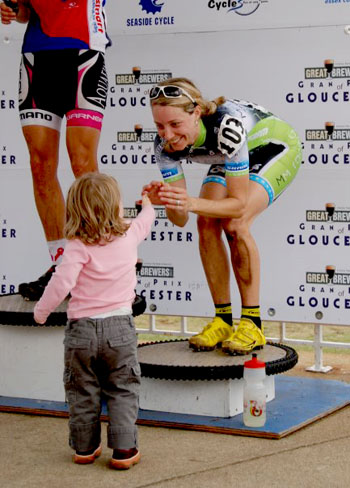
On the East Coast, Mo Bruno-Roy earned victory on Day 2 of the Verge Series’ Green Mountain Cyclo-Cross Weekend. Combined with a pair of second place finishes the previous weekend at the Nittany Lion Cross in Brenigsville, PA and Charm City Cross in Baltimore, MD, Mo has established herself as a consistent podium threat. Her next race will be the Great Brewer’s Gran Prix of Gloucester on October 3-4.
Green Mountain Cyclocross Weekend, Williston, VT UCI Elite Women
Maureen Bruno Roy (USA) MM Racing p/b Seven
Natasha Elliott (USA) Garneau Club Chaussure Ogilvy
Seven Cycles will be displaying two bicycles at the Aldrich Contemporary Art Museum in Ridgefield, CT as part of their Bike Rides: The Exhibition, which begins on Sunday, October 4, 2009 and runs until January 3, 2010. Organized by Aldrich curators Richard Klein and Mónica RamÃrez-Montagut, with the advice of musician, artist, and bicycle advocate David Byrne, the exhibition explores the growing relevance of bicycles in contemporary art and culture.
The Veridian Bike2010 Axiom SL
The two Seven models on display are:
The Viridian Bike, previously known as the Limited Edition Earth Day bike; this model was selected to demonstrate proof of concept that carbon footprint reduction can apply not only to the bicycle rider, but to the manufacturing techniques used to create a sustainable, durable transportation option.
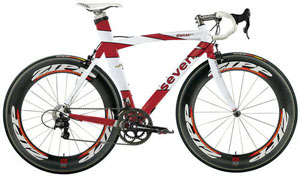
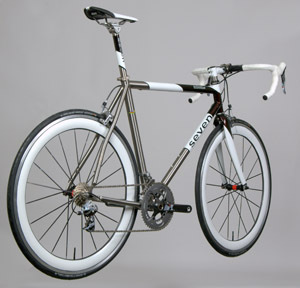
The 2010 Axiom SL; this model was chosen for the exhibit to showcase the aesthetics and broad performance applications of a full titanium road bike. The butted titanium tubeset allows for an unmatched range of ride characteristics, from stable all-day comfort to aggressive, race-tuned responsiveness. The Axiom SL also features a special custom paint scheme on the frameset and wheels.
Of the more than 20 world-class artists and groups taking part in the exhibition, Seven is the only company invited to display bicycles in two different categories. We feel very honored to have this distinction.
Here is an excerpt from the event program:
In the latter context, artist, designer and devoted cyclist Rob Vandermark’s Viridian Bike, a commuter bike from his company Seven Cycles summarizes several of the issues at hand. Having majored in sculpture in college, he left to pursue his two combined passions-”cycling and and building sculpture. Vandermark initiated his career at Merlin Metalworks, a high-end bicycle frame builder and one of the first to work with titanium. Vandermark’s own durable titanium bicycles like this Viridian Bike are completely customized to the specific body measurements and riding habits of each commuter, affording maximum efficiency and performance. For this bike, Vandermark’s efforts have also gone into reducing the carbon footprint in the production and distribution of the bike-”recycling, and, for example, using green materials such as cork for the handle grips. Curiously, the effort to reduce the use of energy during manufacturing has made it necessary in some instances to rely on more time-consuming and labor-intensive handwork, rather than high-end technology.
Fabricators of the Viridian Bike, Massachusetts based Seven Cycles is the largest custom bike manufacturer in the world and is recognized internationally in the cycling industry as one of the most innovative designers in titanium frames. Their bicycles use custom frame geometry and rider-specific tube diameters and wall thickness in order to complement the rider’s weight, riding style, intended use, age, and riding terrain. The use of titanium in bicycles such as the 2010 Axiom SL helps reduce unwanted vibration yet provides an underlying sensory connection to the environment while riding. Titanium is an ultralight, extremely strong, high fatigue endurance, and corrosion-proof metal alloy that is used in the aerospace industry. Many Seven Cycles’ bicycles have been specifically designed for world-class athletes, including Olympians, national champions, and Tour de France winners. And Seven Cycles’ President Rob Vandermark has also designed the first performance wheelchair that incorporates titanium as an integral design element.
The exhibition will include artworks or bikes from Lance Armstrong; Bamboo Bike Studio (Justin Aguinaldo, Sean Murray, and Marty Odin); Guy Ben-Ner; Jonathan Brand; David Byrne; Cai Guo-Qiang; Cannondale Bicycle Corporation; David Gelfman; Subodh Gupta; Bari Kumar; Jarbas Lopes; Miguel Luciano; Mexican Pride (Francisco Javier Ceballos, Rogelio and Braulio Martinez, and Vicente Olivares); PARLEE Cycles; Carolina Pedraza; Puerto Rico Schwinn Club (Martha Clavijo, “El Gallo,- and Orlando Rivera); Richard Sachs; Tom Sachs; Secret School and the K.I.D.S. (Colin McMullan [aka EMCEE C.M.] and Huong Ngo); Seven Cycles; David Sowerby and Danny MacAskill; Studio Tractor (Peter Kirkiles design + fabrication and Studio Tractor Architecture); and Rob Vandermark.
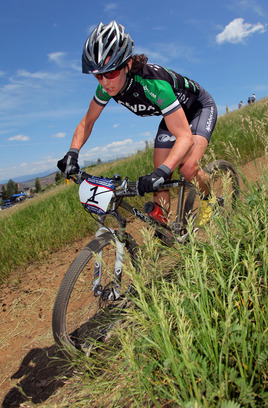
GRANBY, CO – JULY 18: Mary McConneloug of Fairfax, California races to fifth place in the Women’s Pro Cross Country at the US Mountain Bike National Championships at the Sol Vista Bike Park on July 18, 2009 in Granby, Colorado. (Photo by Doug Pensinger/Getty Images)
Two-time Olympian Mary McConneloug, currently the top-ranked U.S. mountain biker, runs her own team with partner Michael Broderick and has no plans of retiring any time soon.
By Peggy Shinn
In early August, USA Cycling’s Pro Mountain Bike Cross-Country Tour (ProXCT) stopped at Mount Snow in southern Vermont, and the top domestic trade teams’ colorful trucks and trailers were parked at the ski resort’s main base area. Under the trailer awnings and team tents, the top American riders mingled. Olympians Jeremy Horgan-Kobelski (Subaru-Gary Fisher), Todd Wells (Specialized), Georgia Gould (LUNA Chix), and Mary McConneloug (Kenda-Seven-NoTubes) were all there.
Except McConneloug’s team rig wasn’t parked with the others. The top-ranked female mountain biker in the U.S., McConneloug and her partner Michael Broderick had parked the Kenda-Seven-NoTubes van and trailer about a mile south of the main venue at Mount Snow’s Carinthia base area, the designated camping spot for this event.
Not because they aren’t welcome by the other teams but because Team Kenda-Seven-NoTubes consists only of McConneloug, 38, and Broderick, 36. Their team rig is a gray Ford van and Tail-Gator trailer that serves as their staging area and their home.
With a full kitchen and bath, large table in the middle, and a bed that descends from the ceiling, the trailer has everything they need and uncluttered, it feels bigger than it looks from the outside. A few pieces of luggage, including a 2008 Olympic team- issued suitcase emblazoned with USA, are scattered in the back.
McConneloug has been approached by the big teams that offer perks such as mechanics, massage therapists, and team managers who handle logistics. But she prefers to go it alone with Broderick, whom she said is “incredible, I wouldn’t be here without him.”
“For me, this is a lifestyle,” she said. “I want to share this with my man. Yeah, it’s more difficult, and I don’t know how much we make compared to anyone else. … But we’re free. We’re able to choose where we want to go and where we want to race. It’s amazing to be in control and not have someone tell me what to do.”
The freedom that she and Broderick have chosen has not only kept her happy and her life more balanced – if incredibly busy – but also has helped her achieve the success that she’s had, including two trips to the Olympic Games and seven World Cup podiums.
McConneloug discovered mountain bike racing relatively late in life. She was 27 in 1997 when her then-boyfriend persuaded her to race. Growing up in Fairfax, Calif., McConneloug had mountain biked for fun but didn’t even know mountain bike racing existed.
She graduated with a degree in vocal performance from Santa Clara University, and perhaps surprisingly, found that studying music was a good rehearsal for mountain bike racing. “I know if I keep practicing something enough, I can get better,” she said.
Although she does not sing regularly anymore, she sometimes speaks melodically and lyrically, and always with passion. “The pedaling, the rhythm, the cadence, the improvisation of getting out there and wondering, ‘What am I going to do here?'” she said, further describing the connection between sport and music.
Once she discovered mountain bike racing, she quickly moved up the ranks, turning pro in 1999. She also met Broderick that same year. Broderick is from Martha’s Vineyard, the island off Cape Cod in Massachusetts, and he was out west racing his mountain bike when friends introduced them.
“The kicker was his truck,” said McConneloug. “He had this Toyota with a homemade cap on the back. Inside was a little single bed, a refrigerator, his camp stove, toaster, espresso maker, surfboard, mountain bike, road bike, and guitar. I was like, this guy is special. He’s totally self-sufficient doing what he loves.”
With Broderick as mechanic and McConneloug as cook, they became their own self-contained team. Seven Cycles became the couple’s primary sponsor in 2002.
“We share the same commitment to authenticity and self-reliance,” said Mattison Crowe, Seven Cycle’s marketing manager, when asked why the company chose to sponsor the duo. “Mike and Mary also happen to be genuinely wonderful people. They way they conduct themselves as ambassadors of our company and the sport are traits we value.”
Kenda Tires and NoTubes.com (tubeless wheel systems) now co-sponsor McConneloug and Broderick along with Seven, but the duo still runs a lean operation, sharing the roles of manager, mechanic, cook, driver, and whatever else needs doing.
McConneloug’s first big victory came at Mount Snow at a national series race in June 2003. By November of that year, she realized that the Olympic Games were within reach.
“We read that there were two positions for [American women mountain bikers at] the Olympics and that I was the second-ranked American,” said McConneloug, who dreamed of going to the Olympic Games ever since watching gymnast Mary Lou Retton win a gold medal in 1984 but never thought someone who picked up a sport at age 27 could pursue it to that level.
Her ranking was based on UCI points. The UCI – Union Cycliste Internationale – is the sports’ governing body and awards points at sanctioned races such as World Cups and national series events. USA Cycling does not have a specific national team and usually appoints riders, who compete during the season for sponsored trade teams, to compete for the U.S. at the Olympic Games and World Championships based on their UCI ranking.
But then the news came in December 2003 that the U.S. would only be allowed to send one woman to the Athens 2004 Olympic Games. According to UCI rules, Olympic berths are awarded to countries based on their national ranking. Countries ranked ninth and lower were awarded only one spot.
The defending overall World Cup champion Alison Dunlap, who had collected most of the UCI points for the U.S. in the previous years, crashed hard in June 2003, separated her shoulder, and sat out the rest of 2003 while recovering from surgery. Without Dunlap collecting points, the U.S. fell to ninth in world ranking (thus giving the U.S. only one spot).
USA Cycling’s Olympic team selection criteria stipulated whichever female rider had the most UCI points collected between July 13, 2003, and July 12, 2004, would be named to the team.
McConneloug started the 2004 season over 150 UCI points behind Sue Haywood. Dunlap, whose shoulder had healed by then, also tried to qualify for the lone U.S. Olympic berth.
But McConneloug had something working in her favor. Without sponsorship commitments to compete in U.S. races, she and Broderick set off for Europe where McConneloug could begin racking up UCI points in early February 2004 – two weeks before Haywood’s first UCI race and five weeks before Dunlap began racing.
McConneloug and Broderick rented an RV in Munich, Germany, and their first stop was the island of Cyprus, where over five weeks, McConneloug earned 160 UCI points. Over the next three months, she competed in nine countries, won 10 races and finished in the top three in three others.
“We would go to these amazing little venues,” McConneloug recalled. “We would look at the UCI calendar, and that was our guide.”
“Mary’s approach to the points chase was brilliant,” said Dunlap in the movie, Off Road to Athens, which depicts the epic struggle these women (and men) undertook in an attempt to make the 2004 U.S. Olympic team.
“It worked very, very well,” Dunlap continued. “I think some of us were maybe a little irritated that she wasn’t racing in the U.S., that she wasn’t doing the national series. But the goal is the Olympic team, and I give her a lot of credit for figuring out what it was going to take to get on that team.”
Although Dunlap was never able to make up the points she missed in 2003 (according to USA Cycling calculations, she was still over 400 points behind by mid-May), McConneloug and Haywood went back-and-forth in the rankings.
In the thick of it, though, the women remained friends. It’s difficult to imagine McConneloug anything but friendly. Even near the end of a six-plus-hour suffer-fest called the 2004 Marathon World Championships – the very last chance she had of earning UCI points before the deadline – she encouraged another rider who struggled toward the finish.
Due to a clerical error and other misunderstandings, the final Olympic selection decision went to arbitration and then to court. In the end, McConneloug was awarded the Olympic berth, but she says the whole process was “sticky and horrible.”
On Aug. 27, 2004, she finished ninth in Athens – a result she remains proud of today.
Qualifying for the 2008 Olympic team was more straightforward but no less difficult. Thanks to several top-five World Cup finishes during 2007, McConneloug and Georgia Gould, along with an increasingly strong contingent of U.S. women including Willow Koerber and Heather Irmiger, kept the U.S. highly enough ranked in the UCI standings that two American women would qualify for the Beijing 2008 Olympic Games.
Still, McConneloug felt the pressure. “Anything can happen. You could get injured and then the next person goes. It’s a lot of pressure to commit to it and know that every single pedal stroke counts.”
Once in Beijing, she was awed by the country and the course. “When I saw [the course], I was like, ‘Oh my gosh, it looks like the back of a dragon! Up and down, all around, twisting, and red dirt, and humidity heavy down upon you. Race day was so hot. You felt so alive and in the muck of it all.”
After a bad start, McConneloug fought her way from 20th to finish seventh. Gould was eighth.
A week after the 2008 Olympic race, McConneloug finished fifth in a World Cup in Australia. During the 2009 World Cup series, she has taken two more fifths.
Recently, though, she noted that the level of competition at World Cups has increased immensely in the women’s field and that making even the top 20 is hard.
“You can’t even slip a pedal stroke and not expect to get passed,” she said. “It’s intense. It’s changed.”
What does it take to consistently finish in the top five in such a heated atmosphere?
“You have to have an incredible support system, not having to worry about anything else but your training and lining up and racing,” she said.
“But for me, that’s not real,” she added. “Keeping it real is how I am and how I’m always going to be. It’s not about winning races. It’s about your journey and how you’re doing it and maybe the people you touch along the way. It’s not just about getting the gold medal.”
When asked if she will try for the London 2012 Olympic Games – when she will be 41 – she smiled.
“Maybe so, we’ll see how it is,” she said. “I take it year by year at this point. Right now, I’m definitely working toward country ranking so we can get maximum positions [at the 2012 Olympics].”
As of January 2009, the U.S. women were ranked third in UCI standings – enough for two Olympic berths in 2012 (assuming the UCI keeps the same qualification criteria as it used in 2008).
In the meantime, McConneloug and Broderick continue their journey. From Mount Snow, they pointed the van west toward Windham Mountain in New York for another ProXCT race. Then it’s off to Australia for the 2009 World Mountain Biking Championships in early September. From there, they fly to Europe for the final two World Cups. Then they fly to Las Vegas for the Interbike trade show.
After that, McConneloug isn’t sure where they will go. Perhaps Chile, where they spent the early part of 2008. Or back to northern California, where they wintered in 2009.
As McConneloug said when asked if she has plans to retire: “Life, you can’t really plan it sometimes. You just have to be open to things that come your way.”