
3 Current Carbon Designs Sacrifice Handling & Control, Leading to More Crashes
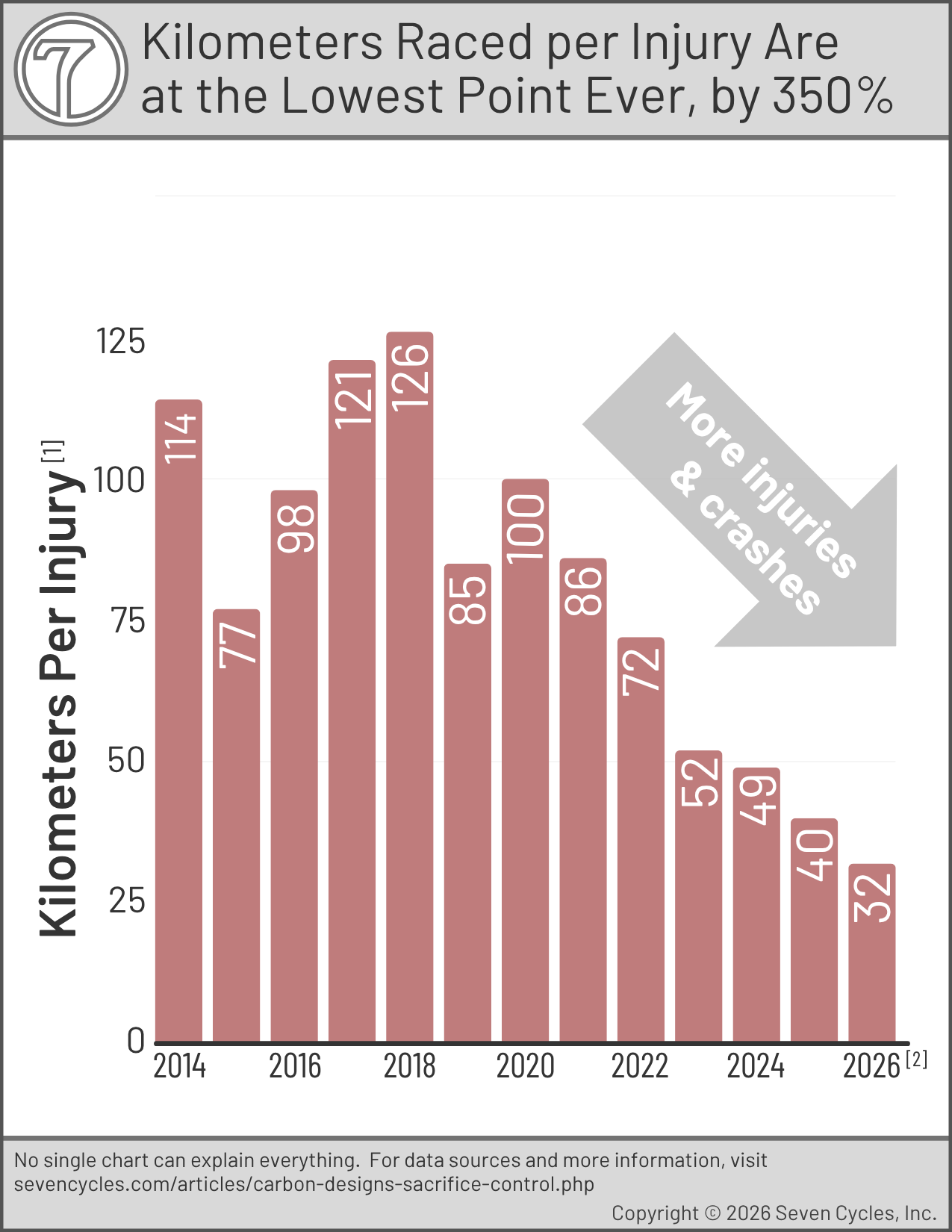
The latest aero bike designs, mated with this year's aero rider position trends, increase the likelihood of crashing by more than 350%.
Over the past decade, the road pro peloton has had ever more trouble staying upright. The data is clear; the question is why. (Read Seven's article about injury statistics.) The numbers in Figure 1 map out the decline in kilometers per injury over the past ten years. The falloff is alarming.
Racing Is Significantly Safer Than A Decade Ago
Contrary to the injury statistics, it would be difficult to argue that racing has become inherently more dangerous over the past decade. Figure 2 shows 18 factors that have made racing measurably safer during that time.
How Can Racing Be Safer And More Dangerous?
At odds with all the safety improvements are a short list of factors that have resulted in more dangerous racing. Before the 2020 pandemic, the big three rider position safety concerns — the supertuck, puppy paws, and super narrow bars — had all been banned (see Figure 2), so they're not relevant. However, people still bring them up and think those issues were more recent. We next list seven recent factors that make racing more dangerous, but it's also difficult to defend that, together, they add up to more than a few percent of the current trend. The remaining six factors that negatively impact safety are all bike design and rider fit changes.
While there are dozens of reasons crashes have been increasing, the bike industry's drive toward aero aesthetics and aero rider position are the primary causes of collisions. Figure 2 illustrates recent bike design trends that have led to an increase in collisions.
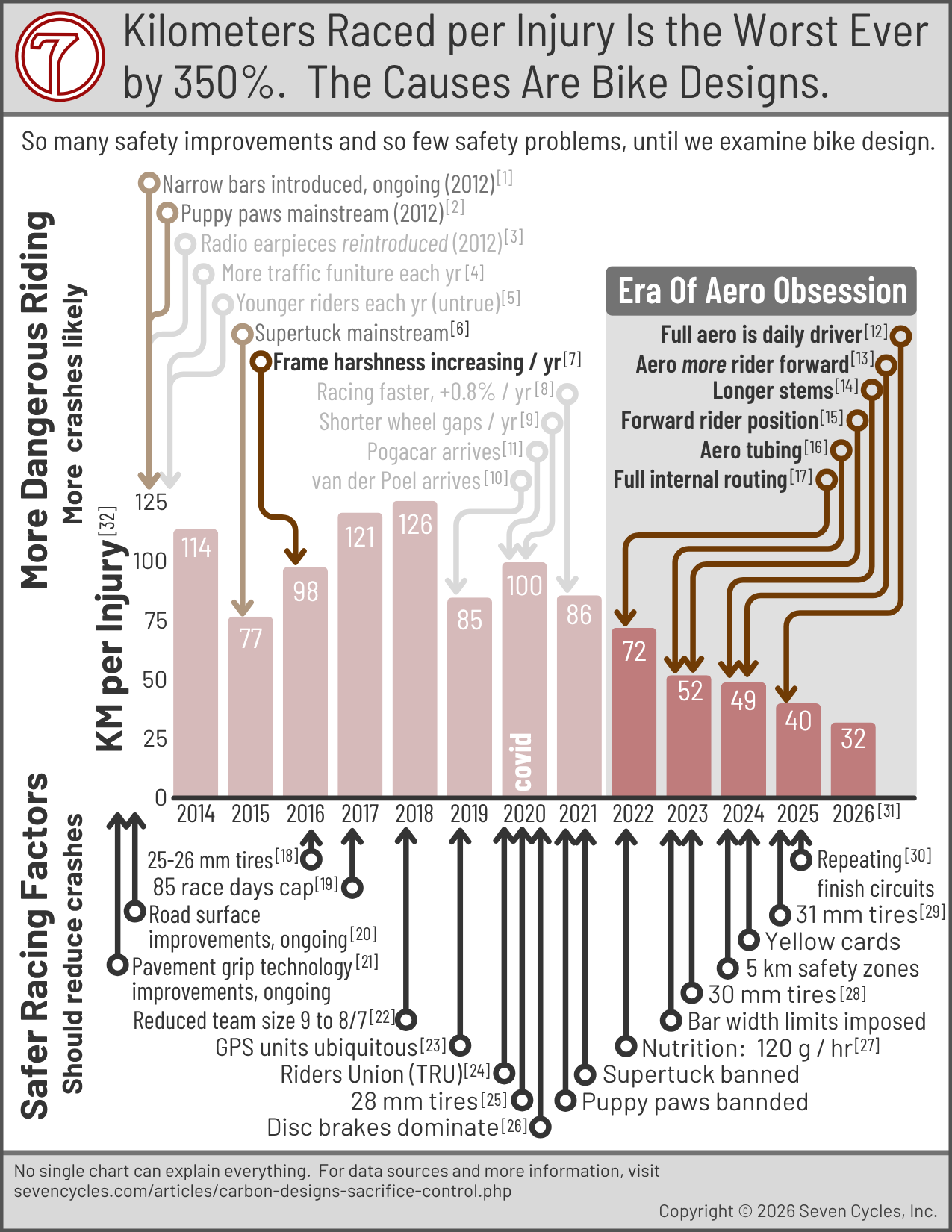
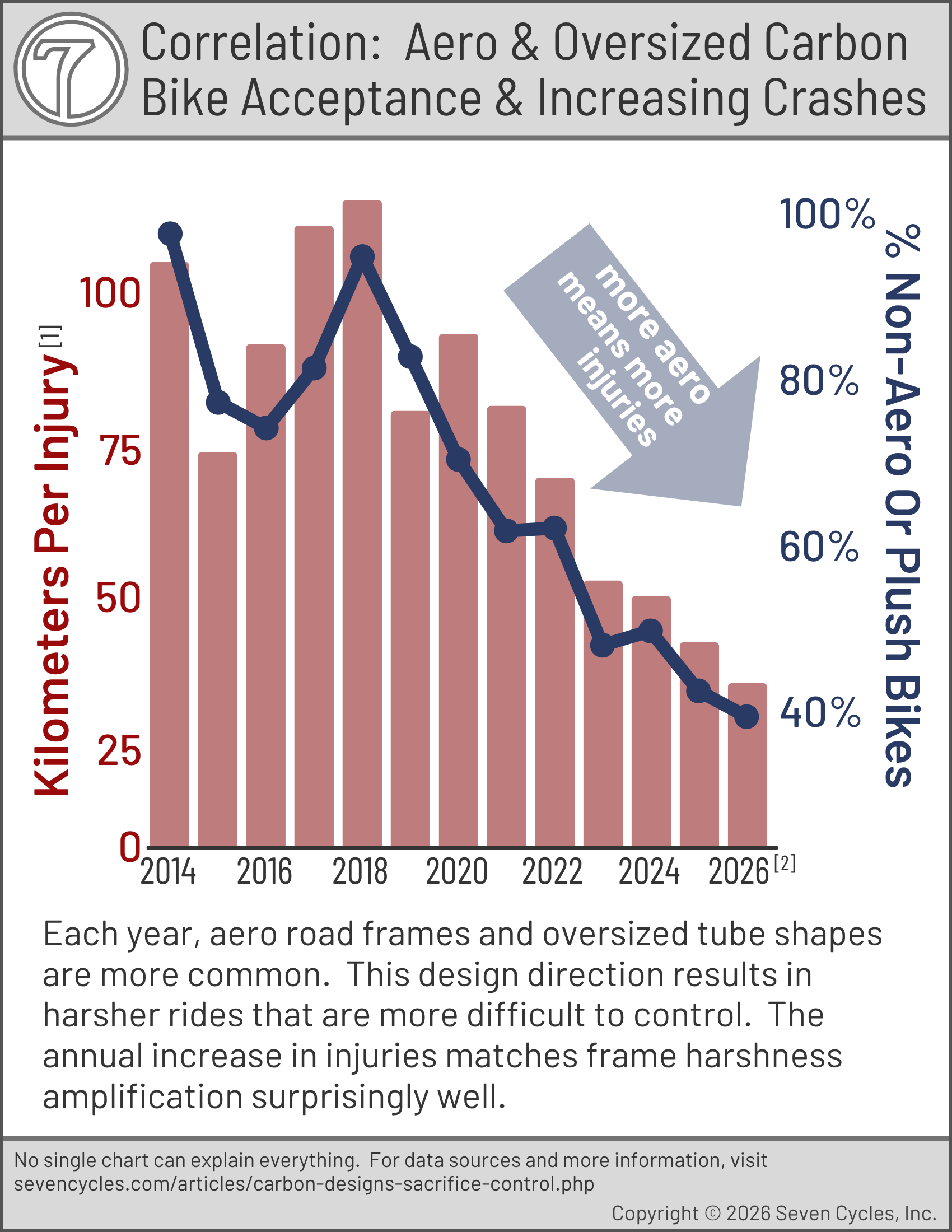
Figure 3 shows the popularity of aero-style bikes in relation to mounting crashes. They track almost perfectly. Correlation is not necessarily causation, but the parity is compelling.
Handle The Truth
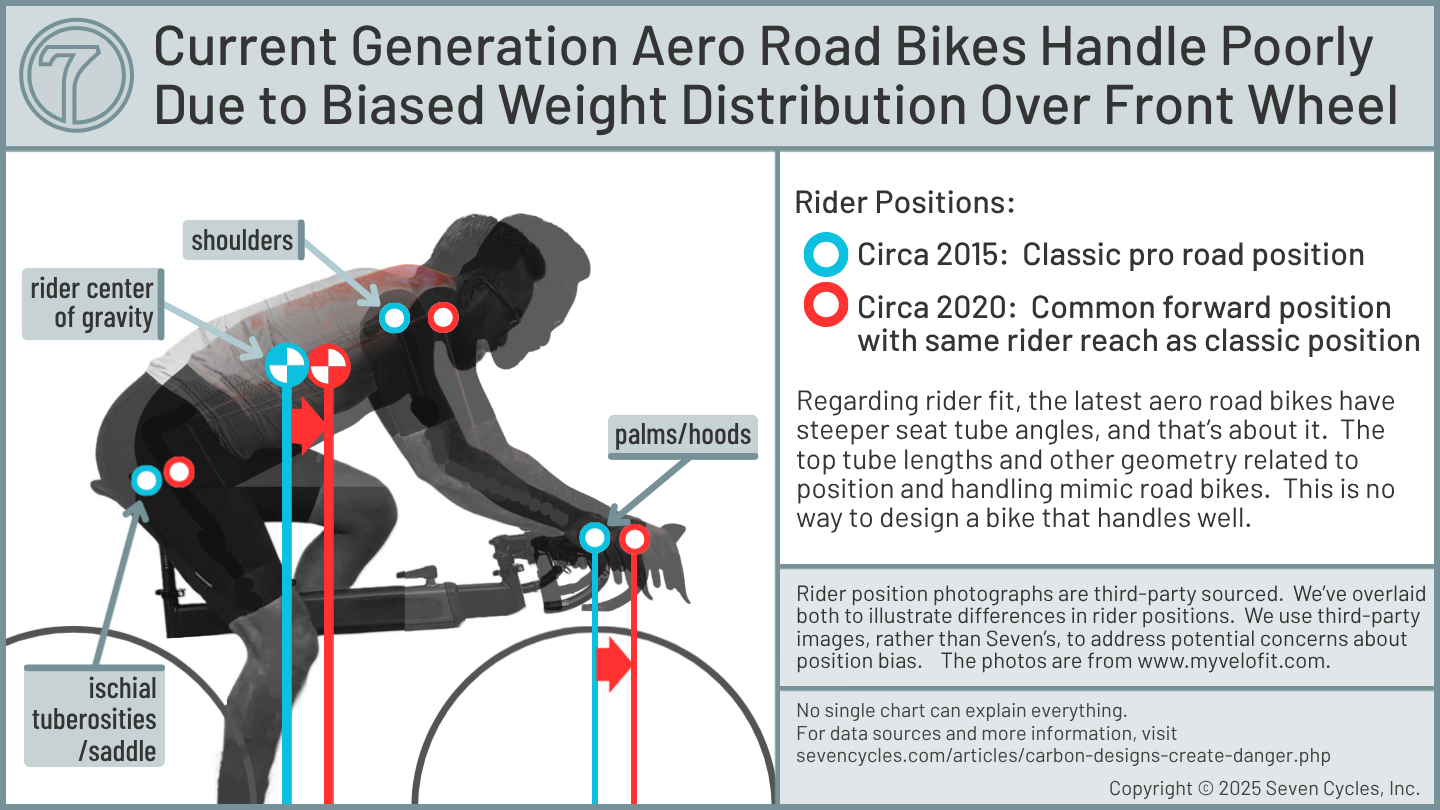
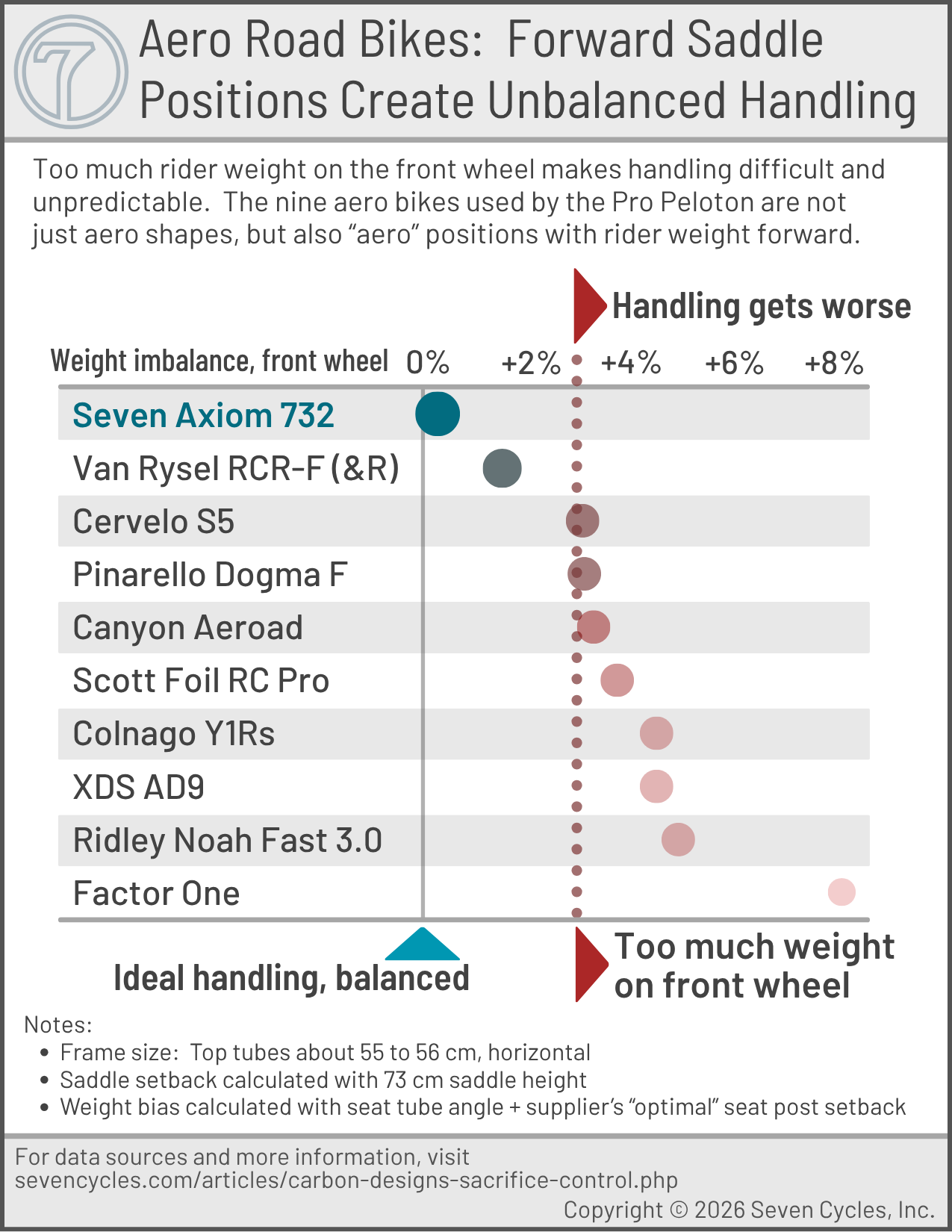
The first handling difficulty of this aero-everything world is having too much weight over the front wheel. Figure 4 illustrates a rider's forward position compared to a contemporary race position. This forward center of gravity causes multiple problems. As Figure 5 shows, with anywhere between 4% and 10% more weight on the front end, steering becomes heavy, sluggish, and unpredictable. Additionally, with the racer's weight biased forward, during moments at the edges of control, the rider is much more likely to lose tire grip or go over the bars.
In situations that require focus, riders intuitively slide back in the saddle to unweight the front wheel. This rearward shift is the opposite of current aero fit trends. But pros want to get back from the front end because biasing the weight rearward affords lighter, more precise handling. Additionally, the rider is less likely to go over the bars in situations at the edges of their capabilities.
The "modern" rider position with a forward weight shift is no way to optimize bike control and safety. Sure, in a wind tunnel, the rider is more aero, but weight distribution is neither measured nor relevant when the bike is bolted to the tunnel deck.
Similar to the forward rider position, handling hell is exacerbated by modern narrow handlebars. This hand position results in less leverage to control the bike. Next, the popularity of longer stems also results in poor control; it's like steering a wheelbarrow. If the bike's geometry isn't designed for it, the handling degrades yet again.
While each of these issues may be small on their own, at 50 mph, small things happen very fast. When stacked together (forward position, longer stem, and narrower bars), problems arise at all speeds.
Don't Take Our Word For It
Some racers and media outlets are beginning to discuss this handling issue.
Oliver Bridgewood of GCN, during a conversation about the problems with aero road bikes, recently said:
"Having a bit more weight distribution further back over the bike, it does make the bike feel and handle better compared to [the aero position]."
Read Seven's full article about GCN's take and all information sources.
Matt Phillips of Bicycling Magazine recently wrote of current carbon race bikes:
"Steering a bike [in the modern racing] position can be challenging. Riding in a group on race bikes is stressful [because the handling is so temperamental]."
Read Seven's full article about Phillips' experience and all information sources.
Of course, not everyone rides in this forward position. Unfortunately, even with a standard race fit, current carbon bike trends introduce safety concerns.
Harsh. Reality.
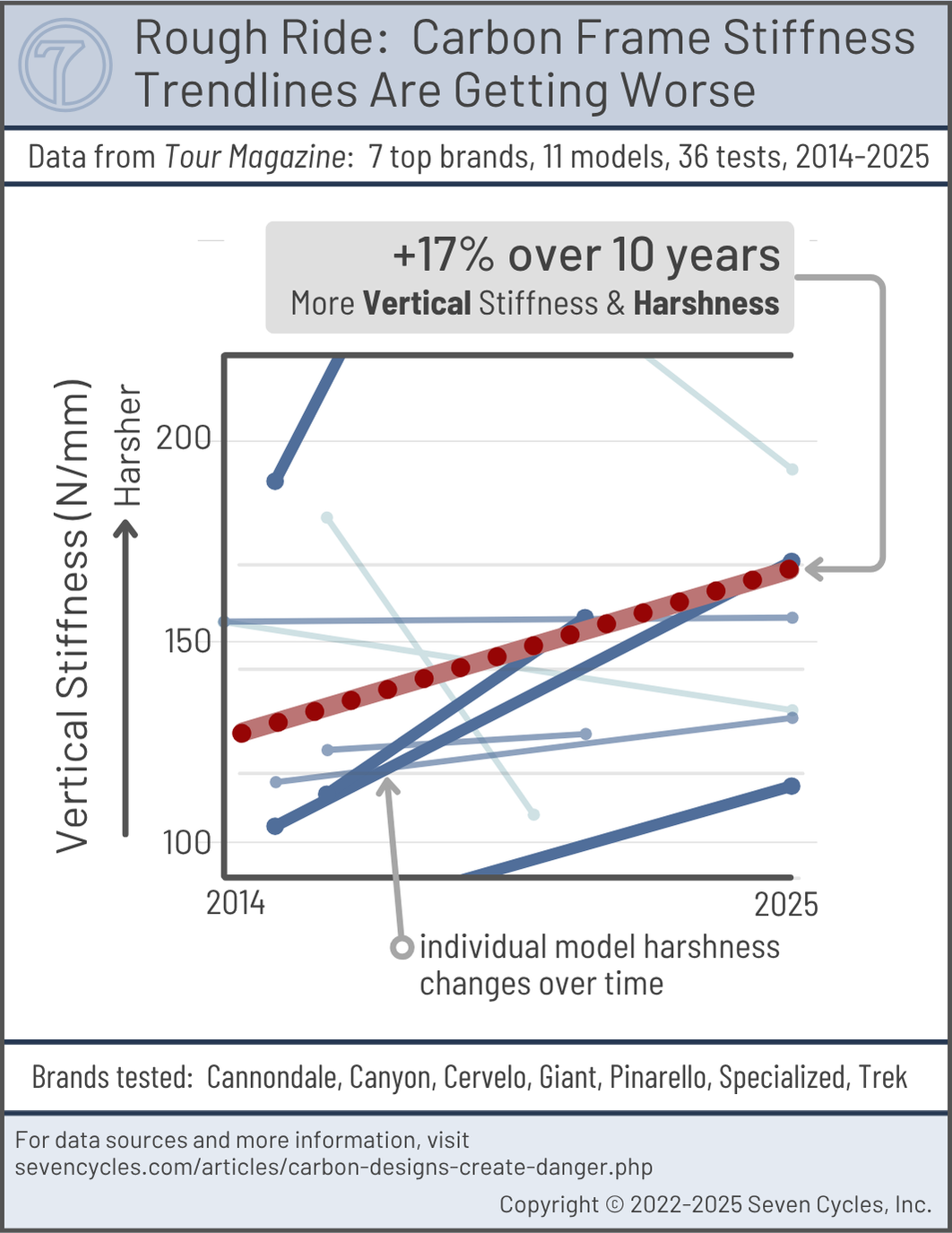
The current generation of carbon bikes, whether aero designs or more typical "lightweight" race constructions, ride significantly harsher than they did a decade ago. Figure 6 illustrates the rough ride problem. It creates a negative feedback loop that can present as numb hands, back pain, hot foot, and other symptoms. Even without physical indicators of detrimental vibration or bracing, the bike's handling suffers significantly.
The rough feel and accentuated vibration create sensory deprivation at the rider's contact points: hands, rear end, and feet. This falloff of subtle surface feedback from the tires results in muted control and slower reaction time.
Past Tense
Equally problematic, the rider's constant bracing, whether knowingly or subconsciously, to protect from the bike's harsh ride, creates a tense, rigid body position. This tension inhibits supple bike-to-body communication and control.
Rough Riders
Longtime pro peloton racer Damien Touzé had a life-threatening in-race crash in 2026. He talked about the cause of the crash in a podcast. Touzé expressed his frustration with the rough ride that results in poor control of modern bikes:
"The bike is now 100% rigid. The slightest shock you take from the wheel is amplified by 100 times to the rider. So what's for sure is you can't rectify a [steering] mistake on the bike."
Read Seven's full article about Touzé's thoughts and all information sources.
Matt Phillips of Bicycling Magazine recently wrote of current carbon race bikes:
"[A non-aero bike may be] slower on flat, perfectly smooth roads, [but] the moment bumps, debris, or cracks enter the picture, [the non-aero bike] starts making up that disadvantage. Quickly. Gaining a bit of efficiency on the smoothest roads [...] isn't worth the tradeoffs."
Read Seven's deeper dive article about Phillips' experience.
"Water Can Flow, Or It Can Crash" — Bruce Lee
Tracking
Tracking means the tires stay connected to the pavement through frame compliance (not tire pressure or tire deformation), generally in the vertical and torsional planes (up and down and cornering). A bike with good tracking should allow the wheels to undulate vertically over road imperfections, and at an angle during aggressive turning, thereby maintaining contact with the ground. Good tracking is maximized through a combination of vertical flow (compliance) and a small amount of torsional flex in the bike's front end. This combination enables the wheels to move in three dimensions while remaining in contact with the ground. As bikes get stiffer every year, their tracking capabilities diminish. As tracking gets worse, bike control and handling become more difficult. The result is an increase in crashes.
Traction
Traction is the tires' ability to maintain grip with the road, primarily in the lateral plane (side-to-side).
If a bike is stiff vertically, and the latest generation of carbon bikes are more than ever (See Figure 6), the result is both poor tracking and inconsistent traction. There is no way to ignore these problems as key causes of the increase in crashes.
Bike Control Dynamics Outperform Aerodynamics
Seven's hypothesis for the primary cause of the recent increase in crashes and injuries is twofold. First, modern carbon aero bikes have larger tube shapes in the vertical plane. This causes a noticeably harsher ride, ultimately leading to more difficult bike control and reduced certainty of tire contact patch-to-ground. Second, aero rider positions place the rider farther over the front wheel, creating an imbalance that degrades handling, control, and confidence, thereby increasing the risk of crashes.
Solutions Seven
Bike designers need to prioritize vibration damping first, then the rider's center of gravity. Seven's design philosophy excels at these priorities. We accomplish this through our application of proprietary titanium, along with four decades of engineering experience (vibration damping) and the successful fitting of 30,000 riders, with a priority on rider center of gravity and overall handling rather than misguided excursions into marginal aero gains that are only viable in wind tunnels. Read Seven's article Aerodynamic Gains In Wind Tunnels for proof.
Aero Solutions
If you want to get more aero while opening your hip angle, ride shorter cranks. Separately, move your saddle forward, but do not extend the front end; bring your hand position back and your bar up. Done correctly, these changes not only maintain your weight balance but also improve the aerodynamics of your forearms.
Seven's Calculation Methodology
Kilometers per crash is calculated by dividing the total kilometers raced by the total number of injuries. Total kilometers raced is determined by averaging the number of km raced by five UCI-ranked riders each season (ranked 10, 25, 50, 100, and 200 by PCS points) and dividing by five.
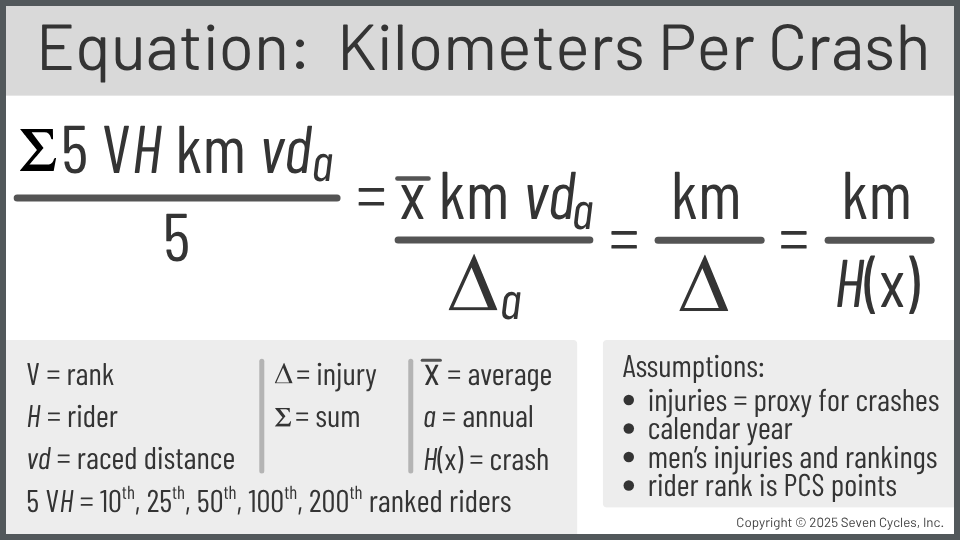
Injury statistics are sourced from UCI reports and athlete disclosures. Seven calculates the 350% increase in injuries by comparing the kilometers raced per injury in 2014 to the projected kilometers per injury in 2026. The first year of publicly available injury data was 2014.
We calculate crashes by equating each single injury report to a single crash. We use injuries as a proxy for crashes because there is no publicly available data on crash statistics. Even though not every injury is the result of an in-race collision, the ratio of in-race and out-of-race injuries is surprisingly consistent year after year. Meaning, if 95% of injuries were attributed to race collisions in 2014, that percentage remains consistent each year. We don't factor in that percentage because the layer of detail doesn't improve accuracy, but does add to confusion. Lastly, where does one draw the data line? For example, we include injuries that occur during training because they generally have the same underlying cause as in-race injuries. Additionally, each special case has minimal impact on the overall analysis.
Footnotes for Figure 1: Kilometers Raced Per Injury Are At The Lowest Point Ever, By 350%
- Kilometers per injury: Calculation details.
- 2026: km per injury projection based on the first four months of the year. This timeframe is an accurate proxy for annual kilometers and injuries.
Footnotes for Figure 2:
- Narrower bars were banned in 2022 so this is unlikely to be a factor in the recent increase of injuries.
- The puppy paws rider position was banned in 2021.
- Radio earpieces: This is a common trope for increasing crashes. The idea being that having someone speaking or screaming in your ear is distracting. That is probably true. If so, where is the injury data? Race radios had been used since the 1990s. They were later banned and then reintroduced in 2012. Additionally, for each dangerous situation that earpieces might cause, there are probably equal times when the Director Sportif's words increase safety, explaining what dangers are ahead, that there's a crash ahead, upcoming weather conditions, to eat and drink more, etc.
- The amount of traffic furniture increases each year, but the number of crashes due to it increases by only about 1% each year. (Read Seven's article Road Furniture and Crashes for details.)
- Younger riders each year is a trope that some use to explain more crashes. Younger means less experience and more likely to be out of control. However, the Average age of riders has gotten only 2.6% younger over the past decade or three decades.
- The supertuck rider position became mainstream in 2015 and was banned in 2021. That span of time actually saw crashes decline, whereas the current seven years are the inexplicable problem.
- The increasing harshness of frames is an ongoing factor. A harsher ride reduces wheel traction and tracking ability. This is a bike design issue.
- Faster racing: Average annual speed increase over the past decade was 0.6%.
- Shorter wheel gaps between riders have been getting smaller each year.
- Mathieu van der Poel arrives: He was probably the first superstar of this generation. His previously impossible sustained power tactics changed race strategies and increased average speeds. Regardless, whatever portion of the 0.6% annual speed increase that belongs to van der Poel's rewriting of racecraft does not connect in any meaningful way to the 300% increase in injuries.
- Tadej Pogačar arrives: He fundamentally changed the tactics of road racing. The correlation between his rise and the increase in average speed is not coincidental. Regardless, the annual 0.6% speed increase since his arrival does not connect in any meaningful way to the 300% increase in injuries.
- Full aero is many riders' daily driver. Many sources agree that this new generation of aero-optimized bikes is a serious cause of crashes for at least two reasons: 1) forward rider position, and 2) harsher ride due to the evolution of aero tube shapes.
- The aero rider position is becoming standard. The puts rider weight bias over the front wheel. This is a bike design issue.
- Longer stems are popular for many reasons. The result of this longer stem style is rider weight bias over the front wheel. This is a bike design issue.
- The forward rider position gains traction in the peloton, beginning the trend of rider weight bias over the front wheel. This is a bike design issue.
- Aero tube shapes are becoming more and more popular. This makes bikes ride harsher, worsening handling and traction. This is a bike design issue.
- Full internal routing, depending on the design and generation, can add drag to the steering system, making steering more unpredictable and masking road feedback. This is a bike design issue.
- 25 to 26 mm tires from 23 mm tires. This increased the tire contact patch, thereby improving handling and control.
- 85 race day cap: Fewer races mean about 10% fewer total kilometers raced and less rider fatigue, thereby improving rider safety.
- Road surfaces improve every year. Road preparation, repaving, and pre-race cleanup all improve each season.
- Pavement grip technology improvements, ongoing. The EU has invested significant funds in tire grip technology.
- Reduced team size: Fewer racers vying for space means fewer crashes each.
- GPS units are ubiquitous: some pundits say that bike computers are a distraction and therefore cause more crashes. This could be true, but given that GPS units show upcoming corners so riders can plan their line is a significant safety improvement. Crashes in corners on descents may be the most common crash type.
- Riders Union (TRU) should make races and riders safer. The TRU certainly can't make racing more dangerous.
- 28 mm tires from 26 mm tires. That increased the tire contact patch again, thereby improving handling and control.
- Disc brakes dominate: Some pundits argue that disc brakes make racing more dangerous. Maybe for someone who doesn't ride five hours a day, every day, but pro road racers gain safety benefits from disc brakes. Certainly, discs don't cause more crashes than they prevent.
- Nutrition of 120 grams per hour means riders are not bonking. Being well-fueled should improve rider safety.
- 30 mm tires from 28 mm tires. That increased the tire contact patch again, thereby improving handling and control.
- 31 mm tires from 30 mm tires. 31 mm tires are the legal limit set by the UCI. Regardless, going from 30 to 31 mm improves traction and tracking, thereby making racers safer.
- Repeating finish circuits: More races are designing routes that have racers cross the finish area more than once. This provides racers with knowledge that reduces finish-zone crashes.
- The 2026 injury number is extrapolated from the first 4 months of the year.
- Kilometers per injury: Calculation details.
Footnotes for Figure 3: Correlation: Aero Bike Acceptance & Increasing Crashes
- Kilometers per injury: Calculation details.
- The 2026: km per injury projection is based on the first four months of the year. This timeframe is an accurate proxy for annual kilometers and injuries.
Footnotes for Figure 4: Current generation aero road bikes handle poorly due to biased weight distribution over the front wheel
Rider position photographs are sourced from a third-party. We've heavily processed and overlaid both images to illustrate differences in rider position. We use third party images, rather than Seven's, to address potential concerns about Seven's position bias. The photos are from My Velo Fit.