
skip to content
Current Lead Times: Rider-Ready Framesets: 4 weeks. Full Custom Bikes: 7 weeks.

Building Your Titanium and Carbon-Titanium Bikes in the USA for 29 Years

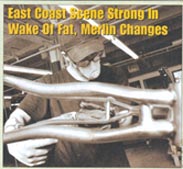
Bicycle Retailer and Industry News: East Coast Scene Strong in Wake of Fat, Merlin Changes

by Adam Vincent

East Coast Scene Strong in Wake of Fat, Merlin Chnages
Seven Cycles is one of the East Coast companies that contributes to half of all high-end sales in the United States

BOSTON, MA For nearly twenty years, New England’s bike makers have been building on what Chris Chance started at Fat City Cycles.

But even though Fat City is now gone and Merlin has moved, the region shows no sign of decline as a major hub of bike making and cycling culture. Fat City loomed large over the New England scene from the mid-1980’s to the mid-1990’s, creating bikes and an attitude behind them that would help make mountain biking what it is today.

“If there is a defining moment for local frame building, it’s Chris making the first mountain bikes on the East Coast. It sparked creativity that we haven’t seen in a long time,” said Rob Vandermark, president of Seven Cycles.

That creativity bore some of the first high-end steel mountain bikes and the first titanium mountain bike frames. Fat City employees would later found titanium builder Merlin. Ultimately, no fewer than 17 bike and component builders emerged from Fat City. “There is an entrepreneurial spirit there. If no one from Fat City went on to do their own thing, the bike business would be very boring.” said Jeff Pedersen, Specialty Racing Products president and a former Fat City employee.

The Boston Globe estimated last year that Boston’s bike and component makers accounted for nearly half of U.S. sales in the high-end market. More than 100 years before Fat City existed, New England and particularly Boston were creating cycling in America. The first U.S. bikes were made near Boston in the mid-1800’s.

“There’s a lot of heritage here, deeper probably than anywhere else,” said Richard Fries, publisher of The Ride, an East Coast cycling magazine. In more modern times the region’s manufacturing base and large pool of intellectual talent-”Boston alone has more than 40 universities-”has helped. “I think there is a strong culture here because the kind of town Boston is and its manufacturing base makes it the scene. You don’t see that in the west coast,” Vandermark said.

When Chance sold Fat City in 1994, others stepped up to prove how strong the bike building culture was there.

It was then that Independent Fabrication was created in Somerville, Massachusetts, a Boston suburb. A dozen former Fat City employees, without jobs after the sale, formed their own company, which quickly became a player in the high-end frame business. Independent took over where Fat City left off, capitalizing on the niche for handcrafted, unique bikes.

“People don’t look at our bikes as just steel bikes. They are buying more into it. They are trying to say something about themselves,” said Steve Elmes, Independent’s vice president of sales and marketing. The East Coast heritage helped too, Elmes admitted.

Though Seven doesn’t label itself as an East Coast company, its roots are undeniable. President Rob Vandermark designed bikes for Merlin for 10 years before starting Seven with other Merlin employees in 1997. Today the company is one of the largest custom builders in the country.

Meanwhile, Merlin moved to Tennessee in July under new owners, JHK Investments. The JHK official said they intend to make a few changes to the brand and its design philosophy. Merlin’s former neighbors, however said they are sad to see the company leave their neck of the woods.

But as companies like Fat City fade away, newer companies-”such as frame and paint shop Vicious Cycles-”step up.

“With these companies leaving, it will just create a new crop of companies. It happened when Fat left in 1994 and it will probably happen again,” Seven’s Vandermark said.
Voice of America: Bicycle Entrepreneur

by Larry Freund

Although bicycles are a big business in the United States, with annual retail sales of more than five-billion dollars, U.S. bicycle manufacturing has been declining. But a small company near Boston, Massachusetts, is reversing that trend, and perhaps pointing the way to the future of manufacturing. Correspondent Larry Freund reports from New York.

Freund: An old garment factory in Watertown, Massachusetts, is the home now of Seven Cycles Incorporated, a company founded by entrepreneur Rob Vandermark in 1997, when he was 29. His concept was simple: building custom-made bicycle frames from lightweight titanium rods, using a manufacturing technique called single piece flow.

Vandermark: It is the idea of making what the customer needs in the quantity that they need it at the time that they need it. And for Seven, that is when a customer calls. They are almost invariably ordering one bike at a time, so we can only make one at a time. So that the piece—in this case it is a bike frame—one piece or one frame flows through the system at a time. So rather than somebody working on a thousand parts in a machining process, they will work on one part until it is complete and then start on the next part.

Freund: Mr. Vandermark says people in the industry thought it was a big mistake to start his company, with so many of the bicycles now sold in the United States imported from such countries as China. But Internet commerce specialist Evan Schwartz says Seven Cycles may be a model for future industry.

Schwartz: This is really an overturn of mass production, which started with the industrial revolution over 200 years ago. And it used to be that you would make the product and then sell the product. Now, on the Web, the customers construct their own personalized product. They pay for it and then you, as the manufacturer, produce it. This company called Seven Cycles started taking orders from people over the phone and getting their measurements and the type of terrain they ride on, producing a custom frame and mailing it out to the customer [retailer]. And this has led to them being the biggest custom bike builder in the U.S.

Freund: The manufacturing process at Seven Cycles is described by Business Week magazine editor Joyce Barnathan as mass customization.

Barnathan: There is a lot less waste if you know exactly what your consumer wants and you provide it. And you do not have to carry the inventory. And in fact, in some cases you do not even have to have capital, because the consumer will pay up front (in advance) exactly for the product that he or she wants at the moment.

Freund: For the Seven Cycles company, the manufacturing formula has meant success. Founder Rob Vandermark says the firm expects to produce 16-hundred bicycle frames by the end of this year and is expanding into related component parts.

Vandermark: Each year, we have exceeded our projections on almost every front: for revenue and profit and units shipped and labor-hours per frame. It could not have been going better. The bike industry is a very competitive industry. There are a lot of small, one-man builders that do it because they love it. So it is a very passionate industry. And it is always difficult to make a living in a passionate industry.

Freund: The bicycle maker maintains a network of retailers and distributors in Europe and Asia, and hopes to double the proportion of its sales outside the United States from 15 percent to 30 percent.

Business Week Online: Why Seven Cycles Is Racing Ahead: The Net

America’s No. 1 Custom-Bike Frame Maker Uses Its Web Site to Personalize Service, Speed Production, and Reach More Cyclists With Just a Small Staff

by Valigra

Former bicycle racer Rob Vandermark, 32, figures he has won the race to bring an old-style, low-tech business into the Information Age. In the two years since co-founding Seven Cycles Inc. (www.sevencycles.com), Vandermark’s company — so named because seven is a lucky number in many cultures — has sped to first place among the 250 or so custom bicycle-frame builders in the U.S. The Internet, he says, has been the key.

How so? Labor-intensive, mom-and-pop shops still dominate the custom bike market, and people seeking state-of-the-art frames often have a tough time finding craftsmen to make exactly what they want. But thanks to the Net, that has become a lot easier. Seven uses its Web site to let customers get deeply involved in the frame-building process, enabling them to design their own high-end bike frames and track their development all the way through the process. And the Web lets Vandermark reach — and service — more customers than rivals can, and with more of a personal touch than ever before. Mom-and-pop shops are able to make only 20 to 30 frames a year. Seven makes 1,000 frames annually.

Key Database

Here’s how it works: Seven’s frames are sold through a network of 125 dealers in the U.S. and distributors in 15 other countries. Dealers help fill in Seven’s four-page questionnaire asking for 50 or so details of the customer’s size and riding habits. That information is fed into a spreadsheet, and Vandermark uses the specifications to design the custom bike. The specs also are kept in a database, making it easier to develop future bicycles. “This database is part of what has allowed us to build custom bikes with such a small staff,” Vandermark says.

Before a single tube is cut for a bike, Vandermark and co-founder Matt O’Keefe call each customer and review their order, within 24 hours of receiving it. It then takes about 28 hours to build the frame. It can take six weeks or more to get the bike, partly because of Seven’s order backlog and partly because of customs delays on international deliveries.

One customer checked the status of his bike up to six times a day on Seven’s “Where’s My Frame” page.

What makes someone pay $6,000 for a bike they will not get to road-test first? Web-driven personalization can make all the difference, Seven dealers and customers say. Just ask Mike Tierney, 51, a Canadian fireman and cyclist who rides more than 100 miles a week. Tierney took to the Net to search for his dream bike, one that is high-performance, light, and custom-built to his own measurements and riding habits. He settled on Seven’s “Sola” — a $2,500 titanium frame. After buying the frame, Tierney had to add another $2,500 worth of hand-picked components such as hubs, spokes, and handlebars to complete the bike.

The cost was offset, though, by the attention Tierney got from Vandermark and his 19 employees. Tierney corresponded regularly by E-mail with Vandermark about his frame as it was being built. Tierney also checked — up to six times a day — on Seven’s “Where’s My Frame?” Web page, where customers can track the status of their bike as it goes through production, find out what’s being done with it in each phase, and learn who’s working on it. Tierney was so pleased with his finished Seven that he posted a photograph of it on his personal Web site.

Expert Hand-Holding

He’s not the only one high on the customization. Many of Seven’s customers have sent Vandermark disposable cameras to get a picture of their frame as it goes through each production step. And some customers are so keen to get their bike that they show up, in person, at Seven’s Watertown (Mass.) factory — a World War II-era structure formerly occupied by the Goddess Bra Co., which made 52 styles of bras. Seven’s bike frames come in 200 sizes or can be customized at no extra charge.

Letting customers tune in throughout the process is the kind of hand-holding that can come with Net service, Vandermark says. That isn’t lost on Seven’s dealers. “When the customer sends an E-mail, they get an answer from the bike’s designer. If you go to other major bike makers’ sites, all you get is some high-school kid reading out of a catalog,” says Scott Fader, a sales executive at Belmont Wheel Works, Seven’s largest dealer. The Boston-area bike shop sells more than 60,000 bikes a year, 100 of them Sevens.

Customers can reaffirm their decisions at each visit, and that helps Seven dealers sell more frames.

Seven’s Web site is one of its big selling points. Bill Revard, a Seven dealer at the Bike Line Inc. shop in Indianapolis, says Seven’s site is set up so customers can reaffirm their decision every time they log onto it, and that has helped him sell more Seven frames. The site gets more than 7,000 hits a day and more than 200 E-mail messages a week, which are answered within 24 hours by Vandermark, O’Keefe, and other Seven staff. The site also includes photographs of Seven’s staff and bike models, plus technical articles and reviews comparing Seven bikes with the competition’s. Says Vandermark: “Part of our success is that we are tied to a business model that includes the Internet.”

So far, so good. Last year, revenues hit $1.27 million, and the company posted $50,600 in profits — an uptick that came earlier than expected. With revenues expected to reach $1.9 million this year, Vandermark turned down a second round of venture financing.

But how much can the bike-frame maker grow and still stay No. 1 in personalization? “Our business can only get so large, and not larger,” says Vandermark. But he’s not worried about it, and neither are dealers like Fader of Belmont Wheel Works. “What’s special about Seven is the way everyone works together,” he says. For Vandermark, seven is proving to be a lucky number.

Bicycle Retailer and Industry News: Manufacturing Space Increases Sevenfold

Seven Cycles Completes Second Year with Success

by Jill Janov

Watertown, MA Despite a sluggish market, Seven Cycles rode strong sales of its high-end bicycles into 1998. The company, which produces some of the most expensive production frames in the industry, reported more than $1.25 million in revenue last year, with sales climbing 244 percent in 1998 over 1997. The young company, in its second year, is already showing profits and growth continuing in the first quarter of this year.

“We started the business at the hardest time to start a new business, when the market was in a downturn. But it hasn’t hurt us to be in the high end. Certainly the high-end is doing better than the rest of the market,” said Rob Vandermark, president and founder. The company’s frames retail for between $1,495 and $2,975, with the most popular model selling for $2,595. Vandermark also attributed his company’s early success to a focused mission, extensive frame-building experience, a hard-working staff and a connection to its customers.

Last year, the first full year of production, the company expanded its product line from 16 to 33 models, moved to a larger factory and cut operating costs. While the company doubled its production, the staff only jumped from 11 to 15 employees–a 36 percent increase. This made it possible for operating expenses to dip by more than 55 percent per frame sale, slicing overall operating expenses by 60 percent in 1998. This happened even as Seven moved to a new factory, seven times larger.

The number of retailers selling Seven’s bikes jumped from 75 to 125 last year, as sales per dealer increased nearly 50 percent. The company’s top five retailers are in Boston, Los Angeles, New York, Palo Alto and San Francisco.

“We could have taken on more dealers, but we wanted to make sure we were supporting our current dealers and giving them good territory bases. We thought more about the revenue per dealer rather than our expansion of dealers,” Vandermark said.

International sales for 1998 amounted to about 10 percent of the company’s revenues and increased by 8 percent, up from 2 percent in 1997. The company expects the number to jump to 16 percent this year. With 13 distributors worldwide–up from 7 last year–those in Canada, Japan and Italy handle the bulk of Seven’s international business.

The company nearly quadrupled its revenue per dollar spent on advertising in 1998. Internet sales, which links shoppers to retailers, have increased 7 percent.

Seven’s 1999 line has a straight-gauge titanium frame at a lower price point, a steel tandem, a redesigned rear suspension mountain frame and short-travel suspension road and cyclocross frames. In 1998, Seven introduced the Odonata, a custom, titanium and carbon-fiber frame that weighs 2.48 pounds; a custom short-travel suspension frame; a titanium tandem and custom titanium stems.

bicycling.com: The Perfect Ride

Joe Lindsey


Bicycling Cover

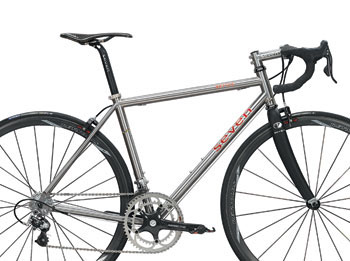
  1. In Seven’s expansive line of road frames, the Aerios is the lightweight champ. The frame employs Seven’s most radically butted tube set, compact geometry, and minimalist non-adjustable housing stops at the head tube. Like all Seven frames, it’s offered in stock geometry-but seven will build you a complete custom bike at no extra charge.
  2. Seven custom-built the Aerios for our test-drive. The geometry numbers looked wrong at first—Seven designs the bike with a much shorter top tube and higher bar than our subject usually rides. After extensive riding however, including the six-day Bicycle Tour of Colorado, our test rider fell in love with Seven’s fit. “It completely eliminated the neck, shoulder and upper back pain that had nagged me on longer rides. The position isn’t as aerodynamic as my previous bike, but I can ride longer and more comfortably now. I completely changed how I feel about my bike fit.”
  3. Besides reducing the Aerios overall weight, the medium diameter, thin walled, butted 3/2.5 titanium tubes have a delicious ride quality. Take the best traits of carbon and steel frames, throw them into a blender, and the resulting mix is much like the Aerios ride. It’s smooth and comfortable, yet it maintains a communicative feel. Seven customizes the tubeset for the rider right down to the butting.
  4. Because he was concerned about the overall stiffness of the frame, our 165 pound test rider requested that Seven put some extra beef in the platform. That lead to a slightly heavier frame, but at just 2.4 pounds it’s hardly porky, and it was plenty rigid enough for our tester to be happy with the ride.
  5. Our tester told Seven what he was looking for in terms of handling, and the company nailed it. “I wanted something like my previous bike. It’s on the quicker side, responsive and sporty, but it doesn’t fall into corners and it doesn’t have too-light a front end. It’s planted and hooked up going down or going up.”

Aerios

Seven Aerios

Best Thing: Having a lightweight road rocket built just for you
Worst Thing: Once you have this bike, will you never want another?
Our Verdict: Another amazing bike from Seven
Weight: 16 lb., 2 oz. (54cm w/o pedals)
Sizes: 44 to 67cm in 1cm increments (custom 54cm tested); custom (no charge)
Component Highlights: (as tested) Compagnolo Record 10-speed group; Neutron wheels; USE Alien post; Thomson X2 stem; 3T Zepp XL bar; Fi’zik Aerione saddle; Vitoria Open Course EVO CX tires
Contact: 617.923.7774; sevencycles.com