
skip to content
Current Lead Times: Rider-Ready Framesets: 4 weeks. Full Custom Bikes: 7 weeks.

Building Your Titanium and Carbon-Titanium Bikes in the USA for 29 Years

Cycle Sport Magazine: Material Worlds

Story, Phil Cavell, Photos
Gerard Brown

Last month we examined the virtues of steel and aluminum. This month, Cycle Sport casts an expert eye over those rarer and more exotic options, titanium and carbon-fiber.
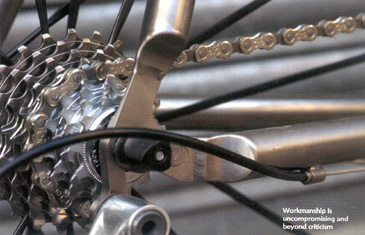
Dropout Detail

Titanium: Seven Axiom

In an ideal world, every country would have at least one bike company steeped in geeky cooldom and armed with an unashamed ‘price is no object’ philosophy. And in this regard the US’s East Coast has rather hogged the scene of late: Fat Chance, Independent Fabrications, Serotta, Merlin and now Seven have all vied for most hip status.

Seven’s torches spluttered into life five years ago when a handful of Merlin’s senior creative staff set up office in Boston, Massachusetts with the lofty notion of only making frames specially to order: Today the company employs 28 people and is one of the USA’s largest fabricators of high-end bespoke excellence, specializing in bike frames for all disciplines, in either steel or titanium.
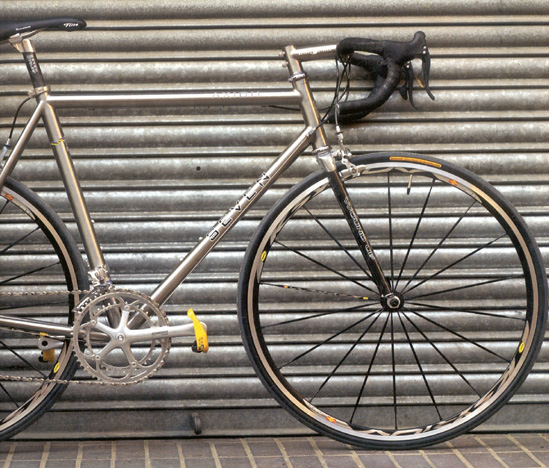
Seven Axiom

Frame

The Axiom is Seven’s uncompromising outfit for people who want to live—or look like they live—the racer role to the extreme. It is available as a custom build at no extra cost, although our test bike was specially made for a customer using Seven’s own ‘Signature’ geometry. The Axiom is constructed from Seven’s own seamless Argen 3AI-2.5V titanium tubeset, which is painstakingly externally butted to a tolerance of O.OO1in, or the width of a human hair; whichever seems most appropriate on the day.

The Axiom’s snaked seat stays and chain-stays are unsurprisingly reminiscent of Merlin’s own, and are executed to a comparably high standard as anything crafted by Tom Kellogg (Merlin’s master builder).

Interestingly, Seven eschews shaped tubes in vogue with other manufacturers at the moment, believing the traditional round shape offers a better stiffness to weight ratio, as well as maintaining greater strength integrity compared to ovalized alternatives. The resulting frame looks classical.

A plethora of choices await you when you order your frame, and most won’t cost you a penny more than the ‘basic’ $2,595 frame cost: bosses, tubing, decals, mudguard mounts, geometry sloping top tube—you’ll be at it all day.

Our 56cm bike measured 56.8cm along the top tube and 59.5cm to the top of the seat collar (56cm center-center of the top tube). The 15cm head tube follows the current US trend by being slightly longer and utilizing a 2cm extension above the top tube (also available with 4cm at no extra cost), while the seat and head angles measure 73.5 degrees apiece.

Seven is one of America’s select few art house builders whose construction processes and presentation are among some of the world’s finest—this kind of work is effectively beyond criticism, and only really available for appreciation.

Fork

Seven collaborated with Salt Lake City’s Wound Up Composites to produce a genuine 450-gram fork, which is based around filament-wound carbon legs and 1 1/8in carbon steerer; bonded into a CNC-machined polished aluminum crown and finished off with aluminum dropouts. The cost is a cool $475, but you get a sub-four-pound frame and fork figure to boast about in combination with the Axiom’s 2.981b (1.35kg) frame weight.

Components

Our test bike was prepared by Sigma Sport in Kingston for a very discerning customer with taste and style (not us). It is not often that such a list of rare and desirable parts finds its way onto one frame: Campagnolo Record groupset, Mavic Ksyrium wheels, Chris King headset, etc. Even the headset spacers are titanium and cost $22 a set. Ready to spin on Continental GP3000 tires, the whole rig costs a once-in-a-lifetime $5,049 and weighs a toenail under 16.8lb (16kg).

Ride

My first thought was that the Seven felt a little big for a stock 56cm, partly due to the long seat and top tube, and partly, if I’m honest, because my legs belong to another much shorter person. Hence I would probably choose a 54cm bike for myself and make a necessary change with the stem size. My second thoughts were aesthetic—I felt the Wound Up fork looked a bit too Mtb for the rest of the classic lines of the Axiom. But then I rode the bike and found the front end of the bike to be a total revelation—I have never ridden a bike that steers so quickly and with so little effort. The balance and confidence coming back from the fork, bar and stem combination is astounding, and it took me a couple of hours to stop hitting imaginary apexes four feet too early.

Chris King Headset

Elsewhere the ride fluctuates between outstanding and excellent. The frame itself feels stiffer than most titanium bikes I have ridden, as there is much more pick-up from the rear triangle than one would expect. The trade-off is that the Seven doesn’t quite have the type of springy, absorbent ride that you look forward to in advancing years for pootling around the country lanes. Maybe the Mavic Ksyriums played their part in giving the Axiom this unexpected aggression, as they are certainly one of the stiffer wheel packages that we’ve tested, as well as being one of the fastest turning. Don’t get me wrong, the bike is still all-day comfortable and satisfying, isolating an estimated one-third more road buzz compared to an all-aluminum frame. The one little problem we had was that the gorgeous looking seat clamp seemed unwilling to get any real bite on the carbon-fiber seatpost—we were constantly stopping to reset the saddle height and retighten the clamp.

Climbing onto any light bike is a delight, but the Seven bestows that something extra to the experience—the bike itself is so classy that you naturally fall into the smooth-as-you-like groove; stay seated in the saddle using languid, powerful pedal strokes as the road kicks right up in front of your face. Or feel the front go stupidly light in your hands—it’s an excellent package.

If you have decided that It is about time that you treated yourself to that once-in-a-lifetime frame purchase, then Seven certainly offers you just about as much scope, and as many options to ‘fill your boots,’ as any other company out there. It is part of that select group of frame-builders who don’t aspire to anything other than passion-infused excellence for people who care about such things.

The Seven Axiom does everything any headbanger race bike will; but with a lot less fuss and drama, and actually encourages you to do the same. It is a race bike for a gentleman and not a hooligan; sure, it is fast and capable, but the expression of its class and ability is an exercise in pure Bostonian understatement.

Bicycling Magazine: Seven Sola – Titanium Runs Through It

by Richard J. Cunningham, courtesy of Mountain Bike Action

Seven Cycles’ founder Rob Vandermark was already fooling with bicycle frames when Merlin Metalworks, the seminal seed of the titanium mountain bike industry,was conceived. He learned to craft the silvery metal there, and also discovered the beauty that can be expressed by bare tubing wrought by craftsmen into a functional frame. Vandermark ultimately splintered off on his own, taking a handful of Merlin’s titanium junkies with him.

Armed with a utopian dream of producing perfect one-off custom frames in a classless workplace, Vandermark put together a business plan and scared up enough funding to make a go of it. “Seven” became a reality in 1996—a 1000 square-foot shop in Somerville, Massachusetts. Seven has now expanded—seven times larger—to a new site in nearby Watertown. The crew still builds one frame at a time to an individual customer’s geometry, or to Seven’s specifications. Although titanium is the material of choice there, Seven also produces frames with a blend of butted steel tubing and a unique chassis with a carbon fiber seat tube and chainstays, bonded to a titanium or steel main frame.

Meet The Sola

Seven’s Sola is its elite titanium frame. Like all Seven’s chassis, you can it order any geometry you please, or pick from a menu of options, and your Sola will still cost a cool $2595. Ours was built with Seven’s stock numbers, and was equipped with an A-type universal disc brake mount. Tube-guides are welded to route the disc brake hose to the rear dropout and, of course, there are no vee-brake bosses. The main frame pipes are Seven’s “Argen” butted tubes. Unlike most butted tubing, the thicker portion is on the outside, making the outer diameter greater at the ends of the tubes. This reportedly increases the stiffness and strength of the chassis. Except for the 6-4 alloy dropouts and some fittings, the Sola frame is entirely 3-2.5 alloy titanium.

Seven’s literature waxes eloquent about their attention to detail, and this frame does not disappoint. The lustrous, brushed-Ti finish is accented by beautiful welding throughout, and its curvy, S-bend rear stays are as sexy as an inanimate object can be. The head tube is eccentrically machined to add thickness where the frame tubes join—to shed a few grams, and to showcase its cast alloy head badge. The Sola’s graphics are pleasantly understated to let the elegant chassis speak for itself.

The only less-than-elegant aspect of the Sola is its dog-ugly seat clamp arrangement. Perched atop this sleek, burnished titanium masterpiece is a dull, bead-blasted external clamp with exposed threads that appears to have been stolen from a Russian submarine. Ah well; nothing, as they say, is truly perfect.

Outfitting The Perfect Hardtail

When you purchase your custom frame, the choice of components is as personal as your bike’s geometry. Our Seven was appointed with Hayes hydraulic disc brakes, a RockShox SID Race fork, and a Selle San Marco Strada saddle. The wheels were Mavic CrossMax Tubeless hoops that rolled on Hutchinson python tires. All the rest was Shimano XTR, with the signature gray color that blends perfectly with brushed titanium. There was nothing to complain about on this list.

Riding the Sola

Anyone who competed during the golden age of NORBA cross-country racing will appreciate the feel of the Sola. Its long, low stem and traditional frame geometry are a tribute to a period when climbing and pedaling efficiency were our only concerns. Heave-ho on its titanium handlebars, stomp on the pedals and it will accelerate straight and steady. Jump out of the saddle, sprint and it will follow your every move. Within the speed range and breadth of difficulty imaginable on a cross-country circuit, the Seven seems infallible.

The Sola feels light, but not feathery like modern aluminum lightweights. Perhaps this is because the titanium chassis carries more weight in its upper tubes. At 23.2 pounds the disc-brake-equipped Seven is very light. A strong cyclist can ride most rollers in the big chainring—and level the lion’s share of single-tracks in the middle ring. Perhaps it’s scientifically true that riding a bike that weighs a couple of ounces less won’t make you a significantly better rider, but the emotional high of spinning around the hills on a sub-24-pound mountain bike seems to counter that argument.

The titanium frame has a tiny lag to it that precedes each power pulse—about half as much as a good steel frame—which is a good trait. This “spring” effect is the quality that steel hardtail lovers revere—it’s the essence that makes a frame feel alive. Too much flexibility in a frame, however, and it will handle and accelerate like a wet noodle. Many early titanium mountain bikes lacked enough rigidity to please aggressive riders. The Seven’s frame exhibits no bad habits in the flex department. Its blend of butted pipes and beefy rear stays can take anything you dish out. The Sola’s steering department could be more stiff. Its handlebar and stem arrangement seems to wind up when you are climbing hard and really honking on the bars.

Overall, we find it hard to fault the Seven Sola. There are some who would want to tame the Sola’s fast steering and try to make it more of a freeriding machine. Others might want to extend its fork travel, or choose more flexible frame tubes to enhance its rough-trail worthiness. We like the Sola’s purity of purpose. It has been carefully honed into the essence of the racing hard tail—why would you spend this much money to experience anything less? Every aspect of the Sola is meant for is the race track: its tubeless tires rolled like they were hovering over the trail surface; its Shimano XTR ensemble was designed on the World Cup XC circuit; its SID Race fork owns more titles than any other slider—and the Sola, in disguise of course, has been ridden to the podium by many luminaries. Don’t mess with success.

MBA’S Last Word

You have to be a committed hardtail junkie to dish out 2600 bucks for a frame. The total cost of our test bike easily passes the $5000 mark—that’s enough to race the entire national circuit on a budget. The proof lies in the ride though, and the Seven is one of the sweetest hardtails we’ve tested. The other motivating factor is the long lifespan of a titanium frame. If you really are the kind of rider who knows exactly what you want—then why fuss with a long sequence of hardtail purchases when you can buy one that will last a lifetime? It’s all about choices at Seven.

Teacher’s notes: If you are an experienced hardtail enthusiast, think long and hard about your frame geometry, riding style, and personal fitness—then call Seven and order the last bike you’ll ever purchase. The Sola is the end of the line in the evolution of the conventional hardtail mountain bike.

Ordering Your Sola: What You Get For $2595

We asked Jennifer Miller, the Market Development guru at Seven, to answer some questions about ordering a frame. Remember, when you order yours, you should be prepared to wait a spell. Although Seven is a top producer, the best frame builders’ turn-around times are about one month. Glitches always crop up, so pad your expectations.

MBA: Do you have to specify all of the geometry when you order a frame?

Jennifer: Since we build every frame to order, the handling is dictated by the needs and desires of the rider. However, if a customer was simply to choose a Sola Ti in one of our Signature Sizes, instead of getting a custom, they would be getting geometry that leans toward race handling. I should add that one can choose a Sola Ti in one of our Signature Sizes with a more relaxed geometry as an option. Also, even if a customer chooses one of our Signature Sizes, he/she can still opt for a custom tube set, which would allow them to get just the right balance of frame stiffness and compliance.

MBA: What if a customer asks for a really stupid bunch of numbers?

Jennifer: In the case where a dealer or end customer requests geometry that we think will compromise the performance of the bike, we would provide a recommended geometry and explain the reasons for our recommendation. There have been one or two rare occasions where someone has asked for something so wacky that we have declined to build the bike. We have some dealers, however, who often order frames on what we call our “Specs as Requested” form, and they take full responsibility for the frame’s geometry. These shops are generally very experienced and highly competent in this area, so usually we won’t make a recommendation to the contrary.

MSA: Rob Vandermark’s signature appears on the Seven’s frame. Does he personally oversee the geometry of every frame, or does Rob set down general guidelines that your individual builders adhere to?

Jennifer: We have four custom specialists at Seven who will generate preliminary specs based on a very comprehensive set of criteria Rob has created, but these specs are all subject to Rob’s approval. Rob has the final say.

MSA: Is it true that every frame Seven produces is custom built?

Jennifer: What Seven brings to the table really stems from our unique manufacturing methodology. We build every frame to order, so basically, we sell a frame and then we build it. We have no finished goods inventory and we are completely flexible to create just about anything our customers can dream up in terms of how they want their frames to handle, feel and even look to a certain extent. Also, each craftsperson here works on only one frame at a time. We never work in batches. This individual attention enables us to have great attention to detail and quality craftsmanship.

MBA: Who is your target customer?

Jennifer: Our target mountain bike customer is really no different from our target customer in general which is anyone who seeks to enhance their riding experience through the optimum fit, handling, performance, and ride characteristics of their bike. One benefit of a Seven that I haven’t said too much about is our ability to completely tailor the frame’s tube set according to the rider’s weight, riding style, and preferences. This has been an extremely attractive feature for bigger, more powerful riders who never thought they could get the stiffness and responsiveness from Ti that they needed, and for smaller riders who have felt beaten up by their frames. Through the precise selection of tube wall, diameter, and butting length and placement, we can address all of a rider’s considerations for weight, durability, and ride characteristics.

Jennifer Miller’s Thoughts on Being an East-Coast Frame Builder

“Geographically, of course, we are an East Coast builder, but I think any other meaning to that has more to do with our heritage and experience than to any particular design elements that you can call East-Coast anymore. As you know, most of us spent the better part of our adult lives at Merlin prior to Seven, and some, including Rob, go back as far as the early days of Fat City. Also, the East Coast, particularly the Boston area where Seven is, has an extraordinary number of colleges and universities. This makes for a very diverse, educated, and creative labor pool, which we have been very fortunate to draw upon. Plus, I think there is a very good work ethic out here.”

Mountain Bike Magazine: Seventh Heaven – We Found the Perfect Bike – Too Bad You Can’t Afford It

by Matt Phillips

Some humans—by their very nature—like to take things to extremes. Witness the legions of people who jump out of perfectly operational airplanes. Not content with that, they push themselves further by skysurfing, BASE jumping and other such nonsense. Bike riders are not immune to this phenomenon. One could certainly argue that after the derailleur was invented, the bike was ideal and didn’t need to be developed further. But we pushed and pushed. The Seven Odonata is the result of one company pushing the limits once again.

Oh, the Frame!

Seven bicycles are regarded by most who see them as beautiful, and by some who ride them as ideal. For president Rob Vandermark to cut up one of his stunning Axiom titanium bikes could be considered sacrilege. After all, the bike is already plenty light and rides like a dream. But Vandermark wasn’t content with that. So out came the titanium seat tube and seatstays, and in went filament-wound carbon tubes, courtesy of Advanced Composites—the same company that makes Wound Up forks.

What’s Vandermark’s reasoning? Weight and ride quality. An Odonata frame is 10% lighter than the all titanium Axiom, and according to Vandermark, it offers a plusher, more comfortable ride. In fact it was carbon’s ride characteristics that first attracted Vandermark to the material.

“The damping characteristics are too good to ignore, but I wasn’t satisfied with the all-carbon bikes out there. So I leveraged some of its good points while minimizing its problems.” To ensure the highest quality ride, Vandermark orients the carbon’s fibers so they provide vertical compliance in the stays, while the seat tube is designed for maximum stiffness in bending and torsion. The carbon is mated to the titanium in what may be considered an unusual manner. At the bottom ends, the carbon fits over lugs, while in the upper ends, the titanium fits over the carbon. Both ends and the brake bridge are bonded in place.

Enough about the carbon bits—there’s a lot of titanium to talk about, too. The titanium is Seven’s proprietary Argen butted tubeset. How and where the tubes are butted depends on you, though. Seven’s extensive custom kit tailors each tube based on your weight, ride style, handling and rigidity preferences. By doing so, the company can create an ideal ride for anyone. (And for those of you who don’t want to take the time to complete the “custom” paperwork, the Odonata is available in 24 stock sizes.)

Between the trick hybrid frame and the extensive custom kit, you may forget to just look at the Odonata. To do so would be like concentrating on the brush strokes of a Cezanne, instead of stepping back to see how they all come together. Seven doesn’t make frames—it makes art. The smooth tapers make the titanium and carbon look like one piece of material, while the brake mount is elegantly simple. Plus, you have those gorgeous welds (which are about the best you can find), that sexy seat clamp and the laser-cut head badge.

Oh, the Parts!

Our test bike was a stock-sized 56 cm. Nothing special about it. Of course that’s like saying a Lamborghini Diablo is “nothing special” because it doesn’t have a custom-made seat. You gotta look at the big picture. The bike is equipped with a relatively tame build kit of Dura-Ace nine-speed and some tubulars. The Wound Up fork was one of the first 1 1/8-inch around (the larger size is available with either a carbon or aluminum steerer). Even though the steerer is a larger diameter, either version is lighter than the 1-inch version with a steel steerer. Additionally, the 11/8-inch fork is stiffer, and with the carbon steerer, more shock absorbing than its 1-inch steel counterpart. We swapped the boring Ritchey post for one of the new Thomson layback posts, which gave us the same seating position, but in a package more suited to the Seven. As it sits, the Odonata weighs 17 pounds.

Oh, The Ride!

Riding the Seven feels like cheating. It’s too fast and it’s too comfortable. But who wouldn’t take an advantage like this? Immediately noticeable is the weight. The bike surges away from stoplights and makes you feel like a high-mileage stud. Up climbs the best term to use is “float.” You may not look like Marco Pantani, but this bike makes you feel like him. Tied into all this is the bike’s efficient rear triangle, no doubt helped by the healthy 7/8-inch curved chainstays. Riders on this bike felt like they could use a higher gear than they use on their normal bike.

Around LA’s uneven roads the shock-absorbing abilities were welcome, especially for riders coming off stiff aluminum bikes. We’ve never heard a road bike described as plush, but it is applicable. Except in this case plush doesn’t mean inefficient, heavy or a bitch to get up hill. It just means all-day comfortable.

Shimano’s Dura-Ace performed mightily. If you think XTR is precise, wait till you try this stuff. Quiet and smooth running, the shifting never required maintenance. All elements of this bike—the weight, the comfort, the solid parts—combine to make it meld with the rider. You become one with the road, melting away the miles and pushing yourself further.

The worst thing about the Odonata is that it only confirms what we already know—there are benefits to being rich that most of us will never realize. Not even with their abundance of engineers, slick ad campaigns or lawyers have the biggest of the mega-bike corporations reached such a level of quality craftsmanship as Seven has here. Eat your heart out Trek, Specialized, Schwinn and GT—the folks at Seven have you beat. This is a contemporary bike for the modern traditionalist, a bike everyone would and could fall in love with—if only we could afford it.

Note to mountain bike traditionalists: Even though the company has excellent line of mountain bikes, Seven doesn’t have an off-road version of the Odonata. The company says it’s possible, but it would be heavier, more complex, more fragile and more expensive than the full titanium hardtail.