skip to content
Current Lead Times: Rider-Ready Framesets: 4 weeks. Full Custom Bikes: 7 weeks.

Building Your Titanium and Carbon-Titanium Bikes in the USA for 29 Years

cyclingnews.com: Seven Heaven – a tour of the Seven Cycles Factory

By Steve Medcroft

The first Seven I ever saw up close was Mary McConneloug’s Tsumani cyclocross bike. She rode it during the 2004 U.S. Gran Prix of Cyclocross series. We wrote a pro bike report on it. Her partner and teammate, Mike Broderick, said that Mary had been riding the same frame for three years and that fact stuck in my head. Three years. Most riders are issued new bikes every year. Most bikes are changed and modified enough each season that the manufacturers have to upgrade their sponsored riders.

But three years before our article, Seven Cycles fit Mary for her Tsunami and she hasn’t needed to replace it since (and was giving no hint that she intended to replace it any time soon). It left me with the impression of a Seven as a lifetime purchase, a frame that would be with its owner forever.

I ran into Mary and Mike at Interbike this year. Mike and I were eyeballing Seven’s IMX hardtail mountain bike; which features titanium lugs and carbon tubing. We were talking about the way the bike rode and he was explaining how Seven tunes the bike for each buyer through a customization process that factors in something like one hundred data points. From how you like the comfort of the bike vertically to how stiff you want the torsional drivetrain, you can have a Seven built to ride and feel exactly like you want it (or exactly the way that will emphasis your riding and racing strengths and minimize your weaknesses).

But Seven isn’t a typical custom bike builder (a small shop designed around a single master frame builder); it’s an eight-year-old, 35-employee, Boston-based bike manufacturer. How do they mass-produce highly customised bicycles? I couldn’t pass up the chance to swing into the Seven factory after covering the USGP stops in Gloucester the weekend of Halloween.

First impressions

Seven got its start in January, 1997 when Rob Vandermark, head designer for Merlin Bicycles, struck out with a small group of colleagues to occupy a 1,000 square-foot corner of someone else’s machine shop 30 miles north of Boston. “The guy who owned the shop was extremely generous to us,” said Vandermark when I visited the company. “He was excited to see us get off the ground. We grew to twelve people quickly with everyone doing everything from welding and machining to sales and R&D in that tiny space.”
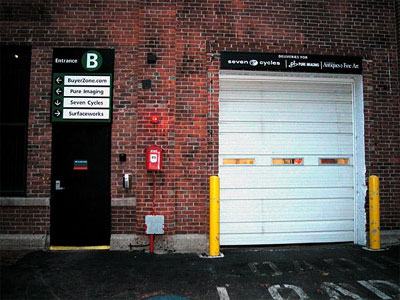
Seven Entrance

Vandermark, an engineer by practice, had a vision for an industrial process that could bring hand-built custom bicycles to an audience as large as a mid-sized mass-producer. He says he felt that the larger companies were too inflexible to truly process customization through their company’s systems and most custom builders were limited in size due to their single-handed approach to customization.

Seven executed Vandermark’s process in that small space until they moved to a 12,000-square foot facility in the lower level of an industrial park in Watertown, MA, about six miles from Boston Harbour as the crow flies. At the company’s front door, there is no fanfare, no neon-lit 20-foot-high Seven logo. The door is, in fact, almost hidden from view in a cul-de-sac at what looks like the rear of the building. I actually walked up to the door and backed away, convinced it was a private entrance or a loading dock and circled the whole building looking for a front entrance before coming back to the cul-de-sac.

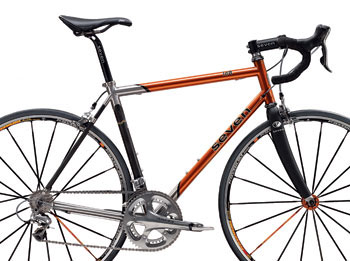
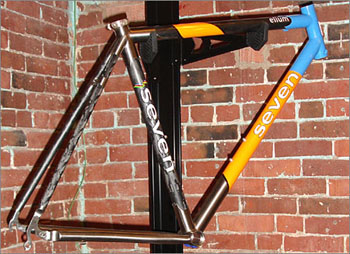
I sat with Director of Marketing, Jennifer Miller, in Seven’s showroom, a cavernous, brick-walled corner of the space complete with racks of completely built Sevens along two walls. The display was a good example of Seven’s line: bikes designed for all different types of riders (The Elium competition road bike, The Alaris Race crit bike, the Axiom Steel for traditionalists, Sola for cross-country racing or Duo for all-mountain riding).

One thing that stuck out about that selection of bikes was the variety of frame materials. I always thought of Seven as a ti shop. “From day one, we worked with materials other than titanium,” Miller said. “The first bike we ever made as a company was steel. We were also working with carbon fibre from day one and introduced the Odonata – the first bike to strategically employ both carbon fiber and titanium tubes – in our first year. The design inspired a revolution; within a year, everyone was doing metal bikes with carbon seat stays, etc.”

Miller’s point is that to Seven, the frame material isn’t the focus of bike (most frame materials can be manipulated to produce almost any desired effect), it is the ultimate one-bike-at-a-time tuneability that can be achieved with almost any frame material that matters most.

A Fit for a King

To learn about the customisation and fit process, Miller introduced me to Zac Daab, Seven’s Senior Fit Specialist. Seven’s bike-build process starts when the retailer fills out a comprehensive customer questionnaire to gather everything they need to know about the rider’s desired fit and comfort, handling and performance, tubing and materials preferences, features and options and any accommodations the bike needs to be ready for the rider’s future.
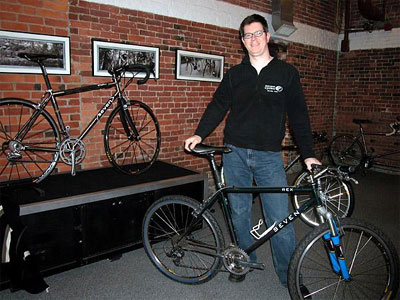
Rob poses with Seven #001

“The questionnaire contains the hundred-plus data points we use to come up with the final build,” Daab said, using a marked-up (the document is continuously refined) copy of the Custom Kit to make his point. The goal is to gather enough data to build a custom frame without ever seeing the rider, so beyond the questions that can be answered by measuring a rider’s legs, arms, wingspan, inseam, etc, Seven asks about a rider’s weight, their previous bike, the components they plan to run, what kind of riding or racing they do. “We want to know if they are using riser bars,” Daab says, “how they want their cable routed, do they want pump pegs, the color of their decals.” Every answer matters. “Fork choice is important, for example; it can help us change the geometry of the front end of the bike.”

Daab says that Seven asks questions customers aren’t used to answering when they buy a mass-produced bike. “When you buy a bike off the floor, for example, it doesn’t matter if you’re doing centuries, crits or full-on time trials every weekend; the handling for that bike has been selected already. By handling; we mean things that control handling; the head tube angle, the bottom bracket drop, the chainstay length – they are already figured out and it doesn’t matter who you are. With a Seven, what we’re working on through the Custom Kit is how to build the perfect bike for that single rider.” That data gathered in the Custom Kit is balanced into a frame design that sets the rider in a neutral position with as much component adjustability as possible.

To prevent ambiguity, a Seven fit specialist calls the buyer directly before a final design is committed to production; a practice Daab says Seven remains committed to event though it has become a much larger task than when Seven was small. “Sometimes we’re resolving inconsistencies – if you said the reach of your current bike felt way too long but we’re looking at your body data (arm length, body length, top tube dimensions) and it doesn’t seem to check out, we want to talk about it with you to make sure we build exactly the right thing. The call is about tuning the build a little bit tighter.

Sweeping the Factory Floor

At about day eleven in the four to seven-week process, the customer signs off on the build then a build sheet, detailing the frame’s design, is sent to the floor. I left Daab, and Miller led me through a double door to view the frame production area. With concrete floors and work zones crammed with stock, machinery and welding equipment, the Seven factory floor is a genuine production facility; a dirty, grungy, make-something-with-your-hands kind of place.
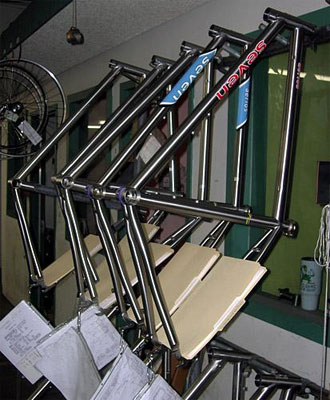
Frames in production

At first pass, it looked chaotic, but although it was a little cramped (Seven has signed a lease on an adjacent space and will double the production floor in early 2006), there seemed to be purpose in the placement of ever person, every tube, every lathe and drill press.

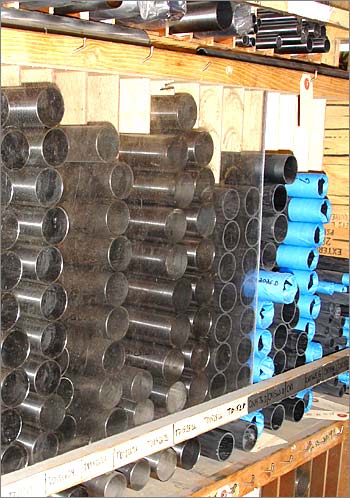
Seven frames begin life in the frame stock bins. Stock tubes are cut, shaped, bent and butted into what is essentially a bike in a box; literally, a shallow, cardboard box filled with a jigsaw puzzle of metal tubes that will be tack-welded together at the next work station. Once the tubes are tacked into geometric position, the assembly is passed to the welders.

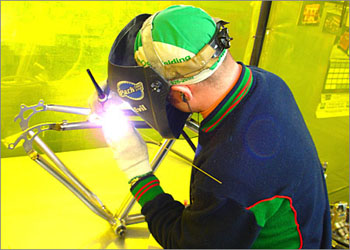
“Tim Delaney is a career-professional bike builder,” Miller said as we watched the lanky Delaney work the head of his Tig welder around the contours of a bottom bracket. “He’s been welding his entire life. Most of our other welders have been trained here. They may receive up to six months of training before they even tack a frame.”

A braided hose hung from a coupling attached to the bike’s head tube. “The frame has to be completely sealed,” Miller said. “It’s filled with Argon (an inert gas) to purge Oxygen and other environmental elements that could compromise the weld’s intergrity if present when the titanium is in a molten state during welding.”

When the welders (of which there are several besides Delaney) finish the frame, any carbon elements are screwed and glued in place, the frame then receives its final pieces and parts then moves on to the finishing stations where they’re buffed and prepped for painting and decals.

Before and after finishing, the frames hang on a rack for Quality Assurance to make sure there’s no reason to send them back to the floor before the final product is shipped.

Knowing which way the rudder is pointed

The fact that the core of the thirty-five employees at Seven are cyclists is evident; many wore long-sleeve wool jerseys and a half-dozen people arrived to work on bikes during my time there. But just as many employees learn their passion for cycling by working at the company. “We have a really good employee purchase programme,” Vandermark said, “We offer a very, very low price. And to the extent our employees can do any work on their bike off the clock, that’s totally taken off the top.”

So at Seven, there are a lot of people paying a few hundred dollars for very expensive bikes. “And there’s a lot of bartering going on,” he added. “A welder who can’t machine will go to a machinist who can’t weld and they’ll trade work on each other’s bikes. We have employees that have built five, six, seven bikes over time. Which is important to us; it helps to have that appreciation when you’re stressing and fussing over details.”

I asked Miller where she thought Seven would be in five years and she grinned and leaned forward in her chair. “We want to grow but we measure growth in different ways. Clearly, sales is one reason to grow and one way to measure growth, but growth also represents the opportunity to do the kind of product development we want to do, to reach that size where we can support things like health insurance and 401k’s and profit sharing. A certain amount of growth is necessary to be able to create the kind of company we want to be.”

What Miller is hinting at is something every small to mid-sized company struggles with; how do you create opportunities for smart and talented people to grow within your organisation when there are only so many ‘big’ jobs to do? “We hire a lot of creative people (an unusual number of art students, Miller told me earlier). It’s important to us that we give them a real career path; a way to start at the entry-level and develop a real career for themselves.”

The company is also dealing with the transition beyond Rob Vandermark’s ability to manage every aspect of Seven’s operation. “In the early years,” Miller says, “we had to manage growth in a different way. We couldn’t keep up with orders. As we mature, we know we have to be more sophisticated with how we chase growth. We need to bring in other perspective and we need to spread the burden of growth. I see that as our big challenge but I feel like that’s an issue most companies our size have to deal with so I’m sure we can work through it.”

There’s also the challenge to Vandermark’s customization process. Can it stay intact if Seven becomes, say, three times its current size? “It doesn’t scare me,” Miller says. “When people say ‘how can you continue to profit with a single-piece flow like that’ I just think back to when we first started. Our labor hours per bike are so much lower now than they were then. I’m confident we’ll continue to get smarter.”

Seven Partners on the Racecourse
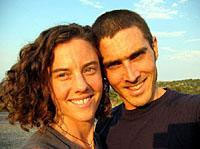
Mike & Mary

It is not uncommon for a bicycle manufacturer to promote its product by sponsoring racers or a racing team. Seven Cycles is not a big-budget, mass-market brand so it has passed on the cost and logistics that come with the opportunity to outfit a 13-member road team and instead works closely with racing and life partners Mike Broderick and Mary McConneloug.

“We can be seen as a road manufacturer so sponsoring a mountain-bike team is odd,” Seven’s Jennifer Miller said during my visit to the company’s Boston factory. “But most of us here at the company, the founding team, were seriously into mountain biking – we all raced and we loved it – so we’re almost living vicariously through Mike and Mary.”

Don’t get Miller wrong; sponsoring McConneloug and Broderick isn’t a corporate whimsy. “Our relationship goes back almost five seasons now. I was racing mountain bikes at the time and Mary won a race that I and another member of our team was in. When Mary and Mike approached us after that about sponsorship, they presented us with a serious and professional agenda.”

The couple seemed to align philosophically with Seven’s founding team as well; they showed a focus on the environmental issues surrounding mountain biking just as Seven has implemented environment-friendly policies throughout the company. “That part of it mattered in a lot of ways,” Miller says. “And since Mary and Mike have increasingly done better and better year after year, we’ve been happy to keep working with them.”

Could Mary and Mike’s success make them more attractive to a bigger-budget team and pull them away from Seven? “Every year, we wonder whether we’ll be able to maintain this relationship,” Miller says. “And I wouldn’t blame them one bit if she was looking for something big. But part of their values are that they want the freedom to race what they want to race and they feel strongly about the companies they work with. Since we feel like we’ve formed a relationship with Mary and Mike and that our sponsorship is not purely a commercial enterprise, there’s no reason why we won’t continue to work together.”

Rob Vandermark’s Resume

1987

— Vandermark is involved in designing and building frames for Olympic medal winners, world champions and Tour de France winners including Lance Armstrong’s Subaru-Montgomery team.

1990 — Designs custom frames for Greg LeMond and his Tour de France winning Z-Team.

1991 — Began two-year study of wheelchair ergonomics and develops revolutionary wheel chair designs. Applies this knowledge of ergonomics to bicycle fit and design.

1992 — Introduces the industry’s first size-specific tube sets.

1993 — Introduces racing wheelchair for Bob Hall (the first wheelchair athlete to complete the Boston Marathon and who went on to form Hall’s wheels, a racing wheelchair supplier). Scientific Frontiers television program calls the chair “A design revolution.”

1994 — Introduces innovative light, mobile, and with a low center of gravity everyday wheelchair.

1997 — Leaves Merlin and launches Seven Cycles using the Custom Kit and Client Interview processes which allows Seven to produce highly customized bicycles in a mass-production scalable system.

2004 — Seven Cycles fits and builds 10,000th bicycle frame.
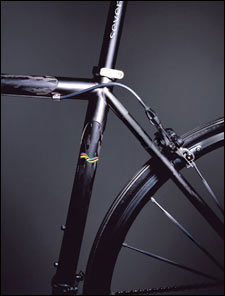
Outside Magazine: Seven Cycles Elium SG Road Bike

Joe Lindsey

Elium Seat Cluster

What You Get

This frame is a superlight marriage of buttery-smooth titanium and stiff carbon-fiber tubes tailored and built to your precise height and weight. Watertown, Massachusetts-based Seven can tune the ride characteristics as well, manipulating tubes and angles-stiffer for high-octane racing or more supple for long hauls down country lanes.

The Process

Seven’s 12-page workbook asks for 11 body measurements, covering everything from inseam to shoulder width. It also asks for a detailed record of your current riding position and any associated ills, descriptions of your cycling style, and the kind of terrain you roll through. Seven ships you the frame, and you have your local bike shop build the bike up, using the parts of your choice. This 16-pounder came with Tour de France-tested Shimano Dura-Ace components and Mavic Ksyrium wheels.

The Payoff

The Elium may be the most comfortable high-performance bike on the planet. Everything-the handlebar drops, the brake hoods, even the reach to the water-bottle cages-feels like an extension of my body; there’s never a sense of strain or overextension. I’ve put almost 4,000 miles on this bike, and my finicky lower back has barely noticed a single one.

The New York Times: The Minimalist On the Bespoke Bicycle

Look around your average minimalist apartment, and it is easy to see why the spartan style gives some people the chills. Where’s the stuff? Where’s the warmth? Where’s the love?

But look around your average apartment, and minimalism is looking good. What else offers a full-strength cure for stylistic confusion, wiping out badly chosen color schemes and banal stacks of trivia in one fell swoop, like Cipro for the home?

Id8

You can debate minimalism’s merits (the embodiment of calm) and pitfalls (another high-priced folly) without end, which its best-known practitioner, the British architect John Pawson, is all too aware of. No matter. From the Calvin Klein flagship store in Manhattan, which he designed a decade ago, through 50 Gramercy Park North, the Ian Schrager hotel-style apartment house, which is to open in January, Mr. Pawson has remained staunchly himself.

His days in and out of the sun have taught him something: You can’t take it all too seriously. He gave vent to that carefree attitude on vacation in Sag Harbor, N.Y., a few years ago, when after a wine-fueled lunch he and a friend bumbled into a high-price bicycle store and left with high-price bicycles. He proceeded to ride his model, a Kestrel, around the Hamptons for the rest of the vacation, a total convert, or at least a reconvert, having cycled in high school.

Taking the bike and his enthusiasm back to London, Mr. Pawson became, he said, “what I euphemistically call a serious cyclist.” As he explained, “I don’t go out without the Lycra.”

However droll he may be about the gear, he became serious enough about his new hobby to enter the Étape du Tour, an amateur race that follows the route of one stage of the Tour de France. And he became serious enough about crossing the finish line with his dignity intact to invest in a new bicycle from Seven, a Boston company that sells only custom-made bicycles, for a custom-made price.

Not everyone was impressed. “My wife was horrified,” he said. His argument that the more than $6,000 he spent was less than the price of a car fell on deaf ears. After all, even the shiniest, German-made midlife crisis seats two.

And when Mr. Pawson showed up in France with his new toy, his friends just stared. “It’s a bit like showing up to go to the beach in a Ferrari,” he said.

The Seven model he bought, the Odonata, has a frame of titanium and carbon. Unlike the design of many novel bikes, the Odonata’s is fairly conservative, its value being in the way it fits your body, taking into account the length of your legs, arms and torso, as well as your weight and center of gravity. “They took more measurements than if I’d been having a suit made,” Mr. Pawson said.

He did ask the bike’s makers not to put their decals on it, “but they put them on anyway,” he said. So much for minimalism. Then there is the clutter — tire pumps, water bottles, cleats and all that Lycra — that the bike trails in its wake. Even so, its great appeal is that it is all Mr. Pawson needs to get away.

“I’ve actually found something that can stop me thinking about architecture,” he said. “Once you’re on the bike, you leave stuff behind.”

Yes, it is all there when you get back, but it seems to matter less. That’s a kind of minimalism everyone can appreciate.

PezCycling News: Seven Elium Race – Another Superbike Test!

by Charles Manantan


Seven Odonata

Housed in a modern little complex tucked away in an older section of Watertown Mass, Seven Cycles turns out their version of custom Titanium and Carbon cycles. Founded 8 years ago by Rob Vandermark and a few close associates, Seven has grown into one of the most recognized “it” brands in Cycling.

They are such an “It” brand that my spoiled bike slathered butt would be willing to leave 70 degree, no arm warmers training days in Phoenix to fly into this!

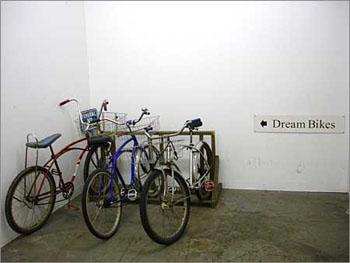
I absolutely hate cold weather and always thought that I would avoid it at all costs. Turns out that “all costs” actually ends some place shy of 5 grand, so off I flew. I get off the plane and, after a bit of “fun” (my damn hand actually froze stuck to the door handle of the car!) hit the Hotel and parked up for the night. Next morning it’s out to the car, where I wait for 10 minutes for the half-inch of crap on the windows to melt and it’s off to Seven. I get outta the car, struggling to see past my breath (breath will actually blow back and freeze to your face if you move fast enough) while sliding down an icy hill and through the parking lot. The whole time I am thinking, “It’s a frikin’ Seven for crying out loud, just suck it up and nail down a Dream Bike!” Then I walk through the door and see this:

Shop bikes

Of course it got a little better when I get walked to the waiting area and found a sample of the bike we would have made for us.

Mr. Seven

Riding in the winter

Seven’s history goes back quite a ways past its relatively short history. It goes back nearly to the roots of Merlin in it’s pre-sold and sold again days before becoming a part of today’s American Bicycle Group (who are Preownedbikes.com / Merlin / Litespeed / QuitanaRoo / Tomac). Rob Vandermark was actually the first full time employee hired by the founders of Merlin. He had been working at a bicycle shop for a few years (he had to find a way to pay for the gear he needed to keep up with his brother) while getting through school on a scholarship as a sculpting major. His emphasis was on representational Bronze, so he had some art world experience with welding, casting and machining, but admitted that he “never thought it would come in handy”

A friend of Rob’s found an ad in the newspaper from a small frame builder working in Titanium and Rob thought he’d give it a look. Funny that he was also thinking that “Ti isn’t a bike material” Once at the interview, he thought “this is crazy, what am I doing here”. But he kept his thoughts to himself well enough to get the job. And as a metal sculptor with artisan skills and a love of bikes, he was promptly put to work.

… As the official company bike packing newspaper crumpler.

“I almost didn’t come back the next day” Rob says, but he’s glad he did as he was with Merlin for eleven more years helping to develop Ti technology for cycling as well as the magic brand that Merlin would become.

But the Bicycle game is what it is and with a few changes in ownership the new management wanted to focus on how the company looked on paper. While business is business and Rob has a lot of respect for the folks at Merlin, he wanted to concentrate on developing a high end, custom / customer focused product. And so, Seven cycles was born.

In it’s eighth year, Seven has become a world recognized custom house. While that’s a young company in the cycling world, Rob has been working with some of the staff at Seven for more than 17 years and they employ a couple of hundred years of Ti bike experience and a bazillion years in the cycling field for their staff. At Seven, extremely good building talent and a bit more modern thought process has done more than just create a hell of a bike. It has also spawned a bit different custom process where Sevens staff take a bit more active roll in working directly with the customer to make sure that they understand how best to apply the tools and materials to what an individual will need in their bike.

Note: The place is full of really skinny smart people that ride (the guy that welded my frame is probably sporting a backwards Molteni cap right now) and I got the feeling that they were as excited about the bike as I was.

Fitter Up!

It was an incredibly satisfying when we got the call from Seven simply to say “Nice job” on the details of a bike test that we had just finished. Of course it was even more satisfying to have them call us later with the opportunity to have a frame and fork.

And rather than having the process handled like a journo schmoozing (not that I qualify as a journalist), red carpet super fit, we didn’t go see em till very late in the process. We got our bike the same way you would (we were even offered the chance to do it with someone out of town so that we could be sure that Seven’s service works everywhere).

The fit process is a little different with Seven. It is less dependent on a fitter (which I found strange and disturbing at first). Seven do ask that you get the help of someone to help you take the measurements for your body and your current bike, and they have a very easy (and complete) set of dimensions they look for.

Odonata frame on a display stand

Once they have your tale-of-the-tape, they use their personal interview process and a top secret formula ( based on a 12-year study of ergonomics, biomechanics, and kinesiology, as well as the overall state of bike fit ) to decide what dimensions your frame should be, while also taking component choices in to consideration (including seat set-back, crank length and stem rise and length, bar reach, etc.).

Screw em!

They also ask for measurements of your old bike (as a point of reference), and they ask you several questions about what you do and don’t like in your current ride. Now we’re nobodies fool (er OK, few people’s fool) and they knew that I was in love with my last bike (another custom fit dreamer). So not only did I ask for a bike that would behave differently than the bike they knew I loved, I gave em a “modified” version of my bikes measures in order to see what their pre-production suggested measurements would be.

In short, I lied to try and screw em up.

Now remember that frame geometry can change dramatically within your fit. Your hands, feet and butt can remain in the same place while the angles between can be way different.

Welding a frame

I already had a perfect fit on a bike with an emphasis on being super stable, relaxed and comfortable (a distance eater that would respond when asked). With that in mind, I asked Seven to build something quicker steering and stiff as a first, second (and third) priority (why not have a custom fit dreamer with another focus eh?). I did give Seven my accurate body measures but did not give them an accurate accounting of where my contact points were on the other bike. Instead I gave them a longer saddle to bar measurement and also screwed up my seat set back.

Sonsabitches found em both.

Zac, my contact and interviewer at Seven, sounded a little worried (much to my sick pleasure) as he started to tell me that the (false) fit I raved about wasn’t what Seven had come up with. “I know you really like what you have now, but I’m not sure that you have the optimum fit, and we were wondering if you might try what we’ve come up with” was how he delicately put it:

I said “sure, what did you come up with?”

After applying my measurements and bike desires to their formula, they corrected my “altered” seat setback to exactly the same spot my current (good) fit dictated, and they corrected the reach to the bars to within 5mm. Not exact enough? Well another variable is that I had spec’d a different handlebar for the Seven and the reach to the hoods was 2.5mm toward the suggested Seven measurement. So they came within one quarter of a stem size of dead on. The saddle height they suggested was also a virtual match…

Filling out the custom kit

Long story long (sorry!) they did a better job of fitting me than I thought was possible without seeing me on a bike. Maybe that was a fluke, but I have not seen a 4 part fit fluke before now! I would also say that you need to be extremely honest about your performance, flexibility, fitness level and desires with them, as they take it all in to consideration.

Note that I love how Seven found my fibs, but I am physically fit and relatively well conditioned with no major problems and no significant fit conditions. I would suggest that you get with a highly qualified fitter if you have special conditions and also discuss them with Seven when ordering, just to make sure that the information you give is acquired, handled and received properly.

So What’d We Get?

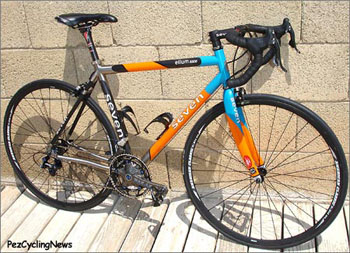
Seven’s top-dog Elium Race.

Bottom bracket cluster

As frames go, it’s obviously a sweet bike. It was made sweeter by a few called in favors. Not only is the frame and fork a top spec, but Cycling Innovations sent us a one of a kind Crank set From ROI Bike special for this bike as well as some other select hardware From Tiso.

you’ll see a review of their stuff shortly

Schmolke sent us their Uber-bars, a sweet stem cap as well as a custom seat post. We’ll do a review of their stuff too.

And we had Reynolds new Carbon Mid V wheels as well as a super new set of Magnesium clinchers from American Classic. Stopped by a set of custom etched Pez Tech edition Zero Gravity brakes.

And Seven’s house stem (with Ti bolt upgrade) is no slouch. So nice that we stayed with it rather than spending money on something that didn’t have opposing force rear bolts and a “pull” rather than “push” face plate.

All this made for a disgustingly nice bike that will have the folks in forums ranting away (much to my personal pleasure mind you?) at our acknowledgement that this is nice kit, as if they wouldn’t take it.

Of course we did use the house wheel sets and saddle, and remounted our standard test bars so that we give you as much of a relative “bike” review as possible, but I will admit that I was as tainted as is humanly possible riding this thing in it’s photo-build.

Oh yeah: The Bike!

Seat cluster

Dealing with one of the better custom houses is a great time to remind you of the old saying “be careful what you ask for. You might get it”. Again, your honesty in the interview process is critical with Seven. They have over 25 Ti tube sizes from the mill to chose from (then they custom butt the Ti for your ride). They also have a rack of different Carbon tubes to run.

The result of this mountain of available tube tuning is that I asked for a bike that focused on quickness in handling and stiffness under force. They handed me just that.

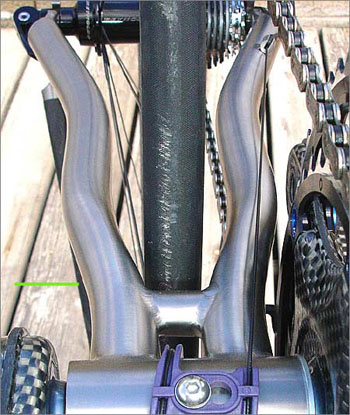
Probably the easiest place to see the focus of this bike on the stiffness side is in the Chain stays. These are the largest I have ever seen on a bike my size.

note the stays are larger than the fully inflated 21 tire. The green mark is where the tire is the same distance from the camera as the stays

The Chain Stays in the photo above were the same size as a massive set of stays on a BMX bike that the shop was working on as I came to look at my frame. There is virtually no wheel twisting the dropouts allowed by these tree trunks (I did break a spoke with the load I put to a wheel though!).

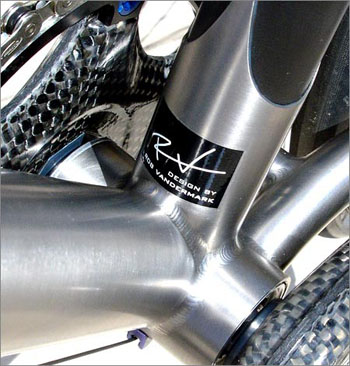
The bottom bracket looked like a bottom bracket. It holds the chain stays out wide and had welds that were so smooth and uniform that they looked like they were drawn on rather than welded.

Keep in mind that (within reason) a twisty bottom bracket area in and of it’s self doesn’t rob you of too much power. As you force a frame to twist as you press down, it’s also rotating and pushing your “up-leg” up (and both forces are driving the chain). You do get a loose “feeling” with a sloppy bottom bracket though, and the play also promotes side force on the tire. That “woosh-woosh” you hear as you stand and pound the cranks is made by the tires pressing sideways and the further your frame flexes to the side, the more power is lost scrubbing tires side to side. Some folks think as much power is lost in nervous energy created as the rider gets the feeling that a lot of power is being wasted or that he / she isn’t stable: and more flex is probably coming from your wheels when you’re riding most of today’s high end stuff.  All that said, the bottom end of the Seven has virtually no twist at all. The feeling is incredibly satisfying stomping the pedals.

carbon fiber tubing

Note It’s important to note that all Ti is not the same. Nor are all welders. Done right, it’s great stuff. Done wrong (too slowly, in an unclean environment, wrong settings with the equipment, unevenly). Ti can be crap. That’s part of the reason it takes a year of training and apprenticeship to weld frames at Seven.

The down tube didn’t look as oversized relative to other bikes as the Chain stays did. Rather than going with a super fat tube, Seven kept things looking a little conservative and simply didn’t remove as much material from the tube walls (strategically removing material is what “butting” basically is). There are certainly sloppy Ti bikes out there, as some manufacturers pull too much material from a Ti bike to shave weight. Seven will pull just the amount of material out that gives you what you ask, bouncy or stiff, your choice.

The easiest bling to see on the Seven is in the funky weave in the Carbon tubes. It’s the first thing people ask about, as it’s obviously carbon and very unique. It’s multi directional carbon and once finished, the layers show up in what I call “camo-fiber”. The top tube is made from the stuff so that it can be very light and also resist twisting.

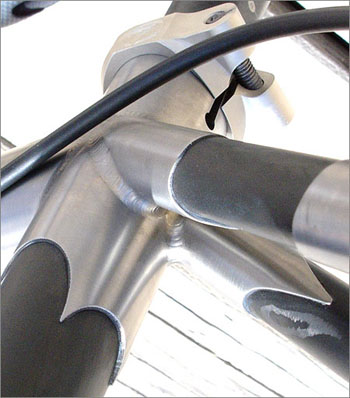
The Seat tube is Carbon to help with vibration absorbing. Seven insert the carbon as far as possible in the lug and leave the bottom of the tube fairly thick at the BB insert (for stiffness). The carbon also runs all the way to the top, at which point it receives a composite insert to house the seat post (you can see it inside the clamp below).

note that the seat collar is well made with a big bolt that is so easy to tighten that you may not think it is as snug as it is, much to my “old” seat posts displeasure.

You’ll also notice, around the seat tube joint, the shape detail machined of the lug, as well as the weld uniformity (can you spot where the welder had to change directions?). Also note the shape and machining of the seat clamp. It’s a little detail, but the little details at this level all add up.

The Seat stays and bridge are a split system rather than a wishbone. Seven say that keeping them separated to the top prevents side flex better than a wishbone for a given weight. Seven also pioneered the carbon / ti thing with the Odonata back in the mid-late 90’s.

These stays are straight as a golf shaft rather than being bent. This along with those tree-trunk sized Chain stays add up to a rear end that holds the back wheel in line as good as anything I have ever ridden (Aluminum, Carbon or Ti!).

ample tire clearance on chain stays

This stiff build spec mates up well with the fork Seven supplied. But then Seven’s fork should match well with darn near any lay out, as it comes in 18 different rakes designed to match character of an individual’s bike. The relationship of the fork to a frame set’s character and the balance of properties between the front and back wheels can’t be stressed enough. Sevens worked with Reynolds to create this huge range of forks and the result speaks volumes to Seven’s commitment to total ride performance. The fork mates with this frame and leaves me asking for nothing more than what I got. Side load handling, twist resistance and brake force resistance are absolutely top notch.

The Low-Down On Weight?

I hear people gripe about the weight of custom Ti / Carbon bikes on the market.

After having been on several (we actually have a couple more customs to publish after this) I can say that the feel and performance of lots of custom Ti only or Ti Carbon bikes, when done well, is great. You ride a bike, not a spec sheet after all.

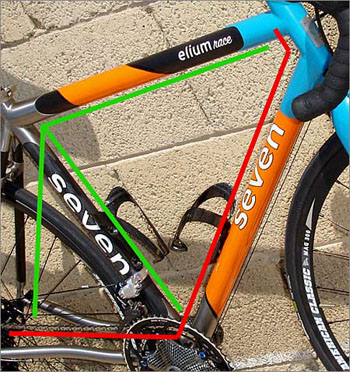
Seven choose Ti down and Carbon up, and a large portion of the weight on this bike sits between the axles and not up high in your hands.

Green’s Carbon, Red’s Ti and the weight is pushed low-low.

Add the light bars, post, stem and brakes, and the weight that you can actually feel on the Elium is as good as any bike at any weight…

That said, it’s light anyway, as the photo build version is below the UCI minimum legal of 14.99 pounds. We were only under by a couple of grams, but this bike is sturdy from stem to QR’s, unlike some of the absolute foolishness that you see up for offer these day.

As weight restrictions go, my take on the UCI’s weight regulations is similar to Mr. Vandermark’s. Neither of us thinks that sticking million dollar athletes in the middle of a weight weenie-measuring contest is a good move. (Given the pathetic insurance that some riders get from teams, I would actually hate to see a workman get hurt even more than one of the stars.) And the UCI weight restriction hasn’t changed or prevented bicycle manufacturers development and concentration on weight at all. People are putting out lighter and lighter gear all the time. The UCI rule just means that riders can use fewer stupid parts on a bike (unless you’re sponsor does something like Cannondale a while back, who chose to add little weights to Simoni’s bike rather than performance).

Honestly, I am not sure the weight regulation hasn’t helped bike companies (and poor marketing folks) more than hurt them. Now manufacturers get to say “Our bike is illegal!” and leave that as a parts only benefit.

Anyway: With the weight being down low in this bike, it feels lighter than 14 and change. This coupled with the steeper geometry, shorter wheel base and super-light hoops, makes for a bike that drops in to corners faster than I was ready for! Flick-able is an understatement with the Elium Race.

What’s The difference?

If bikes were birds, my stable, comfortable, damn fast custom bike would be an Eagle. It gets up in the sky plenty quickly and is also a breath-taking swooping high speed descender. My QUICK-quick turning, quick accelerating damn fast custom Seven is more of a hummingbird.

And the hummingbird just got a beak full of RedBull!

I think “Go left” and don’t get to finish the thought. I think “left – right” and The Elium is already thinking 4 turns past that. I admit that part of this may be because I don’t think so gooder than sum people. But you could have a brain like Einstein and the reflexes of a young Sugar Ray Leonard and still not push the Seven past yawning at you.

Add the stiffness to the handling from a steeper geometry up front and you have an off the charts, slug-em-in-the-face-then-slam-the door-before-they-know-who-did-it Crit bike. This is a perfect toy to make wheel suckers life a living hell trying to stay lined up with your butt. Change of pace is also effortless and it matters not if you’re seated or standing.

Comfort was a secondary concern for me, as I thought I would give up quite a bit to get this kind of quickness, but the Seven soaks up road buzz very well. It translates big bumps a little more than our stable-comfort custom did, but that’s to be expected on a frame that is designed differently. This bike gives the stiffness of the BMC SLT01 or Colnago E-1 but does so with better comfort (not light praise as those are two very good bikes) and better stability that comes from being dead center on fit with a well matched fork. It’s dead on what I asked for with better comfort than I had thought it could have. It is as comfortable as lots of Ti that doesn’t have a prayer of being this stiff, and better comfort than some off the shelf Carbon focused on stiffness. Damn impressive.

That’s the Point!

It’s important to note that a great custom built bike will focus squarely on what you ask, but it will also let you sacrifice less in the areas it is not focused on. If I had wanted this to be a super laid back, longer wheel based, stable, comfort first bike, Seven could have handed be just that. It’s not all about stiffness or all about comfort, it’s all about you.

That’s the real value of custom done well as it considers Fit, but goes two steps further taking material choice as well as manipulation of that material into consideration. The highs are higher and the low’s less so.

Your bank account will get a little lower for a bike spec’d like this though. As built, if you could get zero Gravity to custom etch something and get Tiso to do one-off cranks direct from Italy, waited for Schmolke to get your other parts made to spec and shipped from Germany and then landed Reynolds and American Classics wheels, JagWire’s cables, a funky chain. You’ll be rolling around near 12 grand (shipping, customs and one off time come at a cost). But you can spec an Elium race built up for close to half that. The full custom frame and fork is $4,240. That’s near the top of anyone’s cost sheet, but the services that go in to that make the value relative. You can spend less on a frame just as easily as you can get less from it…

Geometry

Fret not though if you’re looking for Seven’s custom service for less than something that usually comes with an engine. You can get something from them in the $1500 range (frame only) too and the value for custom at that price is extremely good.

Have At It

You can take a peak at Seven by heading to SevenCycles.com. They have dealer locators, company history and the full model line up there (including a slew of options and color schemes).

Also call the guys at Bicycle Ranch if you’re in the South West. They built this puppy and also handled the fit check.

Hit up CyclingInnovations.com for the super trick Tiso gear and ROI Zefiro carbon cranks. They also do OEM stuff for manufacturers and teams.

Schmolke Carbon are the Uber Masters of high end light. They will custom make seat posts (reinforced just at your specific seat height) and bars with a combination of weight and strength that I didn’t think existed. Bring your banker though.

Mean while, I will be busy explaining to the rest of the Pez staff that Seven’s motto is not “One Bike, Yours”. It’s One Bike:

Mine!

Note: if you have other experiences with gear, or something to add, drop us a line. We don’t claim to know everything (we just imply it at times). Give us a pat on the back if you like the reviews, or a slap in the head if you feel the need!


The Ride Magazine: Seven Honored

by Richard Fries

WATERTOWN, Mass. Seven Cycles’ Odonata has been included in an exhibit at the 2003 Geneva Motor Show in Geneva, Switzerland. The Odonata will be displayed at the unveiling of Daimler Chrysler’s Airflite concept vehicle, a new design that combines the styling of a coupe with the function of a sedan.

“The selection for DaimlerChrysler’s Geneva Motor Show exhibit came completely by surprise,” said Jennifer Miller, head of marketing for Seven. “They told me they made their choice by calling some 20 bicycle dealers randomly and asking them what bicycle company best fit the theme of functional art. The curators said Seven’s name came up overwhelmingly.”

The exhibit, dubbed “The Wings Gallery: A Celebration of Functional Art,” includes pieces chosen for their combination of form and function. Other products selected for the exhibit include Harman Kardan’s iSub and SoundSticks and Logitech’s pocket digital camera.