FORT COLLINS, Colo. (VN) Maureen (Mo) Bruno-Roy is a three-time master’s national champion and represented the United States at UCI cyclocross world championships in 2009.
This year Bruno-Roy is racing for Bob’s Red Mill Grains. She and her husband, Matt, are a two-person team with big results.
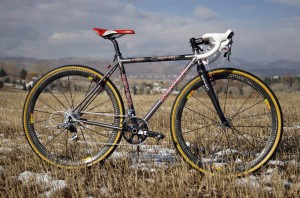
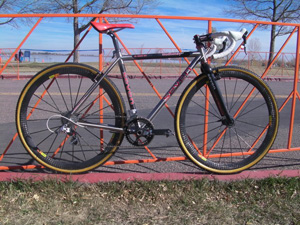
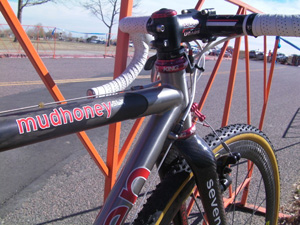
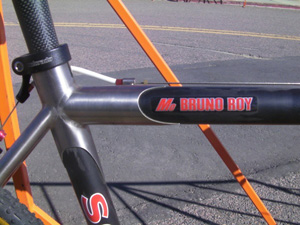
Bruno-Roy doesn’t receive a new frame each season. Her Mudhoneys (she has two identical bikes) are in the middle of their third season of ‘cross. Seven will provide new frames if necessary, but with her bikes in such great shape the past two seasons, Seven instead helps with travel expenses. After each campaign her frames are sent back to Seven for a complete refurbishment. The frame’s alignment is checked, small parts are replaced, the frame is cleaned and new decals are applied.
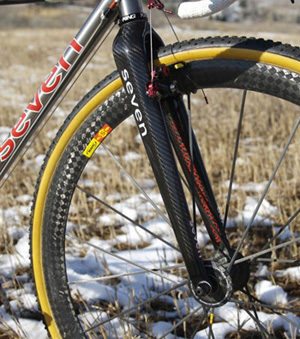
For 2010 Seven introduced a full carbon fork to compliment their titanium and carbon bikes. Bruno-Roy previously rode Alpha Q forks, but loves the new fork from Seven.
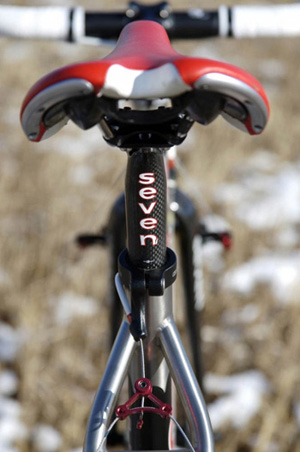
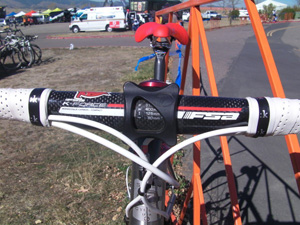
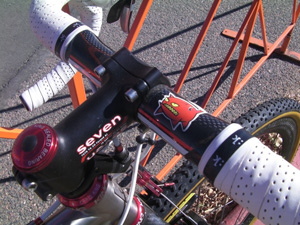
Matt Roy’s attention to detail is clear. Shrink-wrapped cables help seal the shifting system. He drills the red-anodized ferrules to keep cables moving freely. Even taking time to cut down the Fizik handlebar finishing tape, Roy puts in a lot of time on his wife’s bike. Periodically he changes the inspirational stickers on her bike. The Angry Cupcake sticker on her handlebar is the latest.
Spec:
Frame
Custom Seven Mudhoney SLX frame
No water bottle mounts
Custom down tube cable routing
Wheels
Mavic Cosmic Carbone Ultimates with Challenge Grifo 32mm tubulars
Components
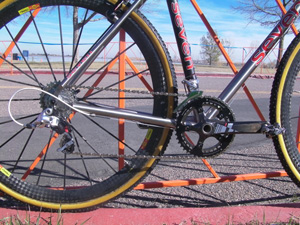
SRAM Red shifters, ceramic bottom bracket, 170mm crank and derailleurs
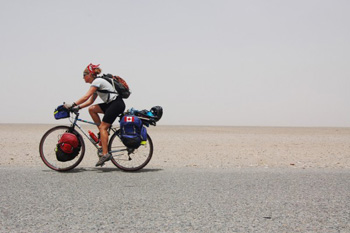
Seven Cycles announced today that they have formed a partnership with Cycling Silk to become the official bike supplier for their upcoming yearlong journey. Cycling Silk is both an epic adventure and an exercise in environmental advocacy. The 2011 expedition’s aim is to explore and promote conservation across borders as a force for peace, environmental integrity and sustainable development in mountainous regions along the famous Silk Road from Istanbul to India.
Cycling Silk is comprised of two scientist/ explorers, Kate Harris and Melissa Yule. Kate is a writer, wilderness conservationist, adventurer and photographer. She won a Rhodes Scholarship to Oxford University where she completed her Master’s thesis on transboundary conservation and peace parks. She also holds a Master’s degree from MIT in earth and planetary sciences. Melissa is a social scientist, environmentalist and endurance athlete. In her work and research, Mel combines community development with environmental science to study ecological impacts on human health. She holds a Master’s degree in International Development from the University of Guelph, and is currently a researcher at the International Development Research Centre in Canada.
Throughout the duration of their trip, Harris and Yule will conduct research to develop case studies on conservation and advocate for eight existing or proposed Transboundary Protected Areas or “Peace Parks” along the mountainous route. They have planned periodic stops along their route to survey the regions, meet with local inhabitants, and continually update followers via their website.
The duo are using bikes to enable the autonomous and adventurous exploration of remote transboundary wildernesses, and to reinforce the notion of the Silk Road as a landscape of continuity, despite the borders that attempt to divide it. In the process, they hope to inspire others to get outside and ride bikes and explore the wild and look beyond borders. Both Kate and Mel will be riding Seven’s Expat S expedition bikes.
“Mel and I are so indescribably thrilled and honored at this chance to ride Sevens down the Silk Road,” said Kate Harris. “With this type of self-supported expedition, having bikes that are utterly dependable and tailored just for us means two fewer things to be concerned about,” added Harris.
“Kate and Mel’s approach to cycling and environmental stewardship fits perfectly with our company philosophy,” said Mattison Crowe, Marketing Manager for Seven Cycles. “Not only do they embrace the challenge, but through their efforts, strive to create an environmental impact many orders of magnitude larger than themselves. On top of all that, this adventure represents an ideal proving ground for our bikes.”
With a background in track and field, Maureen Bruno Roy made the transition to racing cyclocross in 2004 and quickly moved up the ranks with some big wins. Highlights include the overall win in the Verge New England Series, the overall win in the Verge Mid Atlantic Series, winning the Masters 30-34 Cyclocross National Championship, placing 3rd in the Elite Cyclocross National Championships and earning a spot on the US National Team to compete in the World Championships.
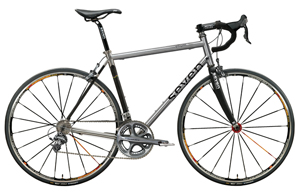
Last year, Mo made the switch to Seven Cycles, who became a title sponsor in the New Englander’s operation. This year, Bruno Roy has teamed up with Bob’s Red Mill and is tackling her first national cyclocross campaign, traveling across the country to some of America’s biggest races. Mo’s Seven Mudhoney SLX features an elegant set of titanium lugs with carbon fiber tubes, as well as a cyclocross specific titanium rear triangle. A full SRAM Red drivetrain provides the shifting for Bruno Roy, while a set of Mavic Cosmic Carbone Ultimates wrapped in Challenge tires keeps her connected to the ground. Mo prefers a 44 tooth Thorne Koksijde compact outer chainring and a 36 tooth compact inner chainring paired with her SRAM Force level cassette in a 12/27 configuration.
Frame – Seven Mudhoney SLX
Fork – Seven CX
Headset – Chris King Nothreadset
Handlebar – Full Speed Ahead K-Force Compact – 40 cm
Tape – Fi’zi:k Microtex Bar:Tape
Brakes – TRP CR950 with SwissStop Flash Yellow King Pads
No other technology I can think of matches the bicycle in beauty, efficiency, and power to do good. Its design, fundamentally resolved a century ago, wastes nothing. Twenty pounds of bike can replace 3,500 pounds of car, get you to work nearly as fast (with a smile on your face), and harm no living thing in the process. Many bicycle designs have risen to the level of art—Cinelli racing bikes from the 1960s, ageless Raleigh 3-speeds, the tricycle that all three of my children rode (with the ingenious removable push handle that saved my back)—but if you’re feeling generous, I’ll take an Elium SL from Seven Cycles.
Bruce D. Snider’s career in residential architecture and construction stretches back more than 25 years, and includes a Bachelor’s degree in environmental design and 14 years as a writer and editor for Hanley Wood magazines. A senior editor for residential architect and CUSTOM HOME, he lives with his wife and three children on the coast of Maine. He keeps his wits sharp by taking on the occasional design project, battling the ravages of age on his family’s 19th century Greek Revival house, and meditating on the relationships among architecture, planning, health, happiness, and the environment from the saddle of his road bike.
bikeradar.com By Marcus Farley & James Costley-White
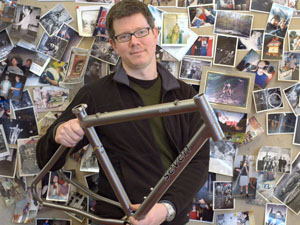
Rob Vandermark of Seven Cycles
Massachusetts-based Seven Cycles have been hand-crafting high-end custom bikes from steel, titanium and carbon fibre since 1997.
They’ve built such a reputation for themselves that they’re now the largest exclusively custom frame builders in the world.
We spoke to founder and president Rob Vandermark about Seven’s exciting new suspension partnership with Dave Weagle, their 2010 range and his bike building philosophy.
So Rob, we hear your new full-suspension mountain bikes will feature a new suspension design…
Our new suspension partnership is with Dave Weagle. Our co-designed bike line is really exciting and innovative. Working with Dave’s vast suspension knowledge in conjunction with Seven’s manufacturing and customisation capabilities has lead to a really innovative outcome: unique and individualised rider-specific suspension tuning and ride feel.
Because of this, Seven are introducing an entirely new series of suspension bikes with some design concepts that have never before been available. We’re really excited about this partnership.
You used to use Maverick’s design. What prompted the change?
Yes, in fact we were the first company – in 2001 – to offer both a titanium Maverick Monolink design and a full-custom geometry version. At that point in suspension’s evolution, the Monolink was a complete departure from how other technologies addressed suspension. Maverick provided a number of advantages with none of the typical shortcomings.
Working with the Maverick team has been a great partnership… [but] all successful products go through a cycle from introduction to growth, maturity and decline, until the lifecycle begins all over again. We’d worked with Maverick for a long period, and the time came to look at dual suspension from a different perspective.
Dave’s experience and reputation for developing technologies such as dw-link and Split Pivot made him an obvious choice. So, we contacted each other and found we each had some compelling ideas about working together. We are also fortunate that both our companies are based in Massachusetts, which makes collaborating easier.
Can you give us any more details of the new platform?
We are licensing the Split Pivot design fully intact; we can’t see any reason to modify the system because it’s a great design. The piece that Seven bring to the design is the way in which we’re tailoring the suspension system for the rider – and the way in which we integrate that suspension into the overall design of the bike.
We’ve developed a holistic order method that enables the customer to specify the suspension characteristics in exactly the same way that we do with the ride characteristics and handling of our non-suspended bikes. To us this is exciting because we’re designing the suspension feel for each rider as an integrated element of the entire bike and rider combination.
A few of the ways we’re adapting the suspension characteristics individually are by tailoring placements of pivot locations on each customer’s frame, integrating overall frame geometry and handling characteristics, matching to the customer’s fork choice, and accounting for key component selections.
These are just a few examples of how we’re optimising the Split Pivot system for the rider; there are many other factors involved but that’s a bit of an overview of how we’re approaching this new design.
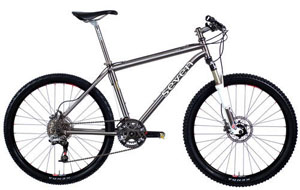
Seven have yet to unveil their 2010 full-suspension bikes, so here’s their Sola SLX hardtail
What’s Seven’s bike line-up looking like for 2010, and is there anything new on the horizon?
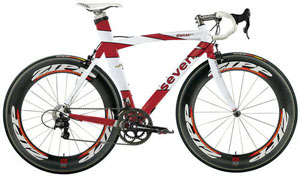
For 2010 Seven offer 27 models across seven categories: triathlon, road, commuting, touring, tandeming (road and mountain), cyclo-cross and mountain bikes (dual suspension and hardtail).
[There are]… a number of improvements such as a new curved down tube on all our mountain bike models, a distinct triathlon model series and a new category we refer to as Traveler, whose models are designed for off-road expeditions, loaded touring, urban commuting and anything in between.
As far as unannounced new products, our manufacturing approach allows us to make rapid product introductions, so you will continue to see new offerings added throughout the year, not just during the fall. Stay tuned to see what we have in store.
Where do you see Seven heading in future?
Because the industry is changing faster than ever, we’re sure that the next five years will be really unpredictable and exciting for riders. Fortunately, we have a five-year R&D plan. Each season our R&D plan shifts depending on customer interests, industry component design changes, and our own internal capability improvements.
A few items on our list, without giving too much away, include: we’re working on some interesting frame and component integration technologies; we’re beta testing some new service methodologies that will change the way we work with customers for the better; we’ll be augmenting our suspension bike offerings and the tune-ability of the suspension systems; we’re developing more components that relate to our frame designs; and we’ve got some big road bike technologies in development.
And yes, there is a new frame material on the near horizon [Seven currently offer bikes in full-carbon, carbon-and-titanium, titanium or steel] – but we’re not discussing it yet.
Seven currently offer frames in full-carbon, carbon-and-titanium, titanium or steel
Seven currently offer frames in full-carbon, carbon-and-titanium, titanium or steel
How are you coping with the credit crunch?
The situation seems to be improving, but the lack of visibility – for next week or next quarter – affects us just as it affects businesses of all sizes. We are fortunate to maintain good long-term relationships with our suppliers and retail partners. Our current approach is not so different from how we normally work, but we communicate more frequently and in greater depth than before.
Like all companies, we seek to reduce unnecessary expenditure wherever possible – except in R&D. Sometimes we change the resource mix for a project or adjust a product introduction timeline, but our ability to adapt quickly makes us better positioned to deal with this type of uncertainty.
Tell us more about Seven Cycles, and how you came to found it…
I’ve been a cyclist my entire life. Cycling became a vocation for me while working in a bike shop during high school and college. I majored in sculpture at the Massachusetts College of Art and The School at the Museum Of Fine Arts, Boston. I left school when I realised I could combine my two passions – cycling and sculpture – in a career of bicycle design and frame building.
Prior to participating in founding Seven, I served as head of R&D at Merlin Metalworks, a high-end bicycle frame builder and one of the first to work with titanium. During the 10 years I worked at Merlin, I was able to work in all aspects of bicycle frame building and design, from machining and welding to product development and process improvement.
I decided to leave Merlin at the close of 1996 because the company began focusing on the mainstream market at the same time that I was becoming more interested in pushing the limits of bike customisation, technology transfer and the Toyota Production System of manufacturing. I really wanted to see how these three ideas could converge in a new and successful way. Four of us started Seven in January 1997. The business has grown steadily over the years.
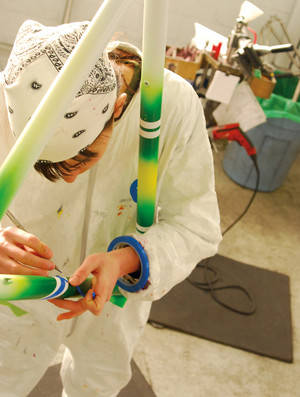
Seven offer bikes in a huge array of colours
Seven offer bikes in a huge array of colours
Where did the name come from?
It’s interesting how the meaning and origin of our name has generated so many myths, which are almost universally untrue. Seven Cycles does not refer to the number of people who started the company, nor the number of days a week we work.
We were brainstorming many different names and for some reason the number seven came up in various combinations on several people’s lists. We selected it because seven is considered a lucky number in many cultures, and there was no pre-existing definition behind the name – we could create our own unique meaning for the company.
Seven specialise in hand-built custom design. Is this your philosophy for everything in life as well as bike building?
Seven’s approach to customisation is unusual. For us, custom fit is just one small piece of the overall experience. We also invest a lot of energy in customising – and optimising – the bike’s tubeset, ride characteristics, handling, performance aspects, aesthetics, build kit, and even our relationship with each rider. Our focus is on exceeding each custmer’s expectations; part of our job is to act as advisors and consultants during the rider’s bike purchase, down to the last detail.
From a manufacturing standpoint, by having each of Seven’s framebuilders focus on only one bike at a time, we have better quality control, fewer defects caused by batch processing, less waste, real-time innovation and product improvements, as well as process improvements – quite a few advantages, really. It’s fundamentally a more customer-centric philosophy to offer a built-to-order bike for each and every rider. Custom building is important to Seven because it provides a better customer experience and it’s better for the planet.
Your next question asks whether that’s my, or Seven’s, philosophy for everything in life. For me personally, I say, “Yes”. I always try to start with a customer-centric resource allocation perspective. By way of non-Seven real world example: a coffee house. How does a customer discern the milk from the skim? How does the business dispense napkins – and in what size? And on, and on. Seriously; it’s an illness I have!
How locally do you source your materials? and what’s Seven’s carbon footprint like?
We source more than 90 percent of our materials from within the United States. More than 30 percent of the total material value comes from within 100 miles of Seven’s factory. In addition, well over 90 percent of the material manipulation and machining – both have major carbon footprints – are performed either in-house or within 100 miles. And, by the way, every one of our frames is made in the United States.
On the carbon footprint front, because of our single-piece-flow and just-in-time manufacturing systems, we create very little waste during fabrication. Even so, we are extremely mindful of our carbon footprint and our overall ecological footprint. We minimise our environmental impact by using petroleum-free cutting fluids, paint recapturing, recycling and filtration systems.
In fact, we reuse or recycle just about anything you can think of: paper, plastic, metal scrap and shavings, wood, cardboard and coolants. And, of course, we incentivise employees to commute to work by bike.